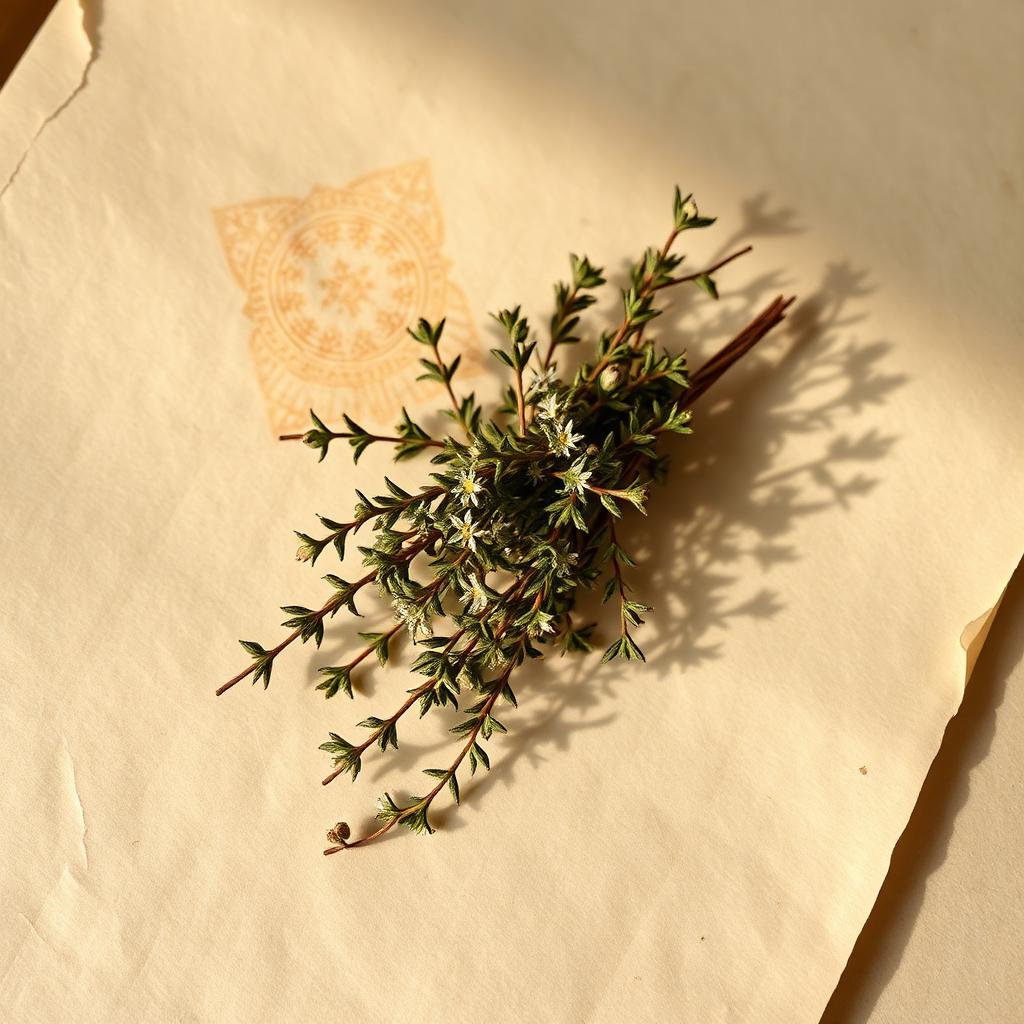
Thyme — The Mountain Herb for Breath and Throat
A small, fragrant mountain herb the Persian and Mediterranean worlds have leaned on for centuries whenever a chest feels tight, a throat feels raw, or a winter cold won't loosen its grip.
- English
- Thyme
- Family
- Lamiaceae
- Also known as
- Avishan, Za'atar (in mixed blends)
What this may support
In laboratory tests on bacteria in a dish, thymol — thyme's main scent compound — slowed the growth of several chest-infection bacteria. Laboratory results do not tell us what happens in a person.
Calms a raw throat when you gargle with it.
Patterns described in research and tradition — not a treatment claim.
A little background
- Used by the Egyptians in embalming, the Greeks for courage, and the Persians in cough syrups and warming teas.
- Steamed over a bowl for congestion long before inhalers existed.
- Dried thyme jars sit beside salt on most Persian kitchen shelves.
What tradition has long understood
- Warm and dry — drying to phlegm, opening to the chest.
- Given to children for coughs as a sweetened honey-and-thyme syrup.
- Sipped after heavy meals to lift heaviness and sluggish digestion.
What the research now shows
- Clinical trials of thyme syrup (often combined with ivy leaf) show meaningful reductions in cough frequency and duration in acute bronchitis.
- In laboratory tests on bacteria in a dish, thymol — thyme's main scent compound — slowed the growth of several chest-infection bacteria. Laboratory results do not tell us what happens in a person.
- Small trials suggest thyme-thymol mouthwashes reduce plaque and gingivitis comparably to chlorhexidine, with fewer side effects.
- Animal studies and early human work hint that thyme relaxes the airway muscles in a dry, tickly cough. This has been studied in animals, but that does not tell us for sure what happens in people.
Evidence-based benefits
- Softens a dry, irritating cough.
- Calms a raw throat when you gargle with it.
- Helps a stuffy head drain when you breathe it in as steam.
- Slips gentle, microbe-slowing plant compounds into everyday cooking.
The active compounds inside
- Thymol and carvacrol — the scent compounds; they slow microbes in lab tests and help relax tight muscle in the airway and gut.
- Rosmarinic acid — a plant compound also found in rosemary and oregano; it helps calm irritation.
- Apigenin and luteolin — pale plant pigment compounds (flavonoids).
What to actually do this week
- Cough tea: 1 tsp dried thyme in a cup of hot water, 10 min, with honey — up to 3 cups/day during a cold.
- Steam inhalation: pinch of thyme in a bowl of just-boiled water, towel over the head, 5–10 minutes.
- Gargle: cooled thyme tea + a pinch of salt, 2–3 times daily for sore throat.
- Cooking: roast vegetables, slow-cooked stews, and lentil soups.
Preparation methods
- Dried leaf for tea; fresh sprigs for cooking.
- Store dried thyme in a dark jar — essential oils fade with light.
- Don't take the neat essential oil internally — at concentrated doses it is an irritant.
Typical culinary use
- Persian abgoosht, mountain bread, lamb stews.
- Mediterranean roasted chicken, beans, tomato sauce.
- Za'atar blend (thyme + sumac + sesame + olive oil) on flatbread.
Best food combinations
- Thyme + honey + lemon — the classic cough tea.
- Thyme + olive oil + garlic — winter cooking trio.
- Thyme + sumac + sesame — za'atar.
Foods that quietly help
- Honey
- Lemon
- Olive oil
- Garlic
Gentle cautions
- Culinary and tea amounts are well tolerated.
- Concentrated essential oil is irritant — never apply undiluted to skin or take by mouth.
- Allergy possible in people sensitive to other Lamiaceae herbs (mint, oregano).
Medication interactions to know
- Blood thinners — high doses of thyme extracts may add to bleeding risk.
- Hormone-sensitive conditions — concentrated extracts may have mild estrogenic activity; food amounts fine.
Pregnancy & breastfeeding
- Food and occasional tea amounts are considered safe.
- Avoid concentrated essential oil and high-dose extracts during pregnancy.
A few honest answers
Is thyme strong enough for a real cough?
For everyday irritating coughs and the tail end of a cold, yes — backed by clinical trials. For a persistent cough longer than three weeks, a fever, or breathing trouble, see a clinician.
Persian avishan vs. supermarket thyme?
Different species, similar chemistry. Persian Z. multiflora and Th. daenensis are often higher in thymol; both make excellent tea.
Can I give thyme tea to my child?
Mild thyme-honey tea is a long-standing home remedy for children over one year. Use less herb, more honey, and keep it warm — not hot.
Real questions, honest answers
How soon will it help my cough?
Tea or steam — which works better?
Will it ruin my sleep like coffee can?
In plain language
A few ideas worth understanding clearly. Tap to read each one explained as Hakim would — quietly, without jargon.
Antispasmodic
Explain this simply. Helps small muscles in the airways stop seizing — which is why dry, hacking coughs ease.
Why it matters. It explains why thyme works for coughs that 'won't let you breathe properly,' not just wet, productive ones.
Expectorant
Explain this simply. Loosens phlegm so it's easier to bring up.
Why it matters. Thyme is mildly both antispasmodic and expectorant, which is why it suits most common coughs.
Practical scenarios — where to begin
Two weeks into a cold, still coughing at night.
- Thyme-honey tea three times daily.
- Steam inhalation before bed.
- If still coughing in another week, see a clinician.
Teacher, presenter, or singer with constant throat strain.
- Warm thyme tea between sessions.
- Thyme + salt gargle in the evening.
- A spoon of honey before sleeping.
Stuffy head, pressure behind the eyes.
- Steam inhalation morning and night.
- Thyme tea twice daily.
- Lift the head of the bed by an inch.
A winter week where thyme quietly tends to the throat and chest
Not a prescription — a quiet example of how the foundations can fit an ordinary week. Adapt freely.
| Day | Morning | Afternoon | Evening |
|---|---|---|---|
| Mon | Warm thyme tea | Roast vegetables w/ thyme | Sleep early |
| Tue | Lemon water | Lentil soup w/ thyme | Steam inhalation |
| Wed | Thyme + honey tea | Walk | Tea & reading |
| Thu | Eggs + za'atar bread | Salad + olive oil | Family dinner |
| Fri | Thyme tea | Soup | Sleep early |
| Sat | Long walk | Lamb-and-bean stew w/ thyme | Steam if needed |
| Sun | Slow breakfast | Bread + za'atar + olive oil | Plan the week |
Where to wander next
These are the next quiet places to explore — each chosen because it deepens what you just read, not because it is merely related.
Why this. Chamomile soothes the nervous system that drives a stubborn night-time cough.
ContinueWhy this. When the chill goes inward and the stomach is involved, ginger is the better partner.
ContinueWhy this. Thyme's natural cooking partner inside a broader anti-inflammatory plate.
ContinueConnects to Immunity · Breath · Nutrition.
Feeds: Cough-cold tea · Evening steam.
Shapes: Immunity · Respiratory · Sleep.
"Some of the best medicines fit inside a teacup and a small ritual at the kitchen counter."
When the next sore throat starts, brew a cup of thyme tea with honey and lemon before reaching for anything stronger.
"Help me use thyme through this cold season."
Ask Hakim, Your Personal AIWhere this comes from
- Kemmerich B et al., Arzneimittelforschung — thyme/ivy combination for acute bronchitis, RCT.
- Salehi B et al., Phytother Res 2019 — Thymus species, phytochemistry and clinical evidence review.
Questions worth asking
When the next sore throat starts, brew a cup of thyme tea with honey and lemon before reaching for anything stronger.
Hakim's Thoughts on Thyme — The Mountain Herb for Breath and Throat
"Thyme is the herb that quietly opens the chest. A small mountain plant, dried in a jar, steeped in hot water with honey — and somehow most winter colds get gentler."
— Hakim
One thoughtful next step
If this resonated, anise — the sweet seed of the evening belly is a gentle next step. A natural next read is "Anise — The Sweet Seed of the Evening Belly" — it carries the same thread from a different angle. Take what feels right; leave the rest for another season.
Anise — The Sweet Seed of the Evening Belly Ask Hakim, Your Personal AIYou may also enjoy…
The licorice-sweet seed of bedtime teas, Persian sweets, and Greek grandmothers — and a quietly evidenced herb for bloating, cough, mild …
ContinueThree crimson threads, hand-picked from a single autumn flower. For three thousand years, saffron has been Persia's most beloved medicine…
ContinueA warm, bittersweet root quietly added to lentils, rice, and stews across South and West Asia for three thousand years. Modern science no…
ContinueTwo related barks travel under the same name. Ceylon — the gentle, true cinnamon of Persian sweets — and cassia, the bolder, cheaper one …
ContinueContinue the thread with Hakim in a calm daily ritual.
Continue