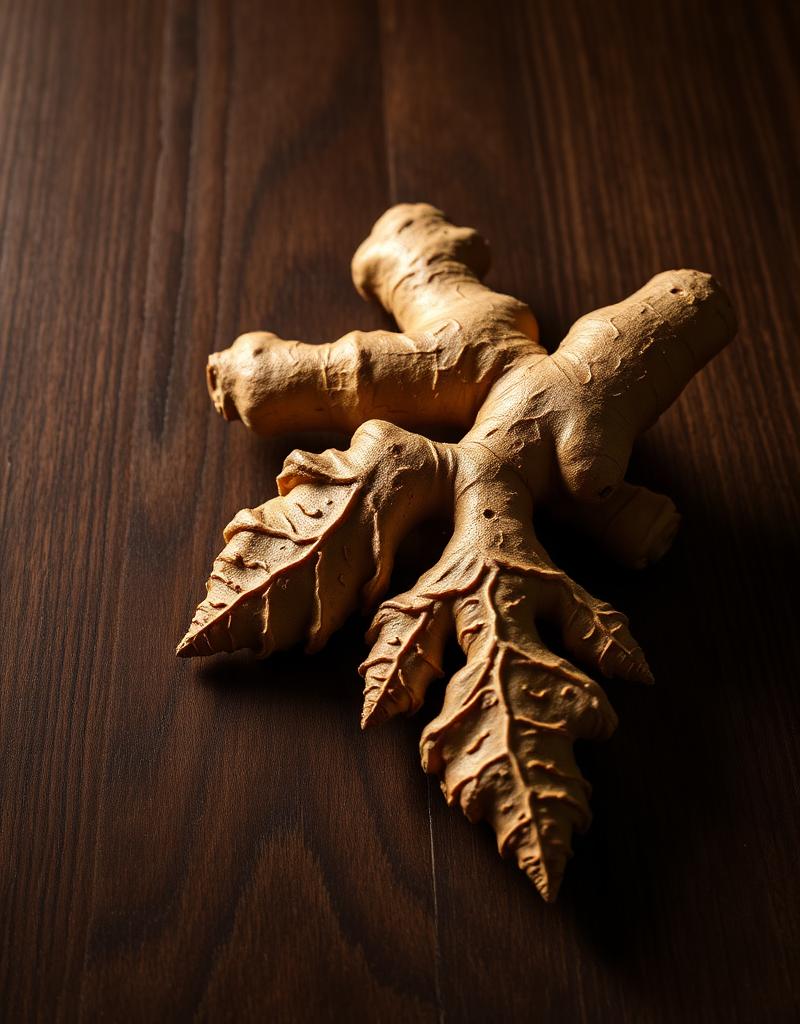
Ginger — The Warming Root for Digestion and Aches
A knotted, pungent root that traditional kitchens turn to for the same things modern trials confirm: nausea, slow digestion, period cramps, mild joint pain, and the gentle warmth wanted on cold mornings. Ginger is one of the few foods that earns its reputation across both cultures and clinical evidence.
- English
- Ginger
- Family
- Zingiberaceae
- Also known as
- Zanjabīl, Adrak
What this may support
Speeds gastric emptying — real relief for slow digestion and bloating.
In human trials in type 2 diabetes, fasting blood sugar and HbA1c — a blood test showing average blood sugar over about three months — improved slightly. Do not change diabetes medicine on the strength of this.
A mild but real anti-inflammatory effect on joints.
Patterns described in research and tradition — not a treatment claim.
A little background
- The Qur'an mentions it, and Avicenna's Canon praises it as a warming, drying root that lifts a cold stomach and a sluggish mind.
- It travelled out of southern China through Persia and the Arabian peninsula along the spice routes — by the 9th century it was already a staple of Baghdad's markets.
- In Persian, Indian, and Chinese kitchens alike it became the quiet first move on a cold day: warm water, a few slices of ginger, perhaps a spoonful of honey.
What tradition has long understood
- Read as hot and dry — the root you reach for to wake up digestion, dispel a chill, and ease the heaviness that follows a rich or oily meal.
- Recommended in small daily amounts for people with cold, weak constitutions, and balanced with cooling foods for those who run hot.
- Warm ginger compresses on stiff joints were common ground between Persian and Chinese households.
What the research now shows
- This is ginger's strongest card: several reviews pooling human trials found that 1–1.5 g a day eases nausea — in pregnancy, motion sickness, and chemotherapy alike.
- Reviews pooling human trials found that 750–2000 mg a day for the first three days of a period eased cramps about as well as common painkillers.
- In human trials, knee arthritis pain eases a little, but repeatedly, at similar doses over 8–12 weeks.
- In human trials in type 2 diabetes, fasting blood sugar and HbA1c — a blood test showing average blood sugar over about three months — improved slightly. Do not change diabetes medicine on the strength of this.
Evidence-based benefits
- Eases nausea of nearly every kind — pregnancy, motion sickness, after surgery, during chemotherapy.
- Softens menstrual cramps, especially right at the start of the period.
- A mild but real anti-inflammatory effect on joints.
- Speeds gastric emptying — real relief for slow digestion and bloating.
The active compounds inside
- Gingerols in fresh ginger, and shogaols formed when it is dried or cooked — the compounds behind the heat on your tongue and most of the studied effects.
- Volatile oils (zingiberene) — give the aroma and contribute to digestive action.
What to actually do this week
- Fresh ginger tea: a few slices steeped in hot water for 10 minutes, with lemon and honey. Simple, and it works.
- Grate it into stir-fries, lentil soups, and stews — anywhere a little warmth is welcome.
- For nausea, the trial dose is 250 mg of ginger powder four times a day.
- For period pain, start ginger at the very first twinge of cramping — not once the pain has settled in.
Preparation methods
- Tea: 3–5 slices of fresh root in 2 cups of water, simmered 10 minutes.
- Simmer it with cinnamon and cardamom — a warming Persian winter drink.
- A few slices of pickled ginger at the start of a meal, as a digestive.
Typical culinary use
- Persian stews, dal, congee, stir-fries, soups, marinades.
- Baked goods (gingerbread, ginger biscuits).
- Fresh in chutneys, dressings, and lemonade.
Best food combinations
- Ginger + turmeric — anti-inflammatory and warming.
- Ginger + lemon + honey — for sore throats and morning sluggishness.
- Ginger + cinnamon + cardamom — a Persian-style warming tea.
Foods that quietly help
- Lemon
- Honey
- Turmeric
- Cinnamon
- Cardamom
Gentle cautions
- Generally well tolerated up to 4 g/day.
- Can cause mild heartburn or loose stools at high doses.
- May lower blood pressure modestly — usually a feature, occasionally a caution.
Medication interactions to know
- Blood thinners — mild antiplatelet effect at high doses, caution before surgery.
- Diabetes medications — may potentiate.
- Calcium-channel blockers — theoretical interaction at high doses.
Pregnancy & breastfeeding
- Used in pregnancy for morning sickness — up to 1 g/day is considered safe in trials.
- Avoid very high doses (>2 g/day) in the first trimester without clinician input.
A few honest answers
Fresh or powdered — does it matter?
Yes, it matters. Fresh ginger carries more gingerols — wonderful for nausea and tea — while dried or cooked ginger has more shogaols, the stronger anti-inflammatory. Use whichever the moment calls for; usually both.
Will ginger thin my blood?
In culinary amounts, no. Supplement doses can mildly inhibit platelets — which only becomes relevant if you're on warfarin or have surgery coming up.
Can children have ginger?
Small amounts in food and weak tea, yes. Concentrated supplements are a conversation for a clinician first.
Real questions, honest answers
I get nauseous in cars — does ginger really work?
Will ginger help period cramps?
Can I take it daily forever?
Why does ginger make me feel warm?
In plain language
A few ideas worth understanding clearly. Tap to read each one explained as Hakim would — quietly, without jargon.
Gastric emptying
Explain this simply. How quickly food leaves the stomach and moves into the small intestine.
Why it matters. Slow emptying is what causes bloating, fullness, and nausea. Ginger speeds it up — gently.
Antiplatelet effect
Explain this simply. Slightly less sticky blood cells.
Why it matters. In culinary amounts it's inconsequential. At high doses it matters if you're on a blood thinner or facing surgery.
Practical scenarios — where to begin
First-trimester nausea, no other complications, doctor says you can try non-pharmacologic options.
- Ginger tea or ginger candies, ~250 mg ginger four times a day.
- Sip slowly with a plain cracker.
- If vomiting more than a few times a day, talk to your clinician — ginger isn't enough for hyperemesis.
Cramps strong enough to need ibuprofen, otherwise healthy.
- Start 250 mg ginger four times daily at the first sign of cramping.
- Continue for 3 days into the period.
- If pain still dominates after 2 cycles, ask about endometriosis — pain that severe isn't normal.
Bloating, slow to feel hungry again, no red-flag symptoms.
- 3 slices of ginger in hot water, sipped through lunch.
- Walk for 10 minutes after eating.
- Reduce portion size by a quarter — ginger helps less if the meal was simply too big.
A week of small, warming ginger habits
Not a prescription — a quiet example of how the foundations can fit an ordinary week. Adapt freely.
| Day | Morning | Afternoon | Evening |
|---|---|---|---|
| Mon | Ginger-lemon tea | Lentil soup | Light dinner |
| Tue | Oats with grated ginger & cinnamon | Stir-fry with fresh ginger | Walk after dinner |
| Wed | Warm water + ginger | Yogurt + herbs | Family meal |
| Thu | Ginger-turmeric tea | Soup | Tea & reading |
| Fri | Eggs | Stew with ginger | Early sleep |
| Sat | Walk + sunlight | Slow lunch | Cinnamon-ginger tea |
| Sun | Slow breakfast | Roast vegetables | Plan the week |
Where to wander next
These are the next quiet places to explore — each chosen because it deepens what you just read, not because it is merely related.
Why this. The two share anti-inflammatory action and cook together beautifully.
ContinueWhy this. Warming, blood-sugar-friendly, and the natural third leg of a Persian winter tea.
ContinueWhy this. Ginger helps digestion; a ten-minute walk multiplies the effect.
ContinueConnects to Nutrition · Stress.
Feeds: Morning warm drink · Pre-meal sip.
Shapes: Nutrition · Digestion.
"What the body wants on a cold morning is rarely complicated. Ginger has been answering that question for three thousand years."
Tomorrow morning, drop three slices of fresh ginger into a mug of hot water and sip it before anything else.
"Help me build a small daily ginger habit for my digestion."
Ask Hakim, Your Personal AIWhere this comes from
- Lete I, Allué J., Integr Med Insights 2016 — ginger for nausea: systematic review.
- Daily JW et al., Pain Med 2015 — ginger for primary dysmenorrhea meta-analysis.
Questions worth asking
Tomorrow morning, drop three slices of fresh ginger into a mug of hot water and sip it before anything else.
Hakim's Thoughts on Ginger — The Warming Root for Digestion and Aches
"Ginger is the warm hand on the back of a cold morning. It does not ask for much — three slices, hot water, ten minutes — and it gives back almost out of proportion to the effort. Most enduring habits are like this."
— Hakim
One thoughtful next step
If this resonated, turmeric — the golden root of quiet inflammation is a gentle next step. A natural next read is "Turmeric — The Golden Root of Quiet Inflammation" — it carries the same thread from a different angle. Take what feels right; leave the rest for another season.
Turmeric — The Golden Root of Quiet Inflammation Ask Hakim, Your Personal AIYou may also enjoy…
A gentle, sweet seed chewed after meals from Tehran to Bombay to Naples. It quiets bloating, softens cramps, and freshens breath — and in…
ContinueThe fragrant green pod that perfumes Persian tea, Arab coffee, Indian sweets, and Scandinavian buns — and one of the oldest known remedie…
ContinueThe everyday Persian mint — kinder than peppermint, woven into doogh, abgoosht, sabzi, and the kitchen window. Quietly studied for digest…
ContinueThe leaf you drop into the pot without thinking — and one of the quietest evidenced herbs for blood sugar, digestion, and the inflammator…
ContinueContinue the thread with Hakim in a calm daily ritual.
Continue