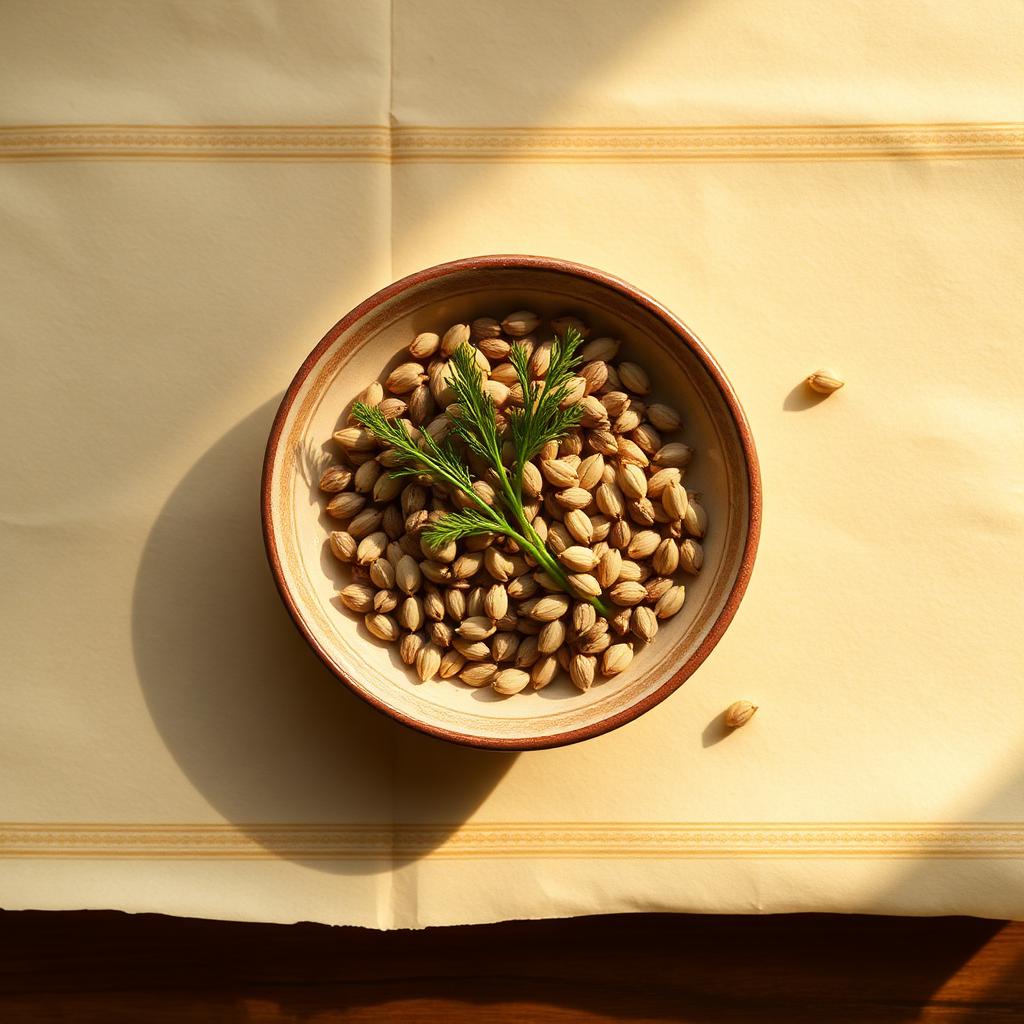
Fennel — The Sweet Seed for a Settled Stomach
A gentle, sweet seed chewed after meals from Tehran to Bombay to Naples. It quiets bloating, softens cramps, and freshens breath — and in nursing mothers, has been used for milk supply for two thousand years. Modern research has begun, quietly, to agree.
- English
- Fennel
- Family
- Apiaceae
- Also known as
- Razianeh, Sweet anise
What this may support
Eases bloating, gas, and post-meal heaviness — especially upper abdominal.
Friendlier than mint for people with reflux.
Patterns described in research and tradition — not a treatment claim.
A little background
- Cultivated since ancient Egypt; carried across the Persian and Roman empires.
- Indian restaurants serve fennel seeds at the door for the same reason Persian grandmothers do — easier digestion of a generous meal.
- Greco-Islamic physicians turned to fennel when digestion ran cold and sluggish, when infants colicked, and when nursing mothers needed help with milk flow.
What tradition has long understood
- Considered warm and dry — a mover of stuck digestion, a softener of cramps.
- Brewed for nursing mothers to support milk flow.
- Mixed with caraway and anise in classic Persian digestive blends.
What the research now shows
- In small human trials where women were assigned by chance, fennel seed extract (about 30 mg three times daily) eased period cramps about as well as the painkiller mefenamic acid.
- Fennel-containing infant colic remedies (e.g. gripe waters) reduce crying time in controlled trials — though concentrated oil should never be given directly to infants.
- Anethole, fennel's main scent compound, behaves a little like the hormone oestrogen at higher doses. That is the proposed explanation for its effects on milk supply and periods.
- Adds fiber and small amounts of potassium when bulb fennel is eaten raw or roasted.
Evidence-based benefits
- Eases bloating, gas, and post-meal heaviness — especially upper abdominal.
- Softens menstrual cramps.
- Traditional and modest modern support for lactation.
- Friendlier than mint for people with reflux.
The active compounds inside
- Anethole — the sweet scent compound; at higher doses it behaves a little like the hormone oestrogen.
- Fenchone, estragole — supportive aromatic compounds.
- Flavonoids — plant pigment compounds — plus fibre from the seed and bulb.
What to actually do this week
- Chew ½ teaspoon of fennel seeds after a heavy meal.
- A cup of fennel tea (1 tsp crushed seeds in 250 ml hot water, 10 minutes) after dinner.
- Add raw shaved fennel bulb to salads with lemon and olive oil.
- Roast fennel bulb with olive oil and salt as a winter vegetable.
Preparation methods
- Crush seeds lightly before steeping — releases the aromatic oils.
- Combine 1:1 with caraway and anise for a classic digestive blend.
- Eat the bulb raw for crunch and fiber, or roast slowly for sweetness.
Typical culinary use
- Persian and Indian digestive blends; Italian sausage, fish, and bread.
- Salads with orange, olive, and shaved fennel.
- Roasted with potatoes; braised with white fish.
Best food combinations
- Fennel + orange + olive — bright winter salad.
- Fennel + cumin + caraway — three-seed digestive blend.
- Fennel + anise + chamomile — gentle bedtime tea.
Foods that quietly help
- Yogurt
- Lemon
- Olive oil
- Whole grains
Gentle cautions
- Culinary and tea amounts are safe for nearly everyone.
- Concentrated fennel essential oil should never be ingested.
- People with hormone-sensitive cancers should use only culinary amounts.
Medication interactions to know
- May modestly increase estrogen activity — relevant if on tamoxifen or hormone therapy.
- May lower ciprofloxacin absorption — separate by 2 hours.
Pregnancy & breastfeeding
- Culinary use is safe.
- Avoid concentrated supplements or essential oil; traditionally used at high doses to influence menstruation.
- Supports lactation in many traditions; small daily amounts are well tolerated postpartum.
A few honest answers
Will fennel help my reflux?
Often yes — unlike mint, fennel doesn't relax the lower esophageal sphincter. A cup of fennel tea after dinner is worth trying for two weeks.
Can I use it during pregnancy?
In food, yes. Skip supplements and essential oil.
Is the bulb the same as the seeds?
Same plant, different parts. The bulb is mostly fiber and crunch; the seeds carry the aromatic, more medicinal compounds.
Real questions, honest answers
Why do restaurants offer fennel seeds at the door?
Will fennel really help my milk supply?
What about period cramps?
Does fennel taste like licorice?
In plain language
A few ideas worth understanding clearly. Tap to read each one explained as Hakim would — quietly, without jargon.
Carminative
Explain this simply. An herb that helps the gut release trapped gas.
Why it matters. It's the technical word for what mint, fennel, ginger, and chamomile have always quietly done.
Galactagogue
Explain this simply. Something that supports milk production in nursing mothers.
Why it matters. Fennel is the most famous gentle one, used across cultures long before lactation consultants existed.
Practical scenarios — where to begin
Upper-abdominal bloating, sometimes reflux, especially with rich meals.
- Chew ½ tsp fennel seeds after lunch and dinner.
- A cup of fennel tea before bed.
- Slow down — at least 20 minutes per meal, sitting.
Predictable monthly pain, currently relying on NSAIDs.
- Start fennel tea 2–3 cups daily the day before bleeding begins.
- Consider a standardized fennel extract for 3 cycles.
- Pair with warmth, walking, and good sleep that week.
Postpartum, healthy, supply seems borderline.
- Fennel tea 2–3 cups daily.
- Frequent feeding remains the most powerful lever.
- Talk to a lactation consultant — herbs help on top of, not instead of, technique.
A week with fennel woven into ordinary digestion
Not a prescription — a quiet example of how the foundations can fit an ordinary week. Adapt freely.
| Day | Morning | Afternoon | Evening |
|---|---|---|---|
| Mon | Yogurt + fruit | Salad with shaved fennel | Fennel tea after dinner |
| Tue | Eggs + herbs | Lentil soup | Chew fennel seeds, walk |
| Wed | Oats + walnuts | Roasted fennel & potatoes | Bedtime tea blend |
| Thu | Toast + olive oil | Persian rice & vegetables | Fennel tea |
| Fri | Yogurt + honey | Bean stew | Family meal, slow |
| Sat | Slow breakfast | Braised white fish with fennel | Tea & reading |
| Sun | Eggs + bread | Soup-and-bread lunch | Plan the week |
Where to wander next
These are the next quiet places to explore — each chosen because it deepens what you just read, not because it is merely related.
Why this. When the issue is lower-gut cramping rather than reflux, mint is often the better tool.
ContinueWhy this. Where fennel is sweet and gentle, ginger is warming and active.
ContinueWhy this. Fennel sits inside a longer story of hormonal and cyclical support.
ContinueConnects to Nutrition · Stress · Hormones.
Feeds: After-dinner tea · Pre-period warmth.
Shapes: Digestion · Hormonal balance.
"Some plants don't try to change us. They just settle what is already there, gently, so the body can do its own quiet work."
After dinner tonight, crush half a teaspoon of fennel seeds, steep them five minutes in hot water, and drink the tea slowly before bed.
"Help me use fennel for the part of my day that feels rushed or heavy after eating."
Ask Hakim, Your Personal AIWhere this comes from
- Omidvar S et al., Iran J Nurs Midwifery Res 2012 — fennel extract for primary dysmenorrhea.
- Alexandrovich I et al., Altern Ther Health Med 2003 — fennel oil emulsion for infantile colic.
Questions worth asking
After dinner tonight, crush half a teaspoon of fennel seeds, steep them five minutes in hot water, and drink the tea slowly before bed.
Hakim's Thoughts on Fennel — The Sweet Seed for a Settled Stomach
"Fennel is the small kindness at the end of the meal — the bowl of seeds by the door, the cup of tea before bed, the sweet anise that asks the body to slow down and digest in peace."
— Hakim
One thoughtful next step
If this resonated, ginger — the warming root for digestion and aches is a gentle next step. A natural next read is "Ginger — The Warming Root for Digestion and Aches" — it carries the same thread from a different angle. Take what feels right; leave the rest for another season.
Ginger — The Warming Root for Digestion and Aches Ask Hakim, Your Personal AIYou may also enjoy…
The fragrant green pod that perfumes Persian tea, Arab coffee, Indian sweets, and Scandinavian buns — and one of the oldest known remedie…
ContinueThe everyday Persian mint — kinder than peppermint, woven into doogh, abgoosht, sabzi, and the kitchen window. Quietly studied for digest…
ContinueThe leaf you drop into the pot without thinking — and one of the quietest evidenced herbs for blood sugar, digestion, and the inflammator…
ContinueThe licorice-sweet seed of bedtime teas, Persian sweets, and Greek grandmothers — and a quietly evidenced herb for bloating, cough, mild …
ContinueContinue the thread with Hakim in a calm daily ritual.
Continue