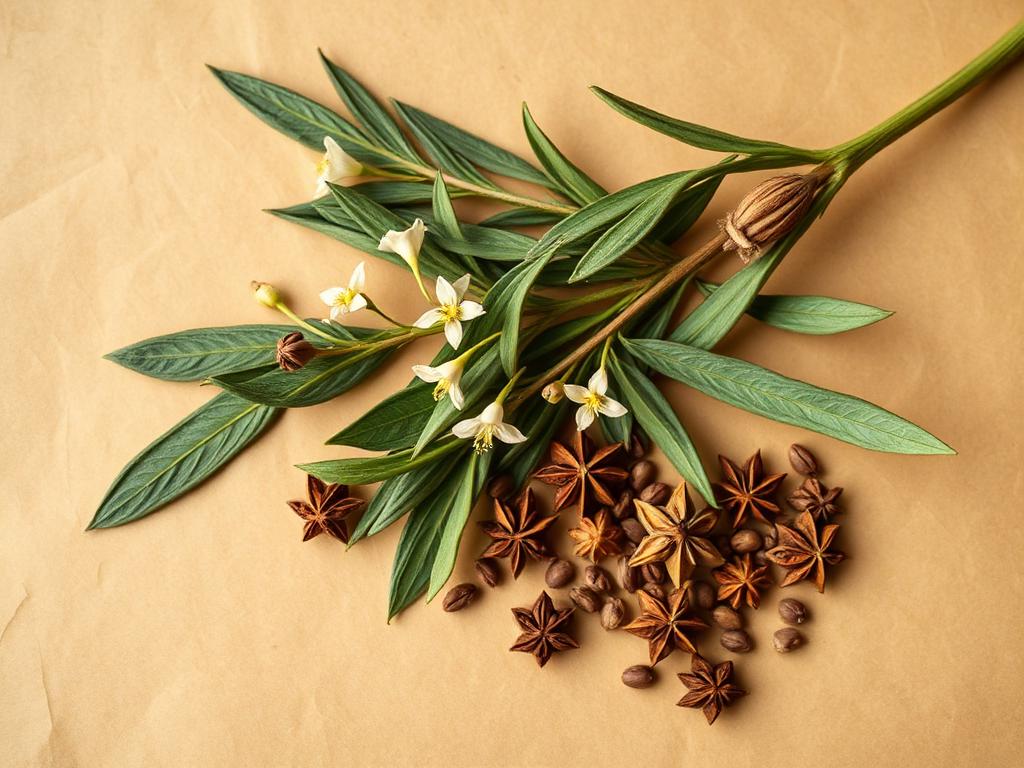
Anise — The Sweet Seed of the Evening Belly
The licorice-sweet seed of bedtime teas, Persian sweets, and Greek grandmothers — and a quietly evidenced herb for bloating, cough, mild depression, and the hot flashes of menopause.
- English
- Anise
- Family
- Apiaceae
- Also known as
- Anison, Aniseed, Sweet cumin
What this may support
Eases bloating, gas, and post-meal heaviness.
Calms mild productive cough — opens the chest gently.
Patterns described in research and tradition — not a treatment claim.
A little background
- Cultivated in Egypt, Persia, and the Mediterranean since at least 1500 BCE.
- Dioscorides praised it for breath, milk, and 'wind in the belly'; Avicenna used it for cough and the chest.
- The signature of arak, ouzo, raki, and Persian sweet pastries.
What tradition has long understood
- Warm and slightly drying — soothes the belly, opens the chest, sweetens the breath.
- Used as tea after dinner, in seed-mixes for nursing mothers, and as a children's stomach remedy.
- A few seeds chewed after a meal is an old Mediterranean digestif gesture.
What the research now shows
- In human trials where people were assigned by chance, anise capsules (3 g a day for 4 weeks) lowered depression scores more than a dummy capsule, in new mothers and in mild-to-moderate low mood. The difference was unlikely to be due to chance — researchers call this statistically significant — but the trials were small.
- Anise tea and capsules show clear benefit for mild indigestion (what doctors call functional dyspepsia) and bloating.
- Trials in menopausal women report reductions in hot flash frequency and intensity over 4 weeks.
- In laboratory and animal studies, anethole — anise's signature compound — loosened chest mucus, relaxed cramping muscle, and slowed microbes. That does not tell us for sure what happens in people.
Evidence-based benefits
- Eases bloating, gas, and post-meal heaviness.
- Calms mild productive cough — opens the chest gently.
- Modestly reduces menopausal hot flashes.
- Lifts mood in mild low mood, including in new mothers, at the doses trials used.
The active compounds inside
- Trans-anethole — the sweet, liquorice-smelling compound behind most of what anise does.
- Estragole, anisaldehyde — antispasmodic aromatics.
- Flavonoids and small amounts of fatty acids in the whole seed.
What to actually do this week
- Anise tea: 1 tsp lightly crushed seeds, 10 minutes covered, after dinner.
- A pinch in baked goods, plum stews, or Persian cookies.
- A few seeds chewed slowly after a heavy meal.
- Blend with fennel and chamomile for a children's belly tea (older children, weak brew).
Preparation methods
- Crush the seeds lightly before steeping — the oils stay locked in whole seeds.
- Cover while steeping — anethole is volatile.
- Choose plump, fragrant seeds — old anise has almost no aroma.
Typical culinary use
- Persian and Levantine sweets, plum and quince stews, fish dishes.
- Mediterranean breads and biscotti.
- Ouzo, arak, raki — the anise-spirit family.
Best food combinations
- Anise + fennel + caraway — the classic European belly-tea trio.
- Anise + cardamom + cinnamon — warming Persian cookie blend.
- Anise + chamomile — bedtime calm.
Foods that quietly help
- Fennel
- Caraway
- Chamomile
- Quince
- Plum
Gentle cautions
- Culinary and tea amounts are very well tolerated.
- Star anise (a different plant) is sometimes contaminated with toxic Japanese star anise — buy from reputable spice merchants.
- High-dose extracts may have mild estrogen-like effects — relevant for hormone-sensitive conditions.
Medication interactions to know
- Hormone therapies and tamoxifen — high-dose extracts may compete at estrogen receptors.
- Sedatives — high doses may add mildly to sleepiness.
- Iron supplements — separate anise tea by two hours.
Pregnancy & breastfeeding
- Culinary and occasional tea amounts are considered safe.
- Avoid daily medicinal-dose capsules during pregnancy.
- Often used traditionally to support milk production; coordinate with a lactation consultant.
A few honest answers
Anise vs. star anise — same thing?
No. Star anise (Illicium verum) is a different plant from East Asia. Flavor is similar, source is different. For tea use Pimpinella anisum — true anise seed.
Will it really help my hot flashes?
A 4-week trial in menopausal women showed a meaningful reduction in frequency and intensity. It is one tool among several — not a complete answer.
Is it safe for children?
A weak warm tea of anise + fennel + chamomile has been a European children's belly remedy for centuries. Keep doses small and brief.
Real questions, honest answers
I bloat almost every evening — is anise tea enough?
I'm in menopause and don't want hormone therapy. Is this a first step?
Does it really lift mood?
In plain language
A few ideas worth understanding clearly. Tap to read each one explained as Hakim would — quietly, without jargon.
Expectorant
Explain this simply. Helps loosen mucus so a cough can clear the chest.
Why it matters. It is the reason anise is the seed of cough syrups across the Mediterranean.
Phytoestrogen
Explain this simply. A plant compound that gently mimics or modulates the body's own estrogens.
Why it matters. Anethole has mild phytoestrogen activity — useful in menopause, worth caution in hormone-sensitive conditions.
Practical scenarios — where to begin
Heavy or late meals settle uneasily.
- Anise tea after dinner, slowly sipped.
- Walk for 10–15 minutes before sitting down.
- Eat the bigger meal at midday for a week and see.
Looking for first-line, gentle help.
- Anise tea twice daily for 4 weeks.
- Pair with sage tea and strength training.
- Read the Women's Longevity Arc.
Lingering after a cold.
- Anise + thyme tea before bed, warm with honey.
- Steam inhalation in the shower.
- Sleep slightly elevated.
A week with the anise cup quietly closing the day
Not a prescription — a quiet example of how the foundations can fit an ordinary week. Adapt freely.
| Day | Morning | Afternoon | Evening |
|---|---|---|---|
| Mon | Oats + walnuts | Lentil soup | Anise tea after dinner |
| Tue | Yogurt + fruit | Salad + olive oil | Walk + anise tea |
| Wed | Eggs + sabzi | Soup + bread | Anise + chamomile blend |
| Thu | Cardamom-rose tea | Fish + greens | Anise tea |
| Fri | Toast + olive oil | Stew + rice | Walk + anise tea |
Where to wander next
These are the next quiet places to explore — each chosen because it deepens what you just read, not because it is merely related.
Why this. Fennel and anise belong to the same family and pair as a complete digestive tea.
ContinueWhy this. Where anise softens the flash, sage works on the hormonal chemistry. Used together they cover both the symptom and the system.
ContinueWhy this. Anise sits inside a fuller midlife and cyclical plan.
ContinueConnects to Nutrition · Hormones · Mood.
Feeds: After-dinner tea · Evening unwind.
Shapes: Digestion · Menopause · Mood.
"The same sweet seed has settled human bellies from the Nile to the Caspian for three thousand years. Trust what has been kept."
Tonight after dinner, lightly crush a teaspoon of anise seeds, cover them with hot water for ten minutes, and drink the cup slowly without screens.
"Help me build a small evening anise ritual that closes my day kindly."
Ask Hakim, Your Personal AIWhere this comes from
- Mosaffa-Jahromi M et al., J Ethnopharmacol 2017 — anise in postpartum depression, RCT.
- Nahidi F et al., J Menopausal Med 2012 — anise and menopausal hot flashes, RCT.
Questions worth asking
Tonight after dinner, lightly crush a teaspoon of anise seeds, cover them with hot water for ten minutes, and drink the cup slowly without screens.
Hakim's Thoughts on Anise — The Sweet Seed of the Evening Belly
"Anise is the seed of the evening — the small sweet cup that closes the day for Persian, Greek, and Egyptian grandmothers alike. Most of its medicine is in the closing."
— Hakim
One thoughtful next step
If this resonated, ginger — the warming root for digestion and aches is a gentle next step. A natural next read is "Ginger — The Warming Root for Digestion and Aches" — it carries the same thread from a different angle. Take what feels right; leave the rest for another season.
Ginger — The Warming Root for Digestion and Aches Ask Hakim, Your Personal AIYou may also enjoy…
A knotted, pungent root that traditional kitchens turn to for the same things modern trials confirm: nausea, slow digestion, period cramp…
ContinueA small, fragrant mountain herb the Persian and Mediterranean worlds have leaned on for centuries whenever a chest feels tight, a throat …
ContinueThe fragrant green pod that perfumes Persian tea, Arab coffee, Indian sweets, and Scandinavian buns — and one of the oldest known remedie…
ContinueThe everyday Persian mint — kinder than peppermint, woven into doogh, abgoosht, sabzi, and the kitchen window. Quietly studied for digest…
ContinueContinue the thread with Hakim in a calm daily ritual.
Continue