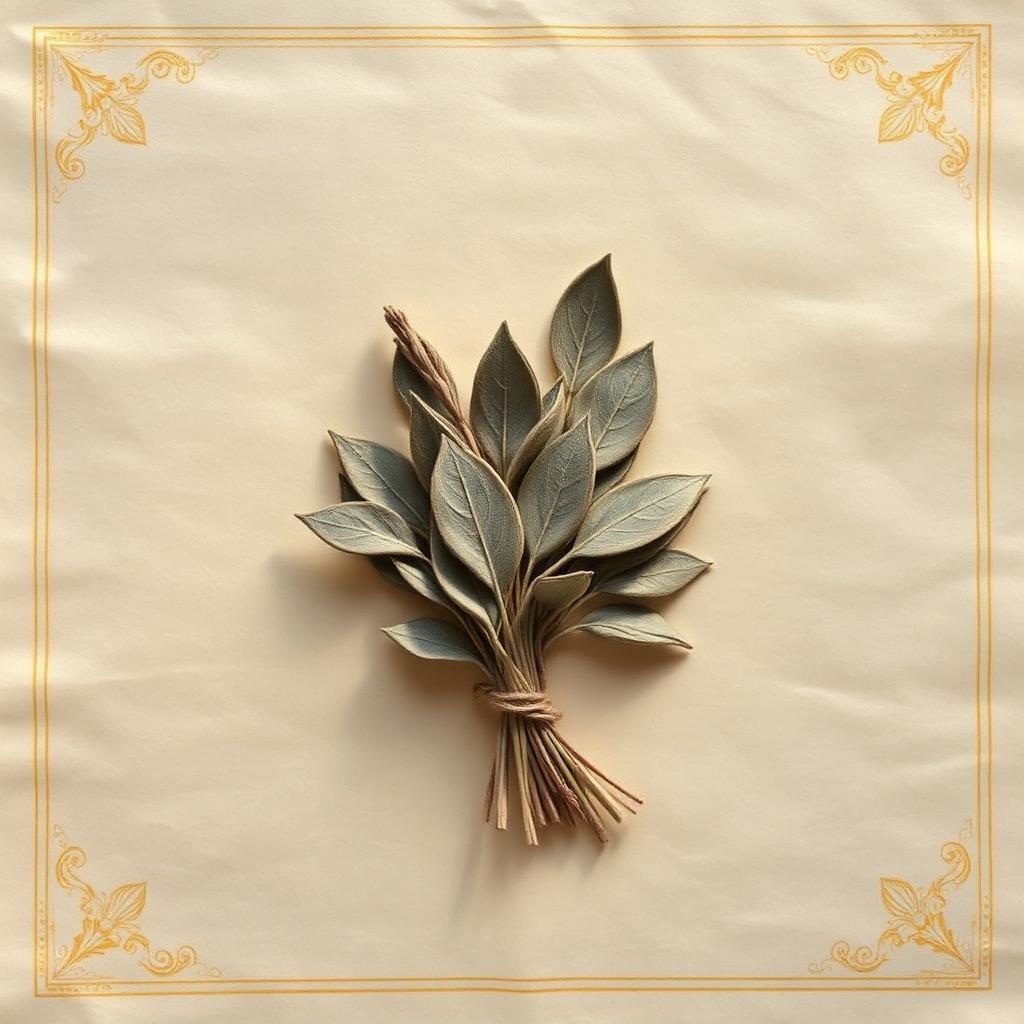
Sage — The Memory Keeper of the Garden
A silver-leafed Mediterranean herb whose Latin name, salvia, means 'to save'. Traditionally drunk for clear thinking, hot flashes, and sore throats — and modern trials are quietly catching up on each.
- English
- Sage
- Family
- Lamiaceae
- Also known as
- Maryam goli, Garden sage, Common sage
What this may support
Gives attention and memory a gentle lift.
In small human trials where women were assigned by chance, sage extract cut how often and how strongly hot flushes and night sweats came on — by roughly a third to a half over 4–8 weeks.
Calms a sore throat when you gargle with it.
Patterns described in research and tradition — not a treatment claim.
A little background
- Cultivated since the Roman empire as a household medicine.
- Reached Persia through Mediterranean trade; called Maryam goli — 'Mary's flower'.
- An old English rhyme: 'He who would live for aye, must eat sage in May.'
What tradition has long understood
- Warm and dry — drying to dampness, sweat, and excess phlegm.
- Used for night sweats, weak voices, and 'old-age forgetfulness'.
- Sipped slowly after meals to settle digestion and clear the mind.
What the research now shows
- In small human trials where women were assigned by chance, sage extract cut how often and how strongly hot flushes and night sweats came on — by roughly a third to a half over 4–8 weeks.
- Trials of sage extract in healthy adults and in mild Alzheimer's disease report modest improvements in attention, memory, and word recall.
- Sage gargle eases sore throat comparably to over-the-counter antiseptic sprays in small studies.
- In laboratory tests, sage slows the breakdown of a brain messenger chemical — the same general mechanism as some Alzheimer's medicines, but far weaker. Laboratory results do not tell us what happens in a person.
Evidence-based benefits
- Softens menopausal hot flashes and night sweats.
- Gives attention and memory a gentle lift.
- Calms a sore throat when you gargle with it.
- Slips microbe-slowing plant compounds into everyday cooking.
The active compounds inside
- Rosmarinic acid — a plant compound that helps calm irritation.
- Thujone (in essential oil) — neuroactive, but limit concentrated forms.
- Carnosic acid and carnosol — antioxidants, which means they help protect cells from everyday wear.
What to actually do this week
- Hot-flash tea: 1 tsp dried sage in a cup of hot water, 10 min, 1–2 cups/day for up to 8 weeks.
- Throat gargle: cooled strong sage tea, 2–3 times daily for sore throat.
- Memory support: 1 cup daily, or standardized extract (300–600 mg/day) — discuss with clinician.
- Cooking: small amounts with roast vegetables, beans, brown butter, white meats.
Preparation methods
- Use dried leaves for tea; fresh for cooking.
- Avoid concentrated essential oil internally — high thujone content is neurotoxic at dose.
- Choose standardized leaf extract for clinical use, not the oil.
Typical culinary use
- Persian and Mediterranean roast lamb, bean stews.
- Italian sage-and-butter pasta sauces.
- Stuffings and herbed breads.
Best food combinations
- Sage + lemon + honey — soothing throat tea.
- Sage + olive oil + garlic — Mediterranean cooking base.
- Sage + rosemary — brain-leaning herbal blend.
Foods that quietly help
- Olive oil
- Lemon
- Honey
- Garlic
Gentle cautions
- Culinary and short-course tea amounts are well tolerated.
- Avoid concentrated essential oil internally — risk of seizures at high doses (thujone).
- Limit medicinal use to short courses (8 weeks) unless supervised.
Medication interactions to know
- Diabetes medications — may add to blood-sugar lowering.
- Sedatives — mild additive effect at higher doses.
- Anticonvulsants — concentrated oil may reduce seizure threshold.
- Hormone-sensitive conditions — discuss with clinician given mild estrogenic activity.
Pregnancy & breastfeeding
- Avoid medicinal amounts in pregnancy — may reduce milk supply (used historically for weaning).
- Culinary amounts in food are considered safe.
A few honest answers
Will sage replace HRT for menopause?
No. But for women who can't or won't take hormones, a daily cup of sage tea or a standardized extract is one of the gentler evidence-supported options for reducing hot flashes.
Does it really help memory?
Modestly, in small trials — most useful as part of a broader brain-protective life of sleep, movement, social connection, and good food. Don't expect a transformation from sage alone.
Persian Maryam goli is a different sage — is it the same?
Persian markets often sell Salvia hydrangea or related local species. Similar effects, slightly different chemistry. Both work for the everyday uses described here.
Real questions, honest answers
How quickly will I notice fewer hot flashes?
Will it dry out my mouth?
Can men drink sage tea too?
In plain language
A few ideas worth understanding clearly. Tap to read each one explained as Hakim would — quietly, without jargon.
Cholinesterase inhibition
Explain this simply. Slows the breakdown of acetylcholine, a brain chemical important for memory.
Why it matters. It's the same family of action as some Alzheimer's medications — sage is much milder, but the direction is similar.
Thujone
Explain this simply. A naturally occurring compound in sage essential oil; safe in food and tea, but risky at concentrated doses.
Why it matters. It's why we drink the leaf and avoid the neat oil internally.
Practical scenarios — where to begin
Hot flashes and night sweats disturbing sleep.
- 1 cup sage tea after dinner for 8 weeks.
- Layer with cool bedroom, breathwork, breathable bedding.
- If sleep doesn't improve in 8 weeks, talk to a clinician about other options.
Forgetting names, words on the tip of the tongue.
- 1 cup sage tea daily.
- Pair with walking, sleep, and a Mediterranean–Persian plate.
- Build social and learning routines — these matter more than any herb.
Teacher or singer with a sore throat.
- Strong sage tea, cooled, gargled twice daily.
- Warm sage-honey tea between sessions.
- Steam in the evening.
A menopausal-support week with a steady evening cup
Not a prescription — a quiet example of how the foundations can fit an ordinary week. Adapt freely.
| Day | Morning | Afternoon | Evening |
|---|---|---|---|
| Mon | Lemon water | Roast vegetables + sage | Sage tea after dinner |
| Tue | Oats + walnuts | Walk | Sage tea + reading |
| Wed | Eggs + flatbread | Lentil soup | Sage tea |
| Thu | Yogurt + fruit | Salad + olive oil | Sage tea + family dinner |
| Fri | Pomegranate | Fish + greens | Sage tea |
| Sat | Long walk | Persian rice & stew with sage | Sage tea |
| Sun | Slow breakfast | Soup-and-bread | Plan the week |
Where to wander next
These are the next quiet places to explore — each chosen because it deepens what you just read, not because it is merely related.
Why this. Sage and rosemary share the same memory-supportive chemistry; using both is the classic herbal pairing.
ContinueWhy this. Sage is one tool inside a fuller midlife and post-menopausal plan.
ContinueWhy this. Sage fits inside a wider brain-protective foundation of sleep, plate, movement, and people.
ContinueConnects to Brain · Women's Health · Nutrition.
Feeds: Evening sage cup · Throat gargle.
Shapes: Menopause · Cognition · Throat.
"Some herbs don't lift; they quiet. Sage is one of those."
Tonight, brew one cup of sage tea after dinner and notice how the evening — and tomorrow morning — feels.
"Help me bring sage into my week for hot flashes / memory / throat."
Ask Hakim, Your Personal AIWhere this comes from
- Bommer S et al., Adv Ther 2011 — sage extract and menopausal hot flashes, open trial.
- Lopresti AL, Drugs R D 2017 — Salvia and cognitive function, clinical review.
Questions worth asking
Tonight, brew one cup of sage tea after dinner and notice how the evening — and tomorrow morning — feels.
Hakim's Thoughts on Sage — The Memory Keeper of the Garden
"Sage is the herb of measured, late-life clarity — a small silver leaf in a teacup, drunk slowly, that helps the body sweat less and the mind hold more."
— Hakim
One thoughtful next step
If this resonated, licorice root — the sweet healer with a strong warning is a gentle next step. A natural next read is "Licorice Root — The Sweet Healer with a Strong Warning" — it carries the same thread from a different angle. Take what feels right; leave the rest for another season.
Licorice Root — The Sweet Healer with a Strong Warning Ask Hakim, Your Personal AIYou may also enjoy…
An ancient sweet root, fifty times sweeter than sugar, used across Persia, Greece, China, and India for sore throats, coughs, and stomach…
ContinueThe everyday Persian mint — kinder than peppermint, woven into doogh, abgoosht, sabzi, and the kitchen window. Quietly studied for digest…
ContinueThe licorice-sweet seed of bedtime teas, Persian sweets, and Greek grandmothers — and a quietly evidenced herb for bloating, cough, mild …
ContinueThree crimson threads, hand-picked from a single autumn flower. For three thousand years, saffron has been Persia's most beloved medicine…
ContinueContinue the thread with Hakim in a calm daily ritual.
Continue