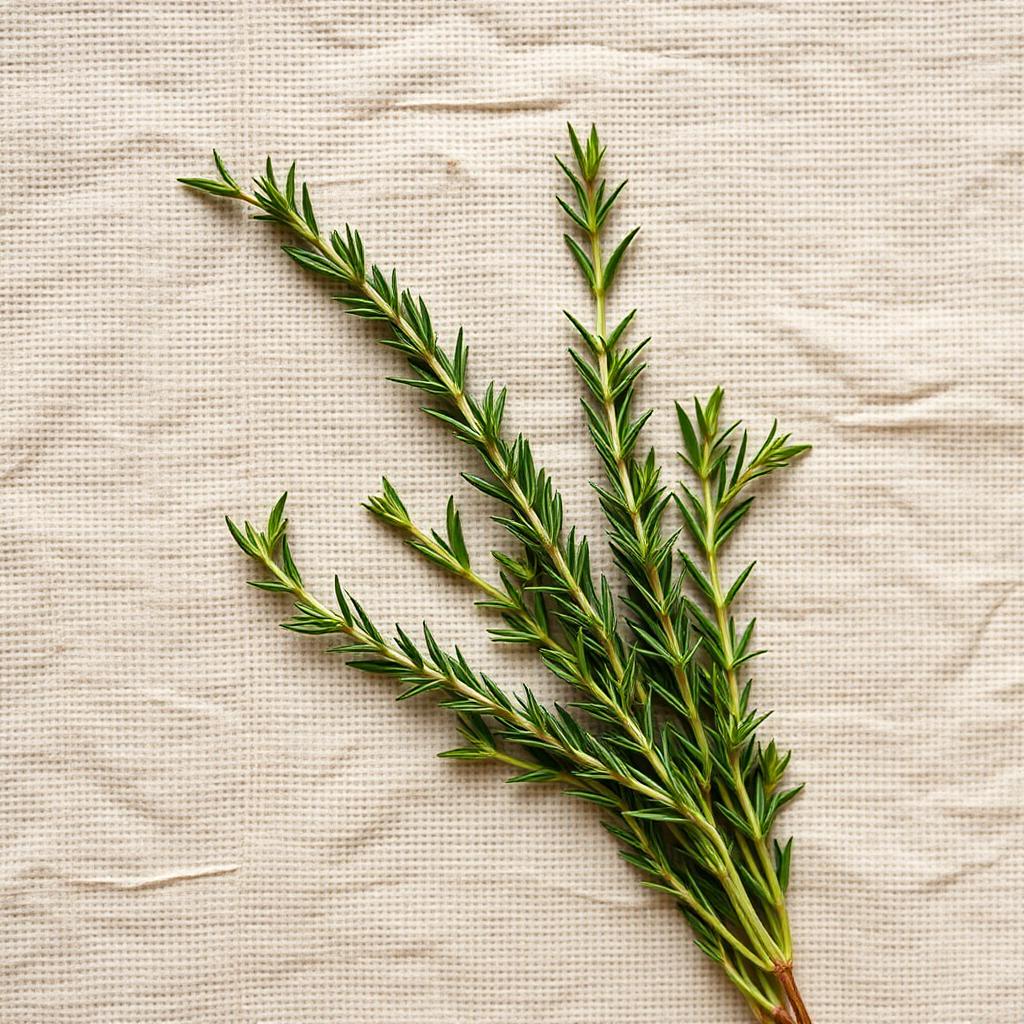
Rosemary — The Quiet Herb of Memory and Morning
A resinous, almost piney shrub that lines Mediterranean and Persian gardens. For two thousand years it has been the herb of memory — pressed into wedding wreaths, burned in sick rooms, brewed by students before exams. Modern science quietly agrees.
- English
- Rosemary
- Family
- Lamiaceae
- Also known as
- Eklil-e kouhi, Dew of the sea
What this may support
Gentle support for focus, alertness, and working memory.
A quiet antioxidant ally for the aging brain.
May support scalp circulation and hair density.
Patterns described in research and tradition — not a treatment claim.
A little background
- Ancient Greek students wore rosemary in their hair while studying — the original cognitive enhancer.
- Persian and Mediterranean kitchens reach for it with lamb, slow stews, and roasted vegetables.
- Greco-Islamic physicians used it for poor circulation, melancholy, and a 'cold, sluggish head'.
What tradition has long understood
- Considered warm and dry — a brightener of a tired mind, a strengthener of weak digestion.
- Infused in olive oil for muscle aches and scalp tonics.
- A sprig in the morning tea was the household answer to grey-day heaviness.
What the research now shows
- In human trials where people were assigned by chance to smell rosemary oil or not, the rosemary group did slightly better on short-term memory and alertness tests.
- In laboratory and animal studies, two rosemary compounds protected nerve cells. That does not tell us what happens in a person.
- Small trials in older adults with mild cognitive decline showed modest gains in memory tests with daily low-dose rosemary powder (≈750 mg).
- Topical rosemary oil matched 2% minoxidil for androgenetic hair loss in a 6-month head-to-head trial (Panahi et al., 2015), with less itching.
Evidence-based benefits
- Gentle support for focus, alertness, and working memory.
- A quiet antioxidant ally for the aging brain.
- May support scalp circulation and hair density.
- Eases mild muscle soreness when used in massage oil.
The active compounds inside
- Carnosic acid and carnosol — antioxidants in the leaf, which means they help protect cells from everyday wear.
- Rosmarinic acid — a plant compound also found in mint and sage; it helps calm irritation.
- 1,8-cineole — the aromatic compound linked to alertness in inhalation studies.
What to actually do this week
- A small sprig in morning tea, or a few crushed leaves added to lemon water.
- Roast vegetables, potatoes, and lamb with rosemary and olive oil — daily kitchen exposure.
- Smell a sprig before a focused work session — the aroma alone is studied for alertness.
- For scalp: dilute 2–3 drops rosemary essential oil in 1 tsp jojoba; massage scalp 3×/week.
Preparation methods
- Tea: 1 tsp dried leaves in 250 ml hot water, covered, 7–10 minutes.
- Infused oil: a few sprigs in olive oil, low heat 15 minutes, strain — keeps for weeks.
- Dried leaves keep their aroma far better than most herbs.
Typical culinary use
- Lamb, potatoes, white beans, focaccia, roasted vegetables.
- Persian khoresh and slow stews — small amounts go a long way.
- Lemon-rosemary fish, citrus dressings, herbal salt blends.
Best food combinations
- Rosemary + olive oil + garlic — Mediterranean foundation.
- Rosemary + lemon — brightens fish, chicken, and beans.
- Rosemary + sage — for memory and savory depth.
Foods that quietly help
- Olive oil
- Garlic
- Lemon
- White beans
Gentle cautions
- Culinary amounts are safe.
- Avoid medicinal doses of rosemary essential oil internally — can be neurotoxic at high doses.
- Concentrated extracts may lower seizure threshold in people with epilepsy.
Medication interactions to know
- May increase the effect of blood thinners at supplement doses.
- May lower blood sugar — monitor if on diabetes medication.
Pregnancy & breastfeeding
- Culinary use is fine.
- Avoid medicinal doses, supplements, and concentrated oils — historically used to provoke menstruation.
A few honest answers
Can sniffing rosemary really help focus?
The published trials are small but consistent — exposure to rosemary aroma improves working-memory scores by 5–15%. Real, modest, and free.
Will it help my hair?
Topical rosemary oil, diluted, used 3×/week for 6 months matched 2% minoxidil for androgenetic hair loss in one well-known trial. Worth trying; not a miracle.
Tea or supplement?
Tea and cooking are gentle, daily, and safe for life. Supplements are stronger but less needed for most people.
Real questions, honest answers
Does rosemary actually help memory?
Is rosemary safe for daily cooking?
Can I grow it indoors?
What's the difference between rosemary tea and essential oil?
In plain language
A few ideas worth understanding clearly. Tap to read each one explained as Hakim would — quietly, without jargon.
Working memory
Explain this simply. The mental sticky-note that holds a phone number, a step in a recipe, or what someone just said.
Why it matters. It's the first thing to slip when we're tired — and what rosemary aroma seems to brighten.
Oxidative stress
Explain this simply. Rust at a cellular level — what happens when there are more free radicals than antioxidants.
Why it matters. Rosemary's carnosic acid is one of the more studied antioxidants for the aging brain.
Practical scenarios — where to begin
Wake clear, fade quickly, reach for a second coffee.
- A cup of rosemary tea after breakfast.
- A small sprig on the desk to crush and smell before deep work.
- Walk and water before more caffeine.
Forgetting names, words on the tip of the tongue, no diagnosis.
- Daily exposure: cooking + tea + a sprig on the desk.
- Pair with walking, sleep, and a Mediterranean–Persian plate.
- Re-read 'Brain Health Across the Decades' for the broader plan.
Androgenetic pattern, otherwise healthy.
- Dilute 3 drops rosemary essential oil in 1 tsp jojoba.
- Massage into scalp 3×/week for 6 months.
- Stick with it — visible change takes 4–6 months.
A week that quietly threads rosemary through cooking, focus, and scalp
Not a prescription — a quiet example of how the foundations can fit an ordinary week. Adapt freely.
| Day | Morning | Afternoon | Evening |
|---|---|---|---|
| Mon | Rosemary tea after breakfast | Roast vegetables with rosemary | Walk + sleep |
| Tue | Eggs with rosemary potatoes | Bean soup | Scalp oil & shower |
| Wed | Lemon-rosemary water | Salad + olive oil | Family dinner |
| Thu | Sprig on desk before work | Roasted chicken & herbs | Reading |
| Fri | Rosemary + green tea | Focaccia & soup | Stretch |
| Sat | Long walk | Slow lamb stew | Calm evening |
| Sun | Slow breakfast | Cook the week's beans with rosemary | Plan the week |
Where to wander next
These are the next quiet places to explore — each chosen because it deepens what you just read, not because it is merely related.
Why this. Rosemary fits inside a longer brain-protective plan — sleep, walking, plate, plants.
ContinueWhy this. Rosemary's natural cooking partner, and the broader anti-inflammatory foundation.
ContinueWhy this. Where rosemary's small daily exposure lives most naturally.
ContinueConnects to Brain · Nutrition · Purpose.
Feeds: Morning focus moment · Roast-and-rest dinner.
Shapes: Cognition · Nutrition.
"Memory is not only what we hold in the mind — it is what we hold in the kitchen, the garden, and the hands."
Tomorrow morning, crush a small sprig of rosemary between your fingers before you sit down to work, and breathe it in slowly three times.
"Help me use rosemary in small daily ways for focus and a clearer head."
Ask Hakim, Your Personal AIWhere this comes from
- Moss M, Oliver L., Ther Adv Psychopharmacol 2012 — rosemary aroma and cognition.
- Panahi Y et al., Skinmed 2015 — rosemary oil vs minoxidil for androgenetic alopecia.
Questions worth asking
Tomorrow morning, crush a small sprig of rosemary between your fingers before you sit down to work, and breathe it in slowly three times.
Hakim's Thoughts on Rosemary — The Quiet Herb of Memory and Morning
"Rosemary is the herb of remembering. Of weddings, of grandmothers, of students before exams. Plant a pot of it where you cook — its small daily presence will quietly do more than most supplements."
— Hakim
One thoughtful next step
If this resonated, you may also enjoy exploring nutrition. A natural next read is "Sage — The Memory Keeper of the Garden" — it carries the same thread from a different angle. Take what feels right; leave the rest for another season.
Sage — The Memory Keeper of the Garden Ask Hakim, Your Personal AIYou may also enjoy…
A silver-leafed Mediterranean herb whose Latin name, salvia, means 'to save'. Traditionally drunk for clear thinking, hot flashes, and so…
ContinueThe everyday Persian mint — kinder than peppermint, woven into doogh, abgoosht, sabzi, and the kitchen window. Quietly studied for digest…
ContinueA small, fragrant flower so closely tied to the idea of calm that the word itself has become an adjective for soft, slow evenings. Modern…
ContinueFew plants are more woven into Persian life than mint. It cools the hand that brushes it, calms the stomach after a heavy meal, and softe…
ContinueContinue the thread with Hakim in a calm daily ritual.
Continue