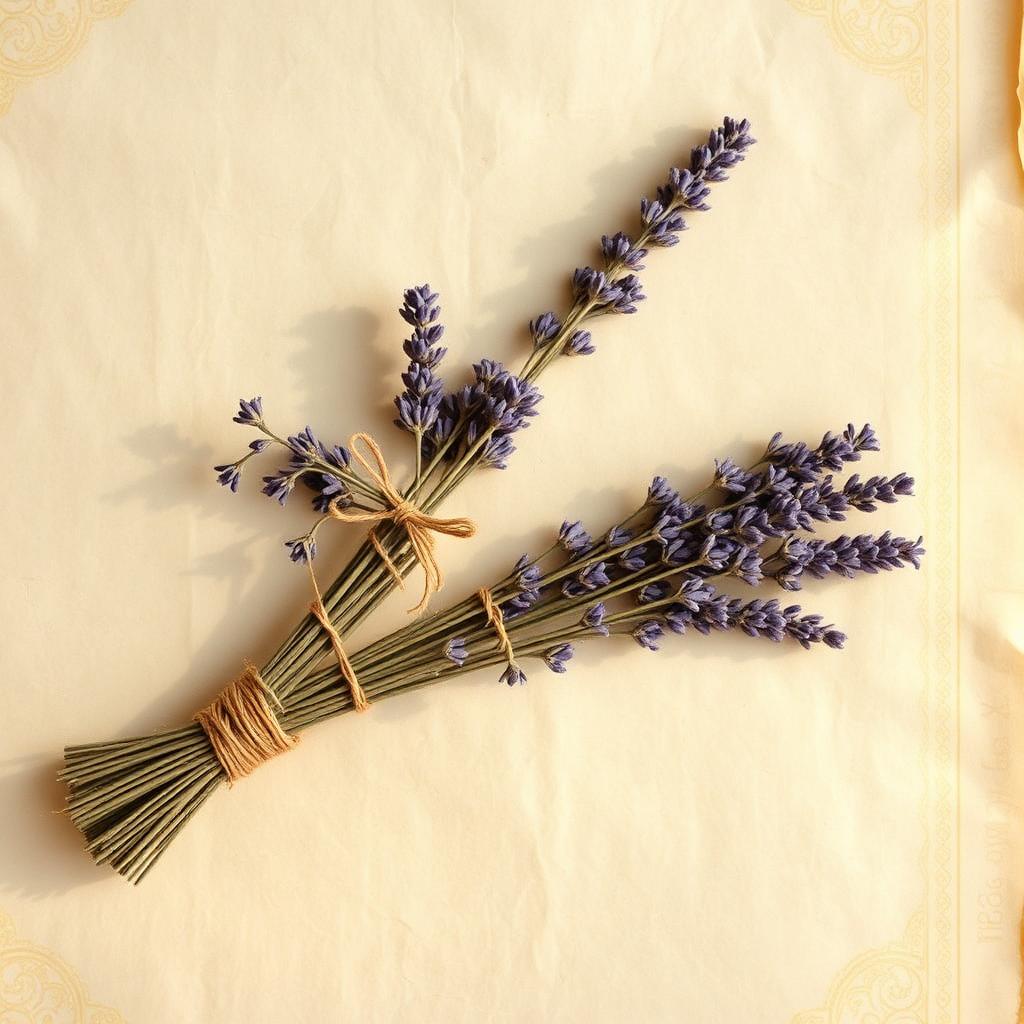
Lavender — The Quiet Purple at the End of the Day
A small, fragrant flower so closely tied to the idea of calm that the word itself has become an adjective for soft, slow evenings. Modern trials have caught up with what the nose has always known: lavender quietly takes the edge off anxiety, helps sleep land more gently, and is among the safest calming options available without prescription.
- English
- Lavender
- Family
- Lamiaceae
- Also known as
- Ustukhuddūs, True lavender, English lavender
What this may support
Researchers think linalool, lavender's main scent compound, nudges the brain's calming and mood pathways — a proposed explanation, not yet a proven one.
Helps sleep arrive sooner and feel deeper.
Eases mild-to-moderate generalized anxiety.
Patterns described in research and tradition — not a treatment claim.
A little background
- Persian and Greek apothecaries knew it as ustukhuddūs — a flower for clearing the head and lifting the mood.
- Roman baths were perfumed with it; the word 'lavender' itself comes from lavare, to wash.
- Persian and European herbalists reached for both the flowers and the oil for headaches, sleeplessness, and grief.
What tradition has long understood
- Read as slightly warm and dry — for clearing a heavy head, lifting a sad mood, and quieting a racing mind.
- Compresses of lavender water for headaches and tense necks.
- Tucked into pillows and bath water for restful sleep.
What the research now shows
- In human trials lasting 8–10 weeks, a standardised lavender oil capsule (80 mg a day) eased ongoing anxiety about as much as a low dose of the medicine lorazepam did. These were single trials with modest numbers of people, so treat this as early evidence rather than settled evidence. Do not stop or change a prescribed medicine without talking to your doctor.
- In small human trials, people who breathed lavender oil said they slept better and fell asleep faster — most clearly in hospital settings. These are small studies of how people rated their own sleep, so hold them lightly.
- Several trials show lavender massage easing post-operative anxiety.
- Researchers think linalool, lavender's main scent compound, nudges the brain's calming and mood pathways — a proposed explanation, not yet a proven one.
Evidence-based benefits
- Eases mild-to-moderate generalized anxiety.
- Helps sleep arrive sooner and feel deeper.
- Calms pre-procedure and post-operative tension.
- A pleasant, non-sedating way to tell your body the day has ended.
The active compounds inside
- Linalool and linalyl acetate — the scent oils that carry most of lavender's calming effect.
- Camphor and 1,8-cineole — secondary aromatic compounds.
What to actually do this week
- A few drops of essential oil on the pillow or in a diffuser, 30 minutes before bed.
- Lavender tea — 1 tsp of dried flowers, covered, 10 minutes. Light and gentle.
- Oral lavender oil (Silexan, 80 mg) is the form used in the anxiety studies — worth a conversation with your clinician.
- A warm bath with a handful of dried flowers tied in muslin.
Preparation methods
- For tea: a small amount, a covered mug, a short steep — over-steeping turns it bitter and soapy.
- For aromatherapy: a diffuser, a pillow spray, or a few drops on a tissue beside the bed.
- Pair the flowers with chamomile for a fuller evening tea.
Typical culinary use
- Lavender shortbread, ice cream, honey.
- Herbes de Provence (with thyme, rosemary, savory).
- Used sparingly — a little goes a long way.
Best food combinations
- Lavender + chamomile — the classic evening duo.
- Lavender + lemon balm — gentle daytime tension relief.
- Lavender + honey + warm milk — a traditional sleep ritual.
Foods that quietly help
- Chamomile
- Lemon balm
- Honey
- Warm milk
Gentle cautions
- Tea and aromatherapy are very well tolerated.
- Essential oil is for external use or diffusing only — never swallowed in undiluted form.
- Standardized oral lavender oil preparations (Silexan) are safe at studied doses.
- Some reports link sustained topical lavender oil exposure in pre-pubertal boys to mild gynecomastia — discontinue if breast tissue changes occur.
Medication interactions to know
- May potentiate sedatives and CNS depressants.
- Discuss with clinician if combining with prescribed anti-anxiety medication.
Pregnancy & breastfeeding
- Aromatherapy and weak tea are generally considered safe.
- Avoid concentrated oral preparations during pregnancy without clinician guidance.
A few honest answers
Does it really help sleep, or am I imagining it?
Multiple small RCTs say yes — particularly for falling asleep faster. The aroma is the active ingredient, so you do have to actually smell it.
Can I cook with the essential oil?
Almost never — culinary lavender is the dried flower, used in tiny amounts. Essential oils are concentrated and not made for swallowing.
Is the Silexan capsule different from the oil at the pharmacy?
Yes — it's a standardized, ingestible preparation specifically studied for anxiety. Most essential oils on shelves are for diffusing only.
Real questions, honest answers
What's the simplest way to start?
Will it help me with daytime anxiety?
Can I use it with kids?
In plain language
A few ideas worth understanding clearly. Tap to read each one explained as Hakim would — quietly, without jargon.
Anxiolytic without dependence
Explain this simply. Calms anxiety without your body needing more of it over time.
Why it matters. It's why lavender oil is a useful daily option where benzodiazepines aren't.
Aromatherapy
Explain this simply. Therapeutic use of plant aromas — usually via diffusion or inhalation.
Why it matters. The aroma reaches the limbic brain through the nose, which is why it acts so quickly on mood and arousal.
Practical scenarios — where to begin
Body is tired, mind is loud, especially on Sundays.
- Lavender on the pillow + dim lights 30 minutes before bed.
- Add a covered cup of chamomile.
- No screens during the wind-down — the aroma needs space to work.
Doctor visits, dental appointments, anything where you sit and wait.
- Carry a small bottle of lavender oil; a few sniffs before going in.
- Pair with 4-second-in / 6-second-out breathing.
- If anxiety dominates your medical care, talk to your clinician about a fuller plan.
An evening of small, fragrant signals
Not a prescription — a quiet example of how the foundations can fit an ordinary week. Adapt freely.
| Day | Morning | Afternoon | Evening |
|---|---|---|---|
| Mon–Sun | — | Optional sniff for tension | Lavender on pillow + chamomile + dim lights |
Where to wander next
These are the next quiet places to explore — each chosen because it deepens what you just read, not because it is merely related.
Why this. Lavender's natural partner in the evening cup.
ContinueWhy this. Where lavender fits into a fuller end-of-day ritual.
ContinueWhy this. Understand what 'calming' actually means in the body.
ContinueConnects to Sleep · Stress.
Feeds: Evening wind-down · Bedtime signal.
Shapes: Sleep · Stress.
"Sometimes the most useful medicine is a smell that tells the body it is safe to let go."
Tonight, put a few drops of lavender oil on your pillow and dim the lights thirty minutes before bed.
"Help me weave lavender into my evening so I actually sleep better this week."
Ask Hakim, Your Personal AIWhere this comes from
- Kasper S et al., Int Clin Psychopharmacol 2014 — Silexan vs lorazepam in GAD.
- Lillehei AS, Halcon LL., J Altern Complement Med 2014 — lavender inhalation and sleep.
Questions worth asking
Tonight, put a few drops of lavender oil on your pillow and dim the lights thirty minutes before bed.
Hakim's Thoughts on Lavender — The Quiet Purple at the End of the Day
"Lavender works mostly through the nose — the most direct path to the part of the brain that decides whether you are safe enough to sleep. Light a small evening signal. The body listens."
— Hakim
One thoughtful next step
If this resonated, you may also enjoy exploring sleep. A natural next read is "Chamomile — The Evening Cup" — it carries the same thread from a different angle. Take what feels right; leave the rest for another season.
Chamomile — The Evening Cup Ask Hakim, Your Personal AIYou may also enjoy…
Much of what we call stress is the body staying in alert mode for too long. The good news is that your system is built to settle again, a…
ContinueFew plants are more woven into Persian life than mint. It cools the hand that brushes it, calms the stomach after a heavy meal, and softe…
ContinueA resinous, almost piney shrub that lines Mediterranean and Persian gardens. For two thousand years it has been the herb of memory — pres…
ContinueThe flower Persian poets have called the heart's mirror for a thousand years — and one of the most studied botanicals for anxiety, mild d…
ContinueContinue the thread with Hakim in a calm daily ritual.
Continue