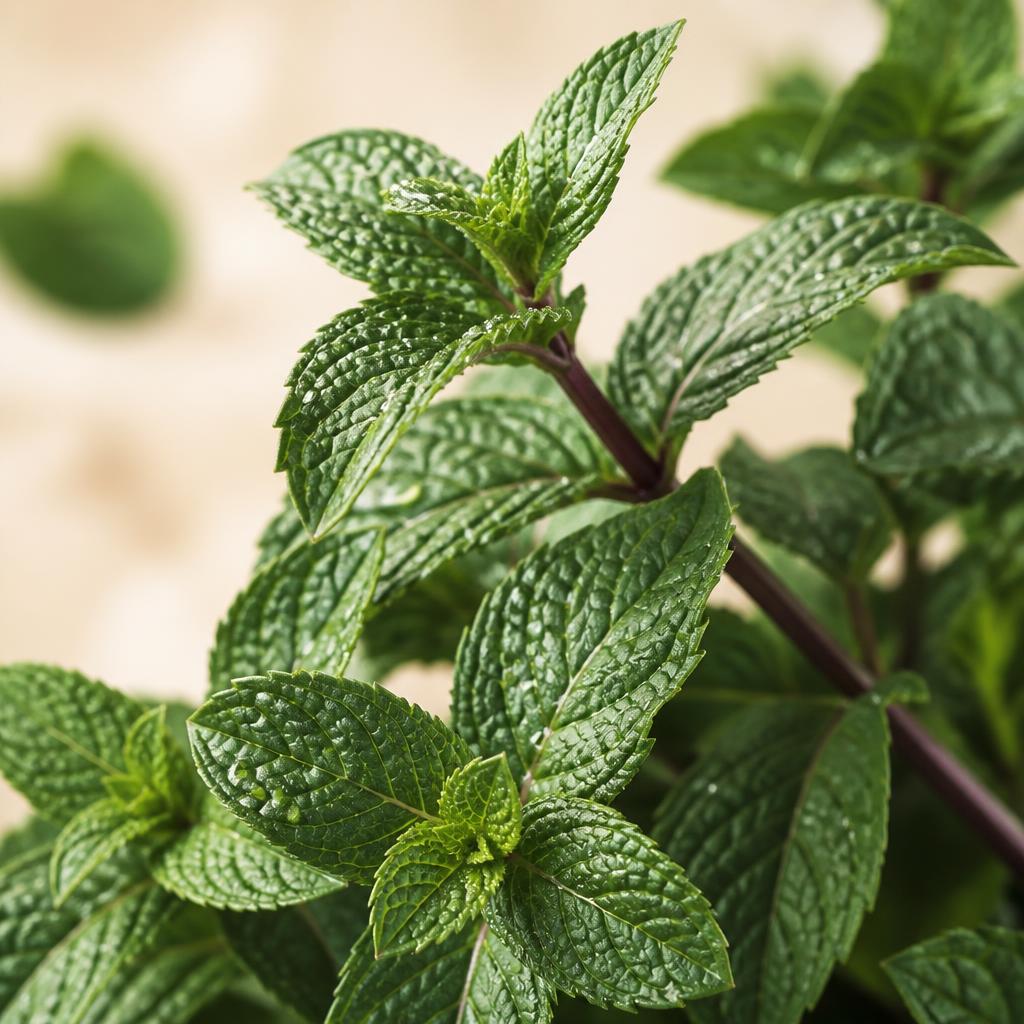
Peppermint — The Cooling Breath of a Persian Garden
Few plants are more woven into Persian life than mint. It cools the hand that brushes it, calms the stomach after a heavy meal, and softens a headache before a pharmacy is opened. Modern trials now study what every grandmother already knew.
- English
- Peppermint
- Family
- Lamiaceae
- Also known as
- Na'na, Nana, Garden mint
What this may support
Eases bloating, cramping, and IBS symptoms.
Menthol switches on the body's cold sensors. That is the cooling feeling — and a mild numbing of the gut lining and the skin.
Menthol switches on the body's cold sensors. That is the cooling feeling — and a mild numbing of the gut lining and the skin.
Patterns described in research and tradition — not a treatment claim.
A little background
- Mint has grown in Persian, Mediterranean, and Egyptian gardens for more than three thousand years — long enough that no kitchen remembers being without it.
- Persian doulmeh, ash, doogh, and salads are unthinkable without it — fresh leaves scattered at the end, never just dried.
- Greco-Islamic physicians reached for it when a stomach turned, digestion dragged, or a headache settled in.
What tradition has long understood
- Considered cool and dry — a settler of a hot, agitated stomach, a clearer of the head after rich food.
- Often blended with rose, lemon balm, and a little honey in summer drinks.
- A handful crushed and inhaled was the household answer to a tension headache.
What the research now shows
- When researchers pooled the human trials, peppermint oil in a capsule that opens in the gut (180–225 mg three times daily for 4 weeks) helped irritable bowel symptoms — roughly half the people felt better, compared with about three in ten taking a dummy capsule.
- In trials where people were assigned by chance, diluted peppermint oil rubbed on the temples eased a tension headache within 15 minutes — about as well as paracetamol.
- Menthol switches on the body's cold sensors. That is the cooling feeling — and a mild numbing of the gut lining and the skin.
- Small studies show modest improvement in alertness and exercise performance when inhaled.
Evidence-based benefits
- Eases bloating, cramping, and IBS symptoms.
- Softens tension headaches when applied topically.
- Settles post-meal heaviness and mild nausea.
- Freshens breath and clears a foggy head.
The active compounds inside
- Menthol and menthone — the cooling, antispasmodic, mildly analgesic terpenes.
- Rosmarinic acid and flavonoids (plant pigment compounds) — a quiet calming-of-irritation in the background.
What to actually do this week
- A small handful of fresh mint torn into yogurt, salads, or doogh after a heavy meal.
- A cup of fresh mint tea (a sprig steeped 5 minutes) after dinner instead of a sweet.
- For IBS: an enteric-coated peppermint oil capsule 30 minutes before meals, for 4 weeks.
- For tension headache: dab diluted peppermint oil on temples (avoid eyes).
Preparation methods
- Fresh leaves are better than dried for flavor; dried are stronger medicinally per gram.
- Tea: 1 tsp dried or a small handful fresh in 250 ml just-off-the-boil water, covered, 5 minutes.
- Always dilute essential oil (1–2 drops in a teaspoon of carrier oil) before skin contact.
Typical culinary use
- Persian ash, kashk-e bademjan, dolmeh, doogh, and almost every salad.
- Lamb dishes, pea soups, summer fruit salads.
- Moroccan and Turkish teas; Mediterranean tabbouleh.
Best food combinations
- Mint + yogurt + cucumber — Persian summer trinity.
- Mint + lemon balm + chamomile — calming evening blend.
- Mint + green tea — brighter, lighter afternoon cup.
Foods that quietly help
- Yogurt
- Cucumber
- Lemon
- Green tea
Gentle cautions
- Culinary and tea amounts are safe for nearly everyone.
- Peppermint oil capsules can worsen reflux/GERD by relaxing the lower esophageal sphincter.
- Avoid concentrated peppermint oil on the face or chest of infants and small children — menthol can suppress breathing.
Medication interactions to know
- May increase absorption of some medications by relaxing gut spasms — minor for most people.
- Can lower cyclosporine levels in theory; mention to your clinician if you take it.
Pregnancy & breastfeeding
- Culinary use and a daily cup of tea are considered safe.
- Concentrated peppermint oil supplements are not well studied in pregnancy — avoid.
A few honest answers
Tea or capsule for IBS?
For diagnosed IBS, the capsule — enteric-coated, so it opens where it's needed. Tea is the gentler, everyday choice for ordinary bloating, but it isn't the studied treatment for IBS.
Will mint help my reflux?
Usually the opposite — it relaxes the valve at the top of the stomach. Try fennel or chamomile instead.
Fresh vs dried?
Fresh for the kitchen, dried for a stronger medicinal tea — dried leaves carry more menthol per gram.
Real questions, honest answers
Why does mint feel cold?
Can I drink mint tea every day?
Does peppermint oil really work for headaches?
Is the mint in my garden the same as peppermint?
In plain language
A few ideas worth understanding clearly. Tap to read each one explained as Hakim would — quietly, without jargon.
Antispasmodic
Explain this simply. Relaxes the smooth muscle of the gut.
Why it matters. That's why mint eases cramping and the trapped-air feeling after eating.
Enteric coating
Explain this simply. A capsule shell that survives the stomach and opens in the intestine.
Why it matters. It's what lets peppermint oil reach the right place for IBS without aggravating reflux.
Practical scenarios — where to begin
Not painful, just heavy and gassy — worse with bread, legumes, or rich food.
- Mint tea after lunch and dinner for two weeks.
- Add fennel seed if bloating is mainly lower abdomen.
- Walk 10 minutes after the meal before sitting down.
Tight band around the head, neck stiffness, screen-heavy days.
- Diluted peppermint oil on temples at first signal.
- Stand up, drink water, breathe slowly for two minutes.
- A cup of mint tea instead of a third coffee.
Diagnosed IBS, mostly bloating and cramps, no alarm symptoms.
- Enteric-coated peppermint oil 30 minutes before meals, 4 weeks.
- Mint tea between meals.
- Track symptoms — re-evaluate at week 4 with your clinician.
A week that quietly carries mint through ordinary cooling moments
Not a prescription — a quiet example of how the foundations can fit an ordinary week. Adapt freely.
| Day | Morning | Afternoon | Evening |
|---|---|---|---|
| Mon | Mint in yogurt | Mint tea after lunch | Walk after dinner |
| Tue | Eggs with herbs | Tabbouleh-style salad | Mint + chamomile tea |
| Wed | Doogh with cucumber & mint | Lentil soup | Early lights-down |
| Thu | Green tea + mint sprig | Salad with feta & mint | Stretch, mint tea |
| Fri | Yogurt + walnuts | Ash with mint topping | Family dinner |
| Sat | Long walk | Persian rice with herbs | Mint tea & a book |
| Sun | Slow breakfast | Soup-and-bread | Tea & early sleep |
Where to wander next
These are the next quiet places to explore — each chosen because it deepens what you just read, not because it is merely related.
Why this. Chamomile soothes where mint cools; the two pair into a complete daily calm.
ContinueWhy this. When nausea or cold-stomach is the issue, ginger is the better tool.
ContinueWhy this. Most chronic bloating and tension headaches live in the nervous system as much as the gut.
ContinueConnects to Stress · Nutrition · Sleep.
Feeds: After-meal tea · Tension-headache pause.
Shapes: Digestion · Stress.
"Some plants heal by force. Others heal by cooling — by reminding the body it does not have to run quite so hot."
After tonight's dinner, tear a small handful of fresh mint into a cup, pour just-off-the-boil water, cover for five minutes, and drink it slowly.
"Help me use mint to settle the part of my day that feels too hot or too full."
Ask Hakim, Your Personal AIWhere this comes from
- Khanna R et al., J Clin Gastroenterol 2014 — peppermint oil meta-analysis for IBS.
- Göbel H et al., Nervenarzt 1996 — topical peppermint oil vs acetaminophen for tension headache.
Questions worth asking
After tonight's dinner, tear a small handful of fresh mint into a cup, pour just-off-the-boil water, cover for five minutes, and drink it slowly.
Hakim's Thoughts on Peppermint — The Cooling Breath of a Persian Garden
"Mint is the cool hand on a hot forehead. It does not demand belief or routine — just a sprig, a cup, a slower sip after the meal that asked too much of you."
— Hakim
One thoughtful next step
If this resonated, you may also enjoy exploring nutrition and sleep. A natural next read is "Ginger — The Warming Root for Digestion and Aches" — it carries the same thread from a different angle. Take what feels right; leave the rest for another season.
Ginger — The Warming Root for Digestion and Aches Ask Hakim, Your Personal AIYou may also enjoy…
A gentle, sweet seed chewed after meals from Tehran to Bombay to Naples. It quiets bloating, softens cramps, and freshens breath — and in…
ContinueThe fragrant green pod that perfumes Persian tea, Arab coffee, Indian sweets, and Scandinavian buns — and one of the oldest known remedie…
ContinueThe everyday Persian mint — kinder than peppermint, woven into doogh, abgoosht, sabzi, and the kitchen window. Quietly studied for digest…
ContinueThe leaf you drop into the pot without thinking — and one of the quietest evidenced herbs for blood sugar, digestion, and the inflammator…
ContinueContinue the thread with Hakim in a calm daily ritual.
Continue