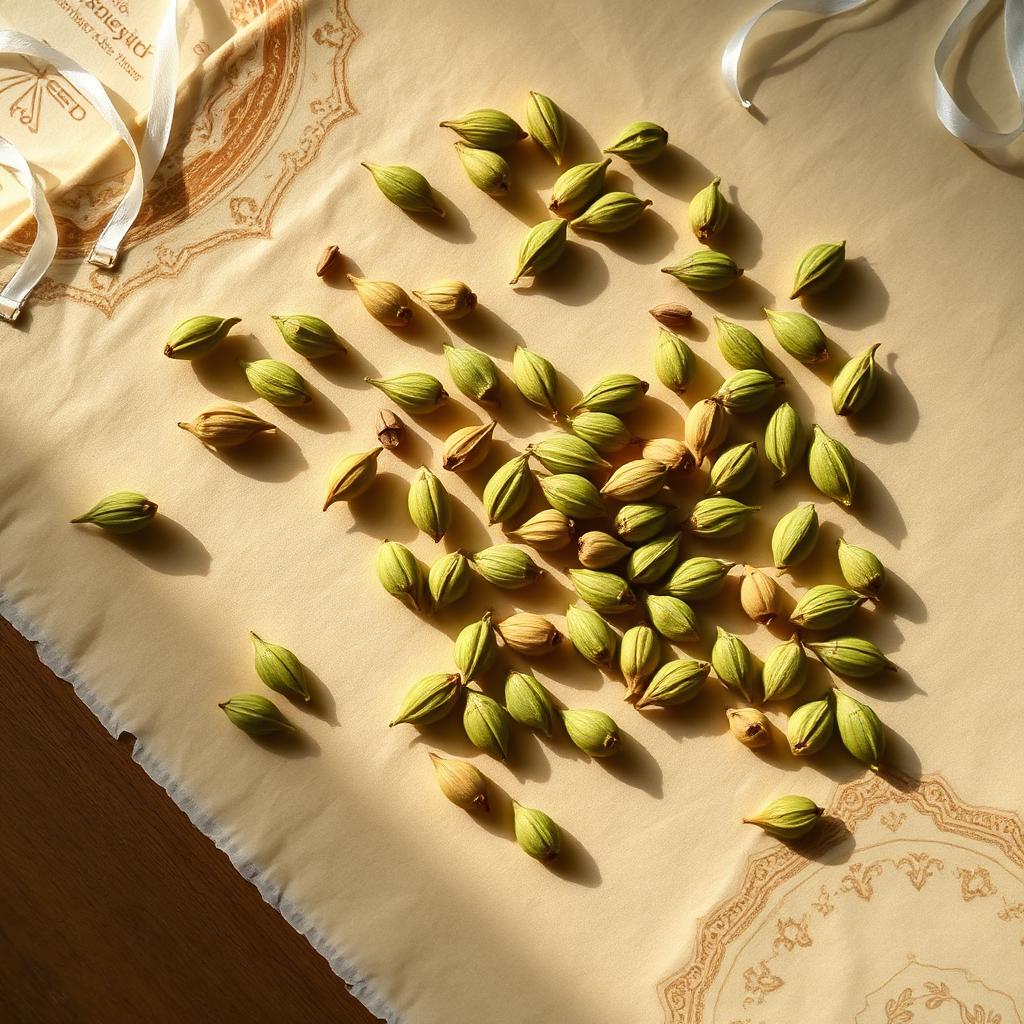
Cardamom — The Queen of Persian Tea and Digestion
The fragrant green pod that perfumes Persian tea, Arab coffee, Indian sweets, and Scandinavian buns — and one of the oldest known remedies for heavy meals, sluggish digestion, and the small mood-lift of a beautiful cup.
- English
- Green cardamom
- Family
- Zingiberaceae
- Also known as
- Hel, Elaichi, Hayl
What this may support
When you use it daily, it lends blood pressure and blood fats a modest helping hand.
Eases bloating and post-meal heaviness.
Small human trials in prediabetes show modest improvements in fasting blood sugar and in blood tests of inflammation.
In laboratory and animal studies, cardamom's scent oil slowed microbes, relaxed cramping muscle, and calmed inflammation. This has been studied in animals and in dishes, but that does not tell us for sure what happens in people.
Small human trials in prediabetes show modest improvements in fasting blood sugar and in blood tests of inflammation.
Patterns described in research and tradition — not a treatment claim.
A little background
- Traded along the Silk Road from southern India and Sri Lanka to Persia, Arabia, and Europe for over 2,000 years.
- Added to qahveh and chai across the Middle East — a sign of welcome and care.
- Avicenna prescribed it for weak digestion, heart palpitations, and 'sadness of the chest'.
What tradition has long understood
- Warm and slightly drying — opening to the chest, lifting to the mood.
- Used after heavy or fatty meals to ease heaviness.
- A pinch in tea was a daily Persian household gesture toward the heart and breath.
What the research now shows
- Small trials of cardamom powder (1.5–3 g/day for 8–12 weeks) report reductions in systolic and diastolic blood pressure, total cholesterol, and triglycerides in adults with metabolic syndrome.
- Small human trials in prediabetes show modest improvements in fasting blood sugar and in blood tests of inflammation.
- In laboratory and animal studies, cardamom's scent oil slowed microbes, relaxed cramping muscle, and calmed inflammation. This has been studied in animals and in dishes, but that does not tell us for sure what happens in people.
- A few clinical trials suggest improvement in mild functional dyspepsia and IBS-like bloating.
Evidence-based benefits
- Eases bloating and post-meal heaviness.
- When you use it daily, it lends blood pressure and blood fats a modest helping hand.
- Freshens breath naturally.
- Lifts the everyday cup of tea or coffee.
The active compounds inside
- 1,8-cineole — the bright eucalyptus-like compound; antimicrobial, expectorant.
- Alpha-terpinyl acetate, limonene — antispasmodic and digestive.
- Plant pigment compounds — the kind researchers group as polyphenols and flavonoids.
What to actually do this week
- Persian tea: 2–3 lightly crushed pods in the teapot with black tea.
- Arabic coffee: ground cardamom mixed with the coffee before brewing.
- Daily metabolic support: ½ tsp ground cardamom in oatmeal, yogurt, or smoothie.
- Chew a pod after meals to freshen breath and ease heaviness.
Preparation methods
- Buy whole green pods; grind just before use — the aroma fades quickly.
- Crack pods lightly to release oils, then steep whole — the flavor is gentler than ground.
- Avoid black (smoked) cardamom in recipes calling for green — different chemistry and flavor.
Typical culinary use
- Persian chai, sholeh-zard, halva, rosewater desserts.
- Indian biryani, masala chai, kheer.
- Scandinavian cardamom buns.
Best food combinations
- Cardamom + black tea + saffron — Persian celebration cup.
- Cardamom + rosewater + pistachio — Persian dessert trio.
- Cardamom + cinnamon + ginger — warming digestive blend.
Foods that quietly help
- Black tea
- Saffron
- Rosewater
- Yogurt
- Oats
Gentle cautions
- Culinary and tea amounts are very well tolerated.
- High supplemental doses may cause mild GI upset.
- Stop 1–2 weeks before surgery — mild blood-pressure-lowering activity.
Medication interactions to know
- Blood pressure medications — may add modestly to lowering.
- Anticoagulants — high-dose extracts may add to bleeding risk.
- Gallstones — high doses may trigger gallbladder colic; use food amounts only.
Pregnancy & breastfeeding
- Culinary and tea amounts are considered safe.
- Avoid high-dose supplements during pregnancy — not well studied.
A few honest answers
Why do Persians always put cardamom in tea?
Practical reasons (digestion, breath, mild lift) and emotional ones (welcome, hospitality, sweetness). The cup carries both.
Is it strong enough to matter for blood pressure?
On its own, the effect is modest — a few mmHg. As part of a fuller picture (hibiscus, walking, salt-mindfulness, the Mediterranean–Persian plate), it compounds usefully.
Green vs. black cardamom?
Green is the everyday Persian pod — sweet, floral, light. Black is smoky and used in Indian savory dishes. They are not interchangeable.
Real questions, honest answers
Will it stain my teeth like coffee?
How much is too much?
I find it perfumey — am I supposed to like it?
In plain language
A few ideas worth understanding clearly. Tap to read each one explained as Hakim would — quietly, without jargon.
Antispasmodic
Explain this simply. Helps smooth muscle in the gut stop cramping.
Why it matters. It's why a cardamom tea after a heavy meal often relieves bloating within minutes.
Carminative
Explain this simply. An old word for an herb that helps move trapped gas through the gut.
Why it matters. Cardamom, fennel, and ginger are the classic carminative trio.
Practical scenarios — where to begin
Family dinners feel like effort.
- Cardamom tea after the meal, slowly sipped.
- Walk for 10–15 minutes before sitting down.
- Smaller portion of rice next time.
Borderline readings, doctor said 'lifestyle first'.
- ½ tsp ground cardamom daily in oats or yogurt.
- Pair with hibiscus and walking.
- Recheck in 8–12 weeks.
Just want a beautiful daily ritual.
- Two cracked pods in the teapot every morning.
- Add a thread of saffron on weekends.
- Pour slowly, drink without screens.
A week where cardamom quietly perfumes the small daily rituals
Not a prescription — a quiet example of how the foundations can fit an ordinary week. Adapt freely.
| Day | Morning | Afternoon | Evening |
|---|---|---|---|
| Mon | Cardamom black tea | Salad + olive oil | Walk after dinner |
| Tue | Oats + cardamom + walnuts | Lentil soup | Family dinner |
| Wed | Cardamom + saffron tea | Soup-and-bread | Cardamom tea after meal |
| Thu | Yogurt + cardamom + honey | Roast vegetables | Tea & reading |
| Fri | Eggs + flatbread | Fish + greens | Sleep early |
| Sat | Long walk | Persian rice & stew | Cardamom tea after meal |
| Sun | Slow breakfast + cardamom buns | Family lunch | Plan the week |
Where to wander next
These are the next quiet places to explore — each chosen because it deepens what you just read, not because it is merely related.
Why this. Cardamom and saffron together are the Persian celebration tea — and a small mood-and-heart ritual.
ContinueWhy this. Where cardamom is warm and aromatic, hibiscus is tart and cooling. Together they cover both seasons of the heart.
ContinueWhy this. Cardamom fits inside a fuller, gentler heart-protective rhythm.
ContinueConnects to Heart · Nutrition · Mood.
Feeds: Morning Persian tea · After-meal pour.
Shapes: Blood pressure · Digestion · Mood.
"The same green pod has soothed digestion in Tehran, Cairo, Mumbai, and Stockholm. The world is smaller and warmer than we remember."
Tomorrow morning, crack two green cardamom pods into the teapot and let your day begin with a Persian cup.
"Help me build cardamom into my daily tea and meals."
Ask Hakim, Your Personal AIWhere this comes from
- Verma SK et al., Indian J Biochem Biophys 2009 — cardamom and lipid profile in hypertensive adults.
- Aghasi M et al., Phytother Res 2019 — cardamom supplementation in metabolic syndrome, RCT.
Questions worth asking
Tomorrow morning, crack two green cardamom pods into the teapot and let your day begin with a Persian cup.
Hakim's Thoughts on Cardamom — The Queen of Persian Tea and Digestion
"Cardamom is the herb of welcome. The pod opens, the kitchen smells like an old aunt's house, the cup is poured slowly. Most of its medicine arrives this way — in the ritual itself, more than in the dose."
— Hakim
One thoughtful next step
If this resonated, spearmint — the gentler mint of the persian table is a gentle next step. A natural next read is "Spearmint — The Gentler Mint of the Persian Table" — it carries the same thread from a different angle. Take what feels right; leave the rest for another season.
Spearmint — The Gentler Mint of the Persian Table Ask Hakim, Your Personal AIYou may also enjoy…
The everyday Persian mint — kinder than peppermint, woven into doogh, abgoosht, sabzi, and the kitchen window. Quietly studied for digest…
ContinueA knotted, pungent root that traditional kitchens turn to for the same things modern trials confirm: nausea, slow digestion, period cramp…
ContinueA gentle, sweet seed chewed after meals from Tehran to Bombay to Naples. It quiets bloating, softens cramps, and freshens breath — and in…
ContinueThe leaf you drop into the pot without thinking — and one of the quietest evidenced herbs for blood sugar, digestion, and the inflammator…
ContinueContinue the thread with Hakim in a calm daily ritual.
Continue