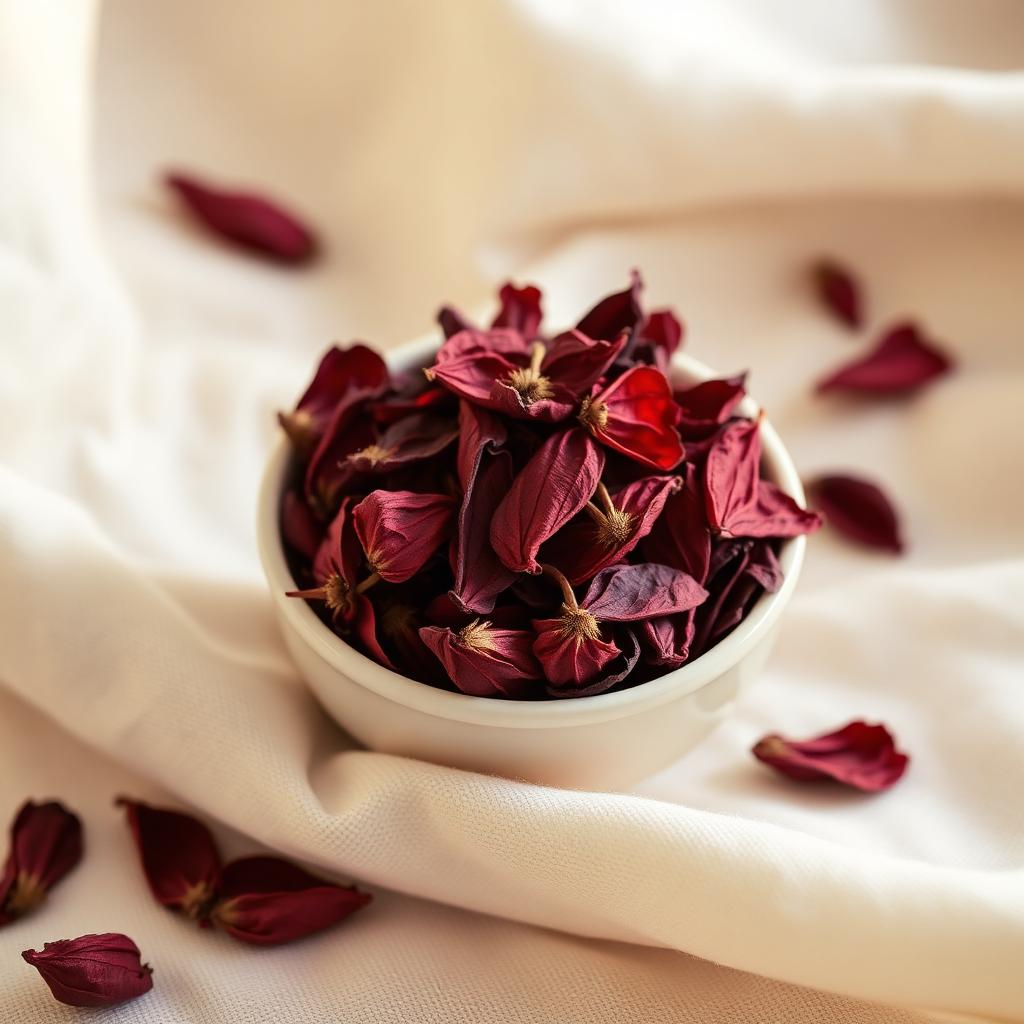
Hibiscus — The Ruby Tea for Blood Pressure and Heart
A deep-ruby, tart tea poured hot in Persian winters and iced through Egyptian summers — and one of the few herbal teas with serious, repeated clinical evidence for lowering blood pressure.
- English
- Hibiscus
- Family
- Malvaceae
- Also known as
- Chai torsh, Roselle, Karkadeh, Sour tea
What this may support
Gently lowers blood pressure with daily use.
Patterns described in research and tradition — not a treatment claim.
A little background
- Native to West Africa, traded into Persia, the Arab world, and the Caribbean centuries ago.
- Served at Egyptian weddings as karkadeh; sipped after long Persian meals as chai torsh to 'cut the heaviness'.
- A daily two-cup habit in many Middle Eastern households, especially in summer.
What tradition has long understood
- Cooling and slightly drying — gentle on summer heat, heavy meals, and 'hot' moods.
- Used to brighten skin and 'clean the blood'.
- Sipped after meat-heavy meals to feel lighter.
What the research now shows
- In several human trials — and reviews pooling them — 2–3 cups of hibiscus tea a day lowered the top blood-pressure number by roughly 5–10 points and the bottom number by 3–6 points in adults with mildly raised blood pressure.
- Some trials have compared hibiscus head-to-head with standard blood-pressure medicines and found it works about as well, at this mild level.
- Small trials suggest modest improvements in LDL cholesterol and triglycerides.
- Rich in anthocyanins — the same red colour pigments found in pomegranate and berries. They are antioxidants, which means they help protect cells from everyday wear.
Evidence-based benefits
- Gently lowers blood pressure with daily use.
- Helps keep cholesterol and triglycerides on the healthy side.
- A deep store of antioxidants for the blood vessels.
- Hydrating, sugar-free alternative to soft drinks.
The active compounds inside
- Anthocyanins — the deep red colour pigments of the petal.
- Organic acids — hibiscus, citric, malic (give the tart flavor).
- Quercetin and gossypetin — plant compounds of the kind researchers call polyphenols.
What to actually do this week
- Daily heart tea: 1–2 tsp dried hibiscus per cup, steep 5–7 min, 2–3 cups/day.
- Cold brew: large jar in the fridge overnight; sip through the day in summer.
- Standardized extract (250–500 mg twice daily) for those who don't drink tea — discuss with clinician.
- Pair with a Mediterranean–Persian plate for compounding heart benefit.
Preparation methods
- Use whole dried calyces, not powder, for the cleanest taste.
- Steep covered to keep aromatic compounds.
- Sweeten lightly with honey or stevia — too much sugar erases the heart benefit.
Typical culinary use
- Persian sharbat-e chai torsh — cold ruby drink for summer.
- Egyptian karkadeh — hot or iced.
- Caribbean sorrel — spiced with ginger and cloves at Christmas.
Best food combinations
- Hibiscus + cinnamon — gentle warming evening tea.
- Hibiscus + ginger + lemon — summer cooler.
- Hibiscus + pomegranate juice — antioxidant heart pour.
Foods that quietly help
- Pomegranate
- Olive oil
- Berries
- Dark leafy greens
Gentle cautions
- Generally well tolerated; mild stomach upset possible at large doses.
- Stains teeth temporarily — rinse with water after.
- Stop 1–2 weeks before surgery — blood-pressure-lowering effect.
Medication interactions to know
- Blood pressure medications — may amplify; monitor at home and tell your clinician.
- Diuretics — mild diuretic effect of hibiscus may add.
- Acetaminophen and chloroquine — hibiscus may alter absorption/metabolism; separate by 3–4 hours.
Pregnancy & breastfeeding
- Avoid medicinal amounts during pregnancy — animal studies suggest possible uterine effects.
- Small culinary or occasional sips are generally considered low risk in later pregnancy, but check with a clinician.
A few honest answers
Can it replace my blood pressure medication?
No — but for mildly elevated readings, a daily two-cup habit alongside salt-mindfulness, walking, and weight care can reduce how much medication you eventually need. Coordinate any change with your clinician.
How long until I see a change in my readings?
Most trials see meaningful drops within four to six weeks of consistent daily use.
Is the bagged supermarket hibiscus enough?
Decent, but loose dried calyces are usually fresher and more potent. Look for deep, almost black-red color.
Real questions, honest answers
Hot or cold — does it matter?
Can I just take a pill instead?
Is it OK every day, forever?
In plain language
A few ideas worth understanding clearly. Tap to read each one explained as Hakim would — quietly, without jargon.
Systolic / diastolic
Explain this simply. The top and bottom numbers in a blood pressure reading. Systolic is the squeeze, diastolic is the rest.
Why it matters. Hibiscus tends to lower both — most studies report 5–10 mmHg systolic improvement, which is meaningful for long-term heart risk.
Anthocyanin
Explain this simply. The pigment that makes hibiscus, pomegranate, and berries deeply red.
Why it matters. These pigments are also the active heart-protective antioxidants — color and benefit travel together.
Practical scenarios — where to begin
130s–140s/80s–90s on home readings, no medication yet.
- 2 cups hibiscus daily, morning and afternoon.
- Walk 20 min after dinner.
- Recheck in 6 weeks; share readings with clinician.
Trying to cut soda and juice.
- Cold-brew hibiscus pitcher in the fridge.
- Add a slice of lemon or ginger.
- Aim for 2–3 glasses a day instead of soda.
Already controlled, but want lifestyle support.
- 1–2 cups hibiscus daily.
- Tell your clinician — they may want to monitor for over-correction.
- Layer with the Mediterranean–Persian plate.
A heart-friendly week with two ruby cups a day
Not a prescription — a quiet example of how the foundations can fit an ordinary week. Adapt freely.
| Day | Morning | Afternoon | Evening |
|---|---|---|---|
| Mon | Hot hibiscus + lemon | Salad + olive oil | Walk after dinner |
| Tue | Oats + walnuts | Iced hibiscus | Family dinner |
| Wed | Hibiscus + cinnamon tea | Soup-and-bread | Tea & reading |
| Thu | Eggs + flatbread | Hibiscus pitcher refill | Walk |
| Fri | Pomegranate + yogurt | Iced hibiscus | Sleep early |
| Sat | Long walk | Persian stew | Hot hibiscus after meal |
| Sun | Slow breakfast | Hibiscus + ginger | Plan the week |
Where to wander next
These are the next quiet places to explore — each chosen because it deepens what you just read, not because it is merely related.
Why this. Same anthocyanin family, same heart story — together they make a daily vascular ritual.
ContinueWhy this. Hibiscus is one tool inside a fuller heart-protective life.
ContinueWhy this. The walk and the cup compound — each modestly powerful, together quietly transformative.
ContinueConnects to Heart · Nutrition · Stress.
Feeds: Morning hibiscus · After-meal pour.
Shapes: Blood pressure · Heart · Hydration.
"A red cup, twice a day, is a small loyalty the heart understands."
Today, brew one cup of hibiscus tea after lunch and notice how your afternoon feels — calmer, brighter, less heavy.
"Help me build a daily hibiscus habit that fits my routine and my blood pressure."
Ask Hakim, Your Personal AIWhere this comes from
- Serban C et al., J Hypertens 2015 — hibiscus and blood pressure, meta-analysis.
- Hopkins AL et al., Fitoterapia 2013 — hibiscus pharmacology and clinical review.
Questions worth asking
Today, brew one cup of hibiscus tea after lunch and notice how your afternoon feels — calmer, brighter, less heavy.
Hakim's Thoughts on Hibiscus — The Ruby Tea for Blood Pressure and Heart
"Hibiscus is one of the rare herbal teas where the evidence is as bright as the color. Two cups a day, kept faithfully, quietly does what a stronger pill might do louder."
— Hakim
One thoughtful next step
If this resonated, pomegranate — the ruby fruit at the heart of persian winter is a gentle next step. A natural next read is "Pomegranate — The Ruby Fruit at the Heart of Persian Winter" — it carries the same thread from a different angle. Take what feels right; leave the rest for another season.
Pomegranate — The Ruby Fruit at the Heart of Persian Winter Ask Hakim, Your Personal AIYou may also enjoy…
Three crimson threads, hand-picked from a single autumn flower. For three thousand years, saffron has been Persia's most beloved medicine…
ContinueA bright, sour crimson powder shaken over kebab and salads from Tehran to Beirut to Istanbul. Long before its taste was studied, it was u…
ContinueThe fragrant green pod that perfumes Persian tea, Arab coffee, Indian sweets, and Scandinavian buns — and one of the oldest known remedie…
ContinueThe clove found in every great kitchen on earth — and one of the most consistently evidenced foods for blood pressure, cholesterol, immun…
ContinueContinue the thread with Hakim in a calm daily ritual.
Continue