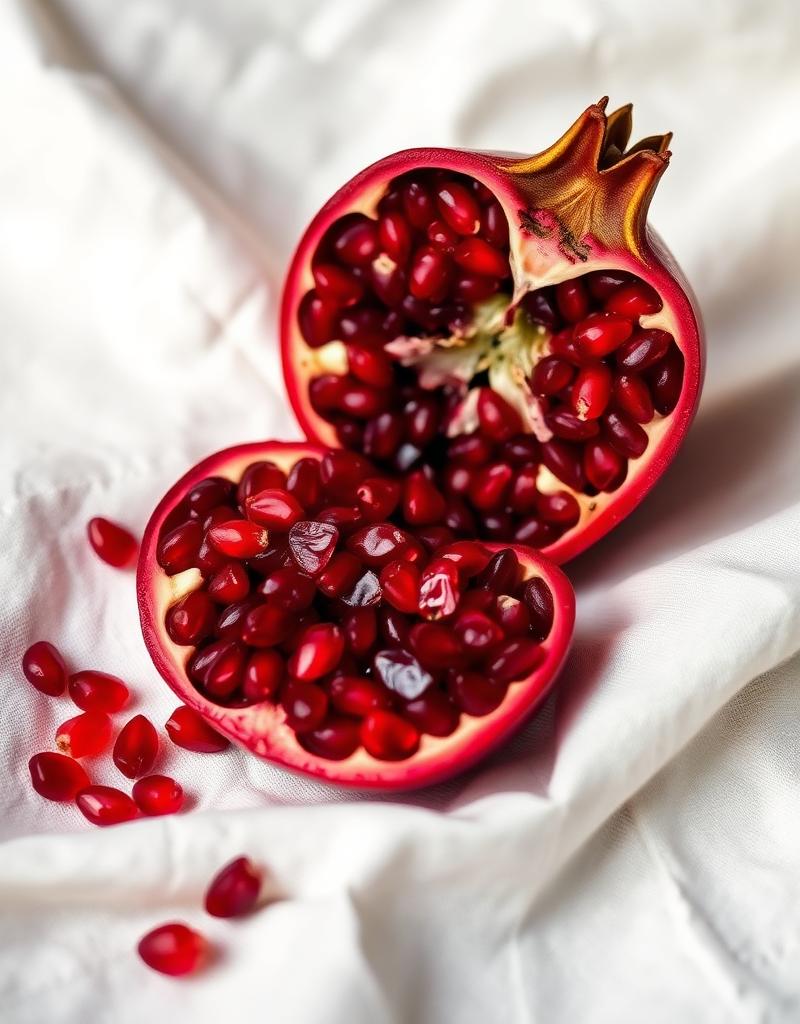
Pomegranate — The Ruby Fruit at the Heart of Persian Winter
Few fruits carry more story than the pomegranate. At Yalda — the longest Persian night — families gather around a table crowned with anār, because its red is the color of dawn returning. Modern research now tells us the fruit's polyphenols quietly look after the heart all year long.
- English
- Pomegranate
- Family
- Lythraceae
- Also known as
- Anār, Persian apple
What this may support
Gentle support for healthy blood pressure.
Emerging evidence — via urolithin A — for mitochondrial and muscle aging.
An anti-inflammatory effect across multiple tissues, the gut included.
An anti-inflammatory effect across multiple tissues, the gut included.
Emerging evidence — via urolithin A — for mitochondrial and muscle aging.
Patterns described in research and tradition — not a treatment claim.
A little background
- Native to the region between modern Iran and northern India, and cultivated for at least five thousand years.
- The pomegranate turns up everywhere in Persian culture — in poetry, on Sassanid silver, in the carvings of Persepolis — as a symbol of fertility and life.
- On Yalda Shab, the winter-solstice night, the pomegranate sits at the center of every Persian household, welcoming the return of longer days.
What tradition has long understood
- Persian medicine saw pomegranate as cooling, gently astringent, and balancing for a body that runs warm.
- Sour pomegranate juice (āb-e anār-e torsh) is a traditional digestif, and a tonic for low appetite.
- The fruit is honored at Yalda, at Nowruz, and after every harvest — a quiet seasonal medicine.
What the research now shows
- Across multiple meta-analyses, pomegranate juice (≈150–250 ml/day) modestly lowers systolic blood pressure.
- Trials lasting 3–12 months have observed improvements in LDL oxidation, endothelial function, and arterial stiffness.
- Your gut bacteria convert punicalagins into urolithin A — a compound now under active study for mitochondrial and muscle health as we age.
Evidence-based benefits
- Gentle support for healthy blood pressure.
- Antioxidant protection for your blood vessels and LDL particles.
- Emerging evidence — via urolithin A — for mitochondrial and muscle aging.
- An anti-inflammatory effect across multiple tissues, the gut included.
A nutritional snapshot
- About 235 kcal per medium fruit; mostly natural sugars, with ~7 g of fiber.
- Excellent source of vitamin C, folate, and potassium.
- Particularly rich in punicalagins, anthocyanins, and ellagitannins — among the most potent dietary polyphenols.
Preparation methods
- Score the crown, halve it under water, and gently free the arils — the water trick keeps the staining away.
- Pomegranate molasses (rob-e anār) is the thickened, sweet-sour Persian staple behind so many stews and dressings.
- Whole fruit beats juice: more fiber, and a lighter sugar load on your bloodstream.
Typical culinary use
- Anār seeds scattered over yogurt, salads, or rice.
- Pomegranate molasses as the soul of fesenjān (walnut–pomegranate stew).
- A winter salad of pomegranate seeds, walnuts, feta, and herbs.
Best food combinations
- Pomegranate + walnuts — the most famous Persian pairing; antioxidants meet omega-3s.
- Pomegranate + yogurt — tart-sweet, gentle on the stomach, ideal at breakfast.
- Pomegranate + olive oil + herbs — a Mediterranean-Persian salad worth keeping forever.
Foods that quietly help
- Walnuts
- Yogurt
- Olive oil
- Whole grains
- Leafy herbs
Gentle cautions
- Pomegranate juice and extracts can interact with several medications via CYP3A4 inhibition.
- Whole-fruit consumption in normal amounts is safe for nearly everyone.
- Choose unsweetened juice; many commercial juices are heavily diluted and sugared.
Medication interactions to know
- May potentiate statins, certain blood-pressure drugs, and warfarin — review with a pharmacist if you drink juice daily.
A few honest answers
Juice or whole fruit?
Whole fruit, when you can. The fiber slows the sugar release and feeds the gut bacteria that turn polyphenols into urolithin A.
How much is enough?
Half a fruit a day, or ~150 ml of unsweetened juice — that's the amount used in most cardiovascular trials.
Is pomegranate molasses healthy?
Used as a flavoring — a teaspoon or two — yes, it keeps many of the polyphenols. It's not a drink, though; treat it like olive oil's tart cousin.
Real questions, honest answers
Seeds or juice?
Is the sugar in pomegranate okay if I have diabetes?
How do I open one without staining everything?
Pomegranate molasses — same benefits?
In plain language
A few ideas worth understanding clearly. Tap to read each one explained as Hakim would — quietly, without jargon.
Urolithins
Explain this simply. Compounds your gut bacteria make from pomegranate polyphenols.
Why it matters. Urolithin A is now being studied for mitochondrial health — the engine inside your cells.
Yalda night
Explain this simply. The longest night of the Persian winter solstice, traditionally spent with family — eating pomegranates and nuts, reading poetry.
Why it matters. Pomegranate's medicine is partly nutritional, partly the company it keeps.
Practical scenarios — where to begin
Borderline numbers, doctor says lifestyle first.
- ~150 ml of unsweetened pomegranate juice daily for 8 weeks.
- Pair it with walking, sleep, and less salt.
- Track your numbers at home; pomegranate is one of several supports, not a cure.
You want to pass something quiet and meaningful forward.
- Make pomegranate part of a weekly ritual — Yalda, a Sunday afternoon, a birthday.
- Open it slowly together; the slowness is the gift.
- Tell the story while you eat the seeds.
Pomegranate, woven through the cold months
Not a prescription — a quiet example of how the foundations can fit an ordinary week. Adapt freely.
| Day | Morning | Afternoon | Evening |
|---|---|---|---|
| In season | Pomegranate seeds on yogurt | Half a fruit as snack | Pomegranate molasses on rice or salad |
Where to wander next
These are the next quiet places to explore — each chosen because it deepens what you just read, not because it is merely related.
Connects to Nutrition · Heart.
Feeds: Pomegranate seeds on yogurt · Yalda evening.
Shapes: Heart · Nutrition · Connection.
"Some foods refuse to be hurried. They become medicine partly because of what they ask of you while you eat them."
Buy one pomegranate this week. Open it slowly on a quiet afternoon, and share the seeds with someone you love.
"Help me bring pomegranate into the cold months as a small family ritual."
Ask Hakim, Your Personal AIWhere this comes from
- Sahebkar A et al., Pharmacol Res 2017 — pomegranate juice and blood pressure: meta-analysis.
- Andreux PA et al., Nat Metab 2019 — urolithin A and mitochondrial health.
Questions worth asking
Buy one pomegranate this week. Open it slowly on a quiet afternoon, and share the seeds with someone you love.
Hakim's Thoughts on Pomegranate — The Ruby Fruit at the Heart of Persian Winter
"Some foods are eaten in a hurry. Pomegranate refuses to be one of them. It asks for patience to open, attention to enjoy, company to share. Perhaps that is part of its medicine too."
— Hakim
One thoughtful next step
If this resonated, hibiscus — the ruby tea for blood pressure and heart is a gentle next step. A natural next read is "Hibiscus — The Ruby Tea for Blood Pressure and Heart" — it carries the same thread from a different angle. Take what feels right; leave the rest for another season.
Hibiscus — The Ruby Tea for Blood Pressure and Heart Ask Hakim, Your Personal AIYou may also enjoy…
A deep-ruby, tart tea poured hot in Persian winters and iced through Egyptian summers — and one of the few herbal teas with serious, repe…
ContinueThree crimson threads, hand-picked from a single autumn flower. For three thousand years, saffron has been Persia's most beloved medicine…
ContinueA bright, sour crimson powder shaken over kebab and salads from Tehran to Beirut to Istanbul. Long before its taste was studied, it was u…
ContinueThe clove found in every great kitchen on earth — and one of the most consistently evidenced foods for blood pressure, cholesterol, immun…
ContinueContinue the thread with Hakim in a calm daily ritual.
Continue