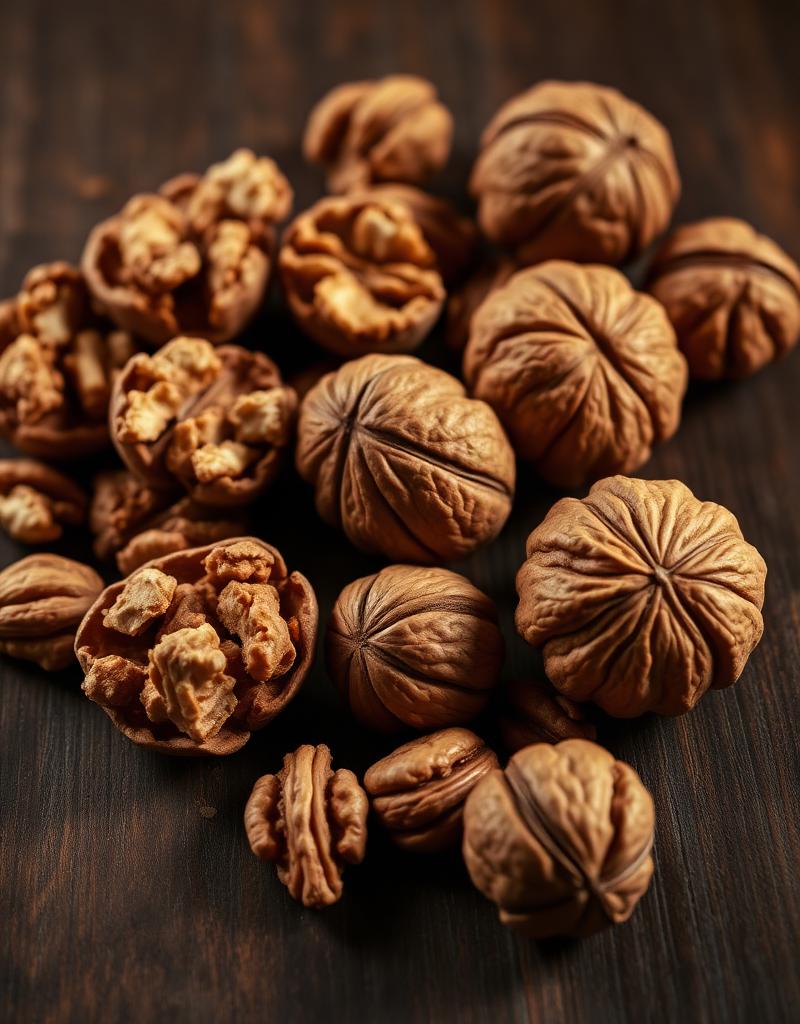
Walnuts — The Brain-Shaped Nut Persian Families Have Trusted for Centuries
Persia is the walnut's original home — the species name literally means 'royal Jovian nut.' A small handful a day is one of the few foods that simultaneously protects the brain, the heart, and the metabolism. Modern science is, gently, catching up with the Persian grandmother.
- English
- Walnut
- Family
- Juglandaceae
- Also known as
- Gerdū, Persian walnut, English walnut
What this may support
Lower LDL cholesterol and arteries that work better.
Modest but real support for memory and cognitive aging.
Modest but real support for memory and cognitive aging.
Walnut polyphenols also appear to feed the beneficial gut bacteria that produce short-chain fatty acids.
Gentle mood and sleep support — likely thanks to the omega-3, magnesium, and the small amount of melatonin.
Steadier blood sugar when you eat them as a snack alongside carbs.
Gentle mood and sleep support — likely thanks to the omega-3, magnesium, and the small amount of melatonin.
Patterns described in research and tradition — not a treatment claim.
A little background
- Wild walnut forests still stand in northern Iran and Central Asia — this is very likely where the species was born.
- Walnuts traveled the Silk Road westward and became a staple of the Roman table — the name 'Persian walnut' is more than poetry.
- In Persian kitchens, walnuts anchor fesenjān, get crushed into mast-o-mūsīr, and sit at the center of every ajeel platter shared at Yalda and Nowruz.
What tradition has long understood
- Persian tradition pairs walnuts with yogurt or honey for nourishment, with feta and fresh herbs at breakfast, and with dates as a winter warmer.
- The walnut's shape — two halves like the hemispheres of a brain — was taken, long before modern research, as a quiet sign of where it helps most.
What the research now shows
- In the PREDIMED trial, a Mediterranean diet supplemented with mixed nuts (walnuts included) reduced major cardiovascular events by ~30%.
- In randomized trials, eating walnuts daily (≈30–60 g) lowers LDL cholesterol and improves endothelial function — how well the lining of your blood vessels works.
- In the Walnuts and Healthy Aging (WAHA) study, two years of daily walnuts modestly slowed cognitive decline in higher-risk older adults.
- Walnut polyphenols also appear to feed the beneficial gut bacteria that produce short-chain fatty acids.
Evidence-based benefits
- Lower LDL cholesterol and arteries that work better.
- Modest but real support for memory and cognitive aging.
- Steadier blood sugar when you eat them as a snack alongside carbs.
- Gentle mood and sleep support — likely thanks to the omega-3, magnesium, and the small amount of melatonin.
A nutritional snapshot
- About 185 kcal per ounce (28 g).
- The only common nut with meaningful plant omega-3 (ALA): ~2.5 g per ounce — more than any other nut.
- Rich in polyphenols, vitamin E, magnesium, and a small amount of melatonin.
Preparation methods
- Eat raw or lightly toasted — high heat damages the delicate omega-3.
- Soak overnight to soften and ease digestion (a Persian household trick).
- Store in the freezer if not eaten within a few weeks — the oils oxidize faster than most nuts.
Typical culinary use
- Crushed into yogurt with rose water and a drizzle of honey.
- Folded into the slow-cooked stew khoresh-e fesenjān with pomegranate molasses.
- Chopped over morning oats or a winter salad of pomegranate seeds and feta.
Best food combinations
- Walnuts + dates — a classic winter pairing; protein, fiber, and slow sugars together.
- Walnuts + pomegranate molasses — the heart of Persian fesenjān.
- Walnuts + yogurt at breakfast — steady energy, gentle on the stomach.
Foods that quietly help
- Dates
- Pomegranate
- Yogurt
- Olive oil
- Leafy greens
Gentle cautions
- Tree-nut allergy is the main concern — strict avoidance if diagnosed.
- Rancid walnuts taste bitter and harsh; discard rather than mask.
- Energy-dense — a small handful (≈30 g) is the daily amount most of the trials used.
A few honest answers
How many walnuts a day?
A small handful — about 30 g, or 7 whole walnuts — is the amount used in most heart and brain studies.
Raw or roasted?
Both are fine. Raw or lightly toasted protects the omega-3s best; heavy commercial roasting whittles them down.
Are walnuts fattening?
Despite the calories, people who eat nuts regularly tend to weigh less, not more — the fiber, protein, and fat keep you satisfied and crowd out worse snacks.
Real questions, honest answers
How many walnuts a day?
Are they fattening?
Soaked or raw?
Will rancid walnuts hurt me?
In plain language
A few ideas worth understanding clearly. Tap to read each one explained as Hakim would — quietly, without jargon.
ALA (alpha-linolenic acid)
Explain this simply. The plant form of omega-3 — the one you find in walnuts and flax.
Why it matters. Your body converts a small fraction of it into EPA/DHA — the fatty-fish kind. Both forms matter, and walnuts give you the plant one every day.
PREDIMED
Explain this simply. A landmark Spanish trial that found a Mediterranean diet with nuts and olive oil cut heart attacks and strokes by ~30%.
Why it matters. It's the strongest evidence we have that a daily handful of nuts is real medicine, not just nice food.
Practical scenarios — where to begin
Borderline, no medication yet, doctor said 'try diet first'.
- A small handful of walnuts daily, replacing some of your snack carbs.
- Add olive oil and fish — walnuts work better inside a fuller plate.
- Recheck in 12 weeks; most people see a 5–10% LDL drop.
Family history of dementia, mid-50s, otherwise well.
- Walnuts and walking — the two daily habits with the most evidence behind cognitive aging.
- A daily handful in yogurt, oats, or alongside your tea.
- Pair them with sleep and social connection; brain health is never about one nutrient.
A small handful of walnuts, almost every day
Not a prescription — a quiet example of how the foundations can fit an ordinary week. Adapt freely.
| Day | Morning | Afternoon | Evening |
|---|---|---|---|
| Mon | Yogurt + walnuts + cinnamon | Salad + walnuts | Tea + 2 walnut halves |
| Tue | Oats + walnuts + berries | Soup | Walnut + date snack |
| Wed | Eggs + tomato | Walnuts + apple | Family dinner |
| Thu | Yogurt + walnuts + honey | Lentil stew | Walk + tea |
| Fri | Toast + walnut butter | Salad with walnuts | Light dinner |
| Sat | Pancakes + walnuts | Persian ajeel snack | Family meal |
| Sun | Slow breakfast | Walnuts + tea | Plan the week |
Where to wander next
These are the next quiet places to explore — each chosen because it deepens what you just read, not because it is merely related.
Why this. Walnuts work hardest inside a fuller anti-inflammatory plate.
ContinueWhy this. Walnuts are one of the few foods with cognitive-aging evidence.
ContinueWhy this. The other half of the PREDIMED pair.
ContinueConnects to Nutrition · Heart · Brain.
Feeds: Morning yogurt + walnuts · Evening tea + walnuts.
Shapes: Heart · Brain · Nutrition.
"The most powerful medicines often look the most ordinary."
Add a small handful of walnuts to tomorrow's breakfast — into yogurt, over oats, or simply beside your tea.
"Help me build a daily walnut habit that fits the way I actually eat."
Ask Hakim, Your Personal AIWhere this comes from
- Estruch R et al., NEJM 2018 — PREDIMED Mediterranean diet trial.
- Sala-Vila A et al., Am J Clin Nutr 2020 — WAHA study, walnuts and cognition.
Questions worth asking
Add a small handful of walnuts to tomorrow's breakfast — into yogurt, over oats, or simply beside your tea.
Hakim's Thoughts on Walnuts — The Brain-Shaped Nut Persian Families Have Trusted for Centuries
"A walnut is a small, ordinary thing. Eaten quietly with morning tea, day after day for thirty years, it becomes one of the most extraordinary medicines you will ever take."
— Hakim
One thoughtful next step
If this resonated, you may also enjoy exploring movement. A natural next read is "Fatty Fish — The Sea's Quiet Gift to the Long Brain and Heart" — it carries the same thread from a different angle. Take what feels right; leave the rest for another season.
Fatty Fish — The Sea's Quiet Gift to the Long Brain and Heart Ask Hakim, Your Personal AIYou may also enjoy…
The single dietary pattern most consistently associated with a longer, sharper life — and one of the few foods both Persian and Mediterra…
ContinueIf walking were a pill, every clinician in the world would prescribe it. It lowers blood pressure, steadies blood sugar, lifts mood, prot…
ContinueThe most boring-sounding food in the world and, by the strongest evidence in nutrition science, one of the most powerful daily acts for t…
ContinueContinue the thread with Hakim in a calm daily ritual.
Continue