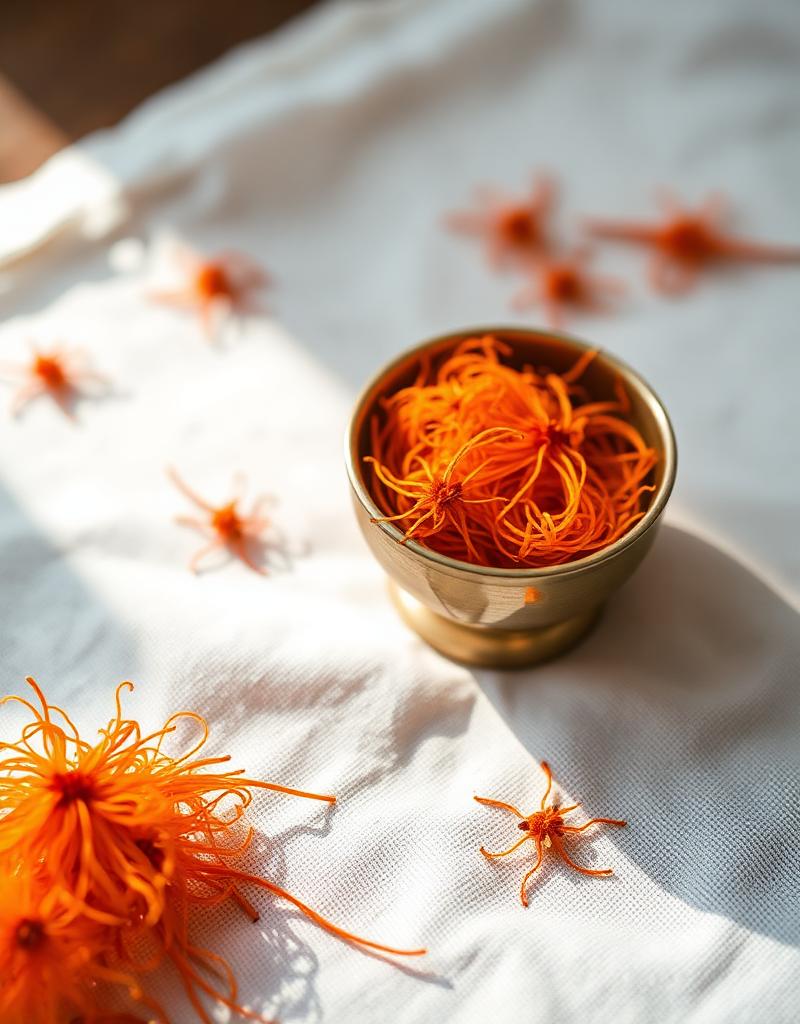
Saffron — The Golden Thread of Persian Medicine
Three crimson threads, hand-picked from a single autumn flower. For three thousand years, saffron has been Persia's most beloved medicine — and modern trials now place it alongside some of the best-studied natural compounds for mood, memory, and gentle metabolic support.
- English
- Saffron
- Family
- Iridaceae
- Also known as
- Zaʿfarān, Kesar, Red gold
What this may support
Early evidence for memory and thinking in age-related decline.
Here's what the research actually shows: in a handful of small human trials lasting about 6–8 weeks — and in reviews that pool those same trials — about 30 mg a day of saffron extract eased mild-to-moderate low mood about as well as the two medicines it was compared with, fluoxetine and imipramine. Those trials were small and short, so this is early evidence about those two comparisons only, not about antidepressants in general. Do not stop or change an antidepressant without talking to your doctor.
Smaller studies hint at help with PMS and anxiety, and small shifts in blood-sugar measures — fasting glucose, and HbA1c, the blood test that shows your average blood sugar over about three months. Do not change diabetes medicine on the strength of this.
Gentle mood support — especially for mild low mood and the irritability that can ride along with PMS.
Antioxidant and anti-inflammatory action across many tissues at once.
Patterns described in research and tradition — not a treatment claim.
A little background
- People have grown saffron in Khorasan, in northeastern Iran, since at least the Bronze Age — you can see its harvest painted on the walls of Susa and Persepolis.
- Back in 1025 CE, Avicenna wrote in the Canon of Medicine that saffron warms the body, brightens the spirit, and strengthens the heart.
- Today Iran still grows more than 90% of the world's saffron, much of it in villages where the harvest is a quiet, family-wide ritual that begins at dawn.
What tradition has long understood
- Persian medicine called saffron mufarriḥ — a heart-gladdening substance — and reached for it in small amounts for low mood, weak appetite, and the heaviness that follows grief.
- The everyday way to take it was a few threads in warm milk or rice — rarely more than a pinch, and always alongside something warm and fatty to help absorption.
What the research now shows
- Here's what the research actually shows: in a handful of small human trials lasting about 6–8 weeks — and in reviews that pool those same trials — about 30 mg a day of saffron extract eased mild-to-moderate low mood about as well as the two medicines it was compared with, fluoxetine and imipramine. Those trials were small and short, so this is early evidence about those two comparisons only, not about antidepressants in general. Do not stop or change an antidepressant without talking to your doctor.
- In human trials in early Alzheimer's disease, 30 mg a day of saffron scored about the same as the medicine donepezil on memory and thinking tests after 22 weeks — though these were small trials.
- Smaller studies hint at help with PMS and anxiety, and small shifts in blood-sugar measures — fasting glucose, and HbA1c, the blood test that shows your average blood sugar over about three months. Do not change diabetes medicine on the strength of this.
Evidence-based benefits
- Gentle mood support — especially for mild low mood and the irritability that can ride along with PMS.
- Early evidence for memory and thinking in age-related decline.
- Antioxidant and anti-inflammatory action across many tissues at once.
- Small but steady improvements in blood-sugar markers in metabolic syndrome trials.
The active compounds inside
- Crocin and crocetin — the red colour pigments (chemists call them carotenoids). Most of saffron's studied effect on mood is credited to them.
- Safranal — the scent compound. In laboratory studies it interacts with some of the same brain signalling systems that calming medicines act on (the GABA system). Researchers are still working out what these laboratory findings mean for how people actually feel.
- Picrocrocin — gives saffron its bitter, complex flavor.
What to actually do this week
- A pinch (10–15 threads) in warm milk before bed — a Persian sleep ritual that goes back centuries.
- Steep 6–8 threads in two tablespoons of warm water for ten minutes, then stir into rice, stew, or tea.
- For mood support, the dose used in trials is a supplemented extract at 28–30 mg/day — worth discussing with a clinician before you start.
Preparation methods
- Bloom the threads: grind a pinch with a few grains of sugar, then steep in 2 tbsp warm (not boiling) water for 10 minutes before using.
- Persian tea: 6–8 threads in a small pot with cardamom and rose petals; brew gently.
- Warm saffron milk: 10 threads, 1 cup warm whole milk, a sliver of honey — a centuries-old evening calmer.
Typical culinary use
- Saffron rice (chelow zaʿferānī), the foundation of the Persian table.
- Stews like khoresh-e fesenjān and tah-chin.
- Saffron ice cream (bastani) and rice pudding (shole zard).
Best food combinations
- Saffron + warm milk and a touch of fat — improves absorption of the carotenoids.
- Saffron + rose water — the classic Persian flavor pairing.
- Saffron + cardamom — gentle digestive support, warming, calming.
Foods that quietly help
- Whole milk or yogurt
- Saffron rice with olive oil
- Walnuts
- Pomegranate molasses
Gentle cautions
- Culinary amounts (under 1.5 g/day) are well within safe limits for nearly everyone.
- Supplement doses above 5 g/day can cause nausea, vomiting, and bleeding — far above any sensible use.
- Buy whole threads, not powder, from a reputable source — saffron is among the most adulterated spices in the world.
Medication interactions to know
- May potentiate antidepressants (SSRIs) — combine only with clinician oversight.
- Mild blood-thinning effect at high doses — caution with anticoagulants and before surgery.
- May lower blood sugar — monitor if on glucose-lowering medication.
Pregnancy & breastfeeding
- Culinary amounts are considered safe.
- Avoid medicinal/supplement doses during pregnancy — historically associated with uterine stimulation at high doses.
A few honest answers
How much saffron is enough?
A pinch really is medicine. Most traditional uses fit inside a quarter of a gram per day, and the trial doses for mood were 28–30 mg of standardized extract.
Is saffron safe daily?
In culinary amounts, yes — Persian households have used it that way for centuries. Supplement-level doses are a separate question: treat them like a gentle medication and talk through long-term use with a clinician.
How do I tell real saffron from fake?
Real threads are crimson with a slight orange tip, brittle when dry, and turn water yellow-gold (not red) slowly over several minutes. If the water flashes red right away, that's dye.
Real questions, honest answers
Can I take saffron every day?
How long until I notice anything for my mood?
Why is real saffron so expensive?
Saffron tea or saffron milk — which is better?
In plain language
A few ideas worth understanding clearly. Tap to read each one explained as Hakim would — quietly, without jargon.
Crocin and crocetin
Explain this simply. The deep red color of saffron — and most of what makes it actually work.
Why it matters. These two carotenoids cross into the brain, where they seem to gently support the pathways behind mood and memory.
Mufarriḥ
Explain this simply. The classical Persian word for substances that 'gladden the heart' — lift mood, ease grief.
Why it matters. Saffron sat at the very top of that list for a thousand years before anyone ran a clinical trial.
Practical scenarios — where to begin
Low mood without clear cause, sleep is okay, work is heavy.
- Try saffron extract at 28–30 mg daily for 8 weeks.
- Pair it with walking and morning sunlight.
- If you're not feeling lighter at 8 weeks, see your clinician — saffron is a gentle adjunct, not a treatment for clinical depression.
Two weeks a month of irritability and weeping, normal cycles otherwise.
- Saffron 30 mg daily through the luteal phase.
- Track your symptoms for 2 full cycles.
- Add magnesium and walking — saffron does more on top of a steady baseline.
A small, golden thread woven through ordinary meals
Not a prescription — a quiet example of how the foundations can fit an ordinary week. Adapt freely.
| Day | Morning | Afternoon | Evening |
|---|---|---|---|
| Mon–Sun | Optional saffron tea | Saffron in cooking (rice, stew) | Saffron milk + early sleep |
Where to wander next
These are the next quiet places to explore — each chosen because it deepens what you just read, not because it is merely related.
Why this. Saffron milk is the heart of a fuller evening ritual.
ContinueWhy this. Where saffron fits into a long view of cognition.
ContinueWhy this. The natural partner — both are studied for mood and brain support.
ContinueConnects to Brain · Stress · Nutrition.
Feeds: Evening saffron milk · Saffron tea.
Shapes: Mood · Brain · Nutrition.
"Three threads, given attention, become medicine. So does a single small habit, kept for years."
Tonight, warm a small cup of milk, drop in a pinch of saffron and a sliver of honey, and drink it slowly without your phone.
"Help me build a daily saffron ritual that fits my life."
Ask Hakim, Your Personal AIWhere this comes from
- Lopresti AL, Drummond PD. Hum Psychopharmacol 2014 — saffron for depression: meta-analysis.
- Akhondzadeh S et al., J Clin Pharm Ther 2010 — saffron vs donepezil in Alzheimer's.
Questions worth asking
Tonight, warm a small cup of milk, drop in a pinch of saffron and a sliver of honey, and drink it slowly without your phone.
Hakim's Thoughts on Saffron — The Golden Thread of Persian Medicine
"Saffron is a quiet reminder that small things, repeated with care, become large. Three threads — gathered by hand at dawn, steeped in warm water, slipped into rice or milk — carry centuries of attention. Wellness is often shaped the same way: not by grand decisions, but by small, beautiful ones, kept faithfully."
— Hakim
One thoughtful next step
If this resonated, pomegranate — the ruby fruit at the heart of persian winter is a gentle next step. A natural next read is "Pomegranate — The Ruby Fruit at the Heart of Persian Winter" — it carries the same thread from a different angle. Take what feels right; leave the rest for another season.
Pomegranate — The Ruby Fruit at the Heart of Persian Winter Ask Hakim, Your Personal AIYou may also enjoy…
Few fruits carry more story than the pomegranate. At Yalda — the longest Persian night — families gather around a table crowned with anār…
ContinueA deep-ruby, tart tea poured hot in Persian winters and iced through Egyptian summers — and one of the few herbal teas with serious, repe…
ContinueChelo is the canvas of Persian dinner — fluffy, fragrant, crowned with saffron and a golden crust (tahdig).
ContinueSumac is the bright, tart crimson dust that crowns kebab and rice — and quietly, a polyphenol powerhouse.
ContinueContinue the thread with Hakim in a calm daily ritual.
Continue