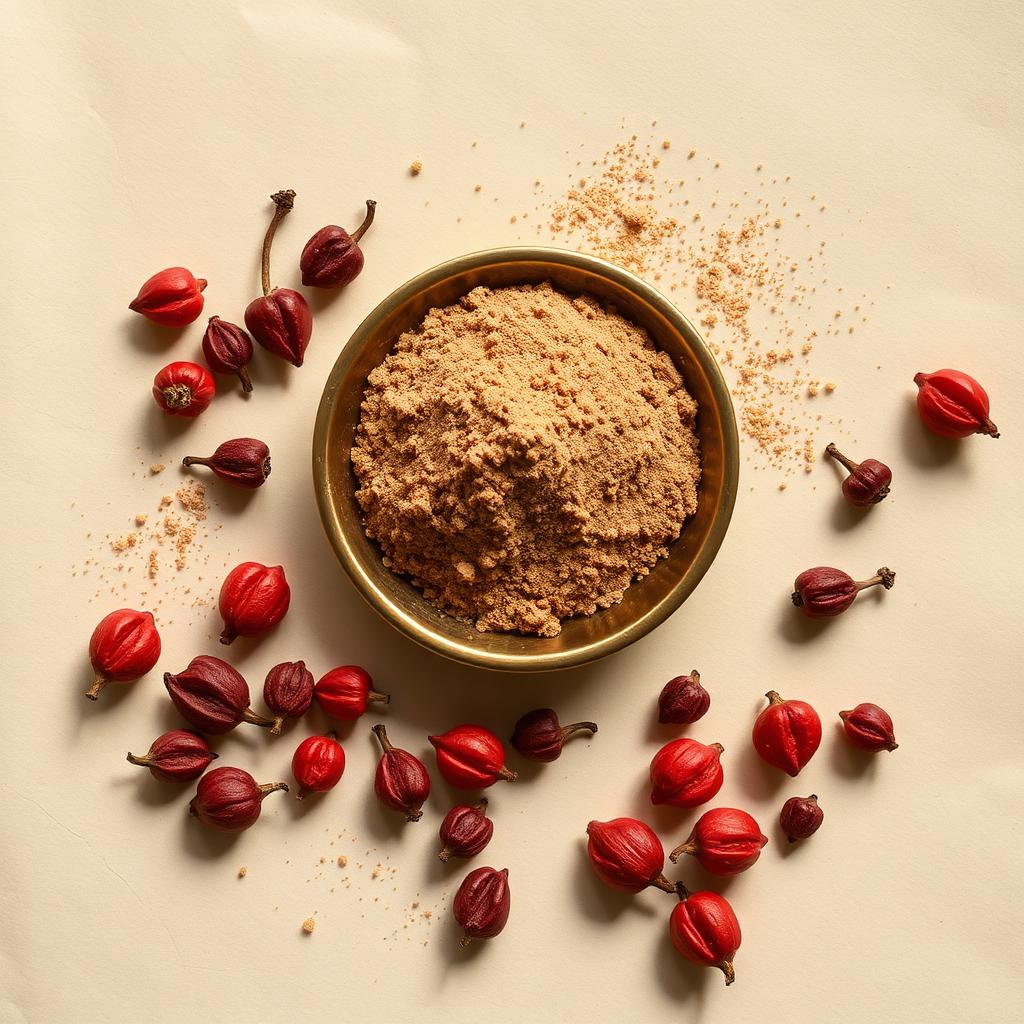
Sumac — The Crimson Spice of Blood Sugar and Heart
A bright, sour crimson powder shaken over kebab and salads from Tehran to Beirut to Istanbul. Long before its taste was studied, it was used as a household sour — and modern trials now connect it to lower blood sugar and better cholesterol.
- English
- Sumac
- Family
- Anacardiaceae
- Also known as
- Somagh, Sicilian sumac
What this may support
May reduce LDL cholesterol modestly.
Supports blood sugar control as part of a daily diet.
Patterns described in research and tradition — not a treatment claim.
A little background
- Used across Persia, the Levant, and Anatolia for at least two thousand years as a sour seasoning before lemons reached the region.
- A small bowl of sumac sits on every Persian kebab table — the partner to grilled meat and rice.
- Greco-Islamic physicians prescribed it for excess heat, weak digestion, and what they called 'thick blood'.
What tradition has long understood
- Considered cold and dry — a cleanser of fat-heavy meals, a settler of inflamed digestion.
- Mixed into yogurt, brushed onto kebab, sprinkled on rice and salads.
- Brewed as a tart cold drink in summer, sometimes with mint.
What the research now shows
- In a small human trial in type 2 diabetes, 3 g of sumac powder a day for three months lowered fasting blood sugar, LDL cholesterol, and HbA1c — a blood test showing average blood sugar over about three months. This is one small trial. Do not change diabetes medicine on the strength of it.
- Rich in the red colour pigments (anthocyanins) and other plant compounds. These score well in laboratory antioxidant tests. A laboratory antioxidant score is not the same as a proven health benefit in people.
- Small human trials suggest a modest drop in blood pressure with daily use.
- The sour taste itself slows gastric emptying, blunting post-meal glucose spikes.
Evidence-based benefits
- Supports blood sugar control as part of a daily diet.
- May reduce LDL cholesterol modestly.
- High antioxidant capacity per teaspoon.
- Brings sourness without the acid burden of vinegar or excess lemon for those who can't tolerate them.
The active compounds inside
- Anthocyanins — the red colour pigments. They are antioxidants, which means they help protect cells from everyday wear.
- Gallic acid and tannins — the plant compounds behind sumac's mouth-drying tang; they help calm irritation.
- Organic acids (malic, citric, tartaric) — the source of the natural sourness.
What to actually do this week
- Shake over kebab, grilled chicken, fish, eggs, and roasted vegetables — daily.
- Mix 1 tsp into Greek yogurt with olive oil and za'atar as a dip.
- Add to salad dressings instead of (or with) lemon juice.
- Stir 1 tsp into warm water with honey for a tart morning drink.
Preparation methods
- Buy whole-berry or coarse-ground sumac when possible — flavor fades fast once finely powdered.
- Store in a cool, dark jar; replace yearly.
- Check the label — some commercial sumac is cut with salt; pure sumac should be deeply red and tart, not salty.
Typical culinary use
- Persian kebab, chelo kabab, fattoush salad, za'atar blends, musakhan chicken.
- Sprinkled over hummus, labneh, roasted cauliflower.
- Replaces lemon in fish marinades.
Best food combinations
- Sumac + olive oil + onion — Persian kebab foundation.
- Sumac + thyme + sesame — za'atar.
- Sumac + yogurt + cucumber — Levantine dip.
Foods that quietly help
- Yogurt
- Olive oil
- Onion
- Whole grains
Gentle cautions
- Culinary use is safe for nearly everyone.
- True culinary sumac (Rhus coriaria) is unrelated to poison sumac (Toxicodendron vernix) — confusion is a common worry but not a real risk in spice form.
- Concentrated supplements: not enough safety data to recommend over food use.
Medication interactions to know
- May potentiate blood-sugar-lowering medications — monitor if diabetic.
- May modestly lower blood pressure — relevant if on antihypertensives.
Pregnancy & breastfeeding
- Culinary use is considered safe.
- Avoid concentrated supplements during pregnancy and breastfeeding.
A few honest answers
Is sumac actually good for diabetes?
Small but consistent trials show 3 g daily for 3 months meaningfully lowers HbA1c. It is not a replacement for medication — it's a worthwhile daily food habit.
What does it taste like?
Tart, fruity, slightly astringent — like lemon dust crossed with cranberry. Less aggressive than vinegar.
Is the sumac in my spice rack the poisonous kind?
No. Culinary sumac is a completely different plant. The bright red, dry powder sold as a spice is safe and edible.
Real questions, honest answers
How much do I need for the diabetes benefit?
Can I make my own from a tree?
Will it stain my food red?
In plain language
A few ideas worth understanding clearly. Tap to read each one explained as Hakim would — quietly, without jargon.
HbA1c
Explain this simply. A blood test that averages your blood sugar over the past three months.
Why it matters. Trials of sumac measured improvements here — meaning the effect held across whole months, not just one meal.
ORAC value
Explain this simply. A laboratory measure of how much antioxidant activity a food shows in a test tube.
Why it matters. Sumac scores high on this laboratory test. The test is done in a dish, not in a person, so a high score is not proof of a health benefit.
Practical scenarios — where to begin
Pre-diabetes range, no medication yet, doctor said 'lifestyle'.
- 1 teaspoon sumac daily across meals.
- Walk 10–20 minutes after lunch and dinner.
- Pair with the Mediterranean–Persian plate; recheck in 12 weeks.
On a blood-pressure-friendly diet, food tastes flat.
- Use sumac generously on eggs, vegetables, fish.
- Combine with herbs and olive oil instead of salt.
- Add lemon zest for brightness.
LDL slightly elevated, not yet on statins.
- Daily sumac on protein and salads.
- Add walnuts, olive oil, and oats to the broader plate.
- Recheck lipids in 12 weeks.
A week that quietly carries a teaspoon of sumac across ordinary meals
Not a prescription — a quiet example of how the foundations can fit an ordinary week. Adapt freely.
| Day | Morning | Afternoon | Evening |
|---|---|---|---|
| Mon | Eggs + sumac | Fattoush salad | Walk after dinner |
| Tue | Yogurt + sumac + olive oil | Lentil soup | Family dinner |
| Wed | Toast + tomato + sumac | Roast chicken with sumac | Tea & reading |
| Thu | Oats + walnuts | Hummus + za'atar + sumac | Light stretch |
| Fri | Eggs + herbs | Salad + grilled fish + sumac | Slow meal |
| Sat | Long walk | Persian kebab + sumac onions | Tea |
| Sun | Slow breakfast | Vegetable bake + sumac | Plan the week |
Where to wander next
These are the next quiet places to explore — each chosen because it deepens what you just read, not because it is merely related.
Why this. Sumac is one tool inside a fuller blood-sugar-friendly plate.
ContinueWhy this. The two most reliable post-meal glucose tools used together.
ContinueWhy this. Sumac's natural partner in Persian and Levantine cooking.
ContinueConnects to Nutrition · Heart.
Feeds: Sumac-on-everything habit · Post-meal walk.
Shapes: Blood sugar · Heart.
"Sometimes the most powerful health choices are the ones that look like seasoning."
Tomorrow morning, sprinkle a teaspoon of sumac over your eggs or yogurt — and notice how easily it slips into the rest of the week.
"Help me use sumac across my week in ways that support my heart and blood sugar."
Ask Hakim, Your Personal AIWhere this comes from
- Shidfar F et al., Int J Endocrinol Metab 2014 — sumac and HbA1c in type 2 diabetes.
- Rayne S, Mazza G., Plant Foods Hum Nutr 2007 — phytochemistry of sumac.
Questions worth asking
Tomorrow morning, sprinkle a teaspoon of sumac over your eggs or yogurt — and notice how easily it slips into the rest of the week.
Hakim's Thoughts on Sumac — The Crimson Spice of Blood Sugar and Heart
"Sumac is the small red habit at the corner of the Persian table. A teaspoon a day, sprinkled almost by accident, can quietly shape blood sugar and cholesterol for a whole season."
— Hakim
One thoughtful next step
If this resonated, you may also enjoy exploring movement. A natural next read is "Pomegranate — The Ruby Fruit at the Heart of Persian Winter" — it carries the same thread from a different angle. Take what feels right; leave the rest for another season.
Pomegranate — The Ruby Fruit at the Heart of Persian Winter Ask Hakim, Your Personal AIYou may also enjoy…
Few fruits carry more story than the pomegranate. At Yalda — the longest Persian night — families gather around a table crowned with anār…
ContinueA deep-ruby, tart tea poured hot in Persian winters and iced through Egyptian summers — and one of the few herbal teas with serious, repe…
ContinueIf walking were a pill, every clinician in the world would prescribe it. It lowers blood pressure, steadies blood sugar, lifts mood, prot…
ContinueThree crimson threads, hand-picked from a single autumn flower. For three thousand years, saffron has been Persia's most beloved medicine…
ContinueContinue the thread with Hakim in a calm daily ritual.
Continue