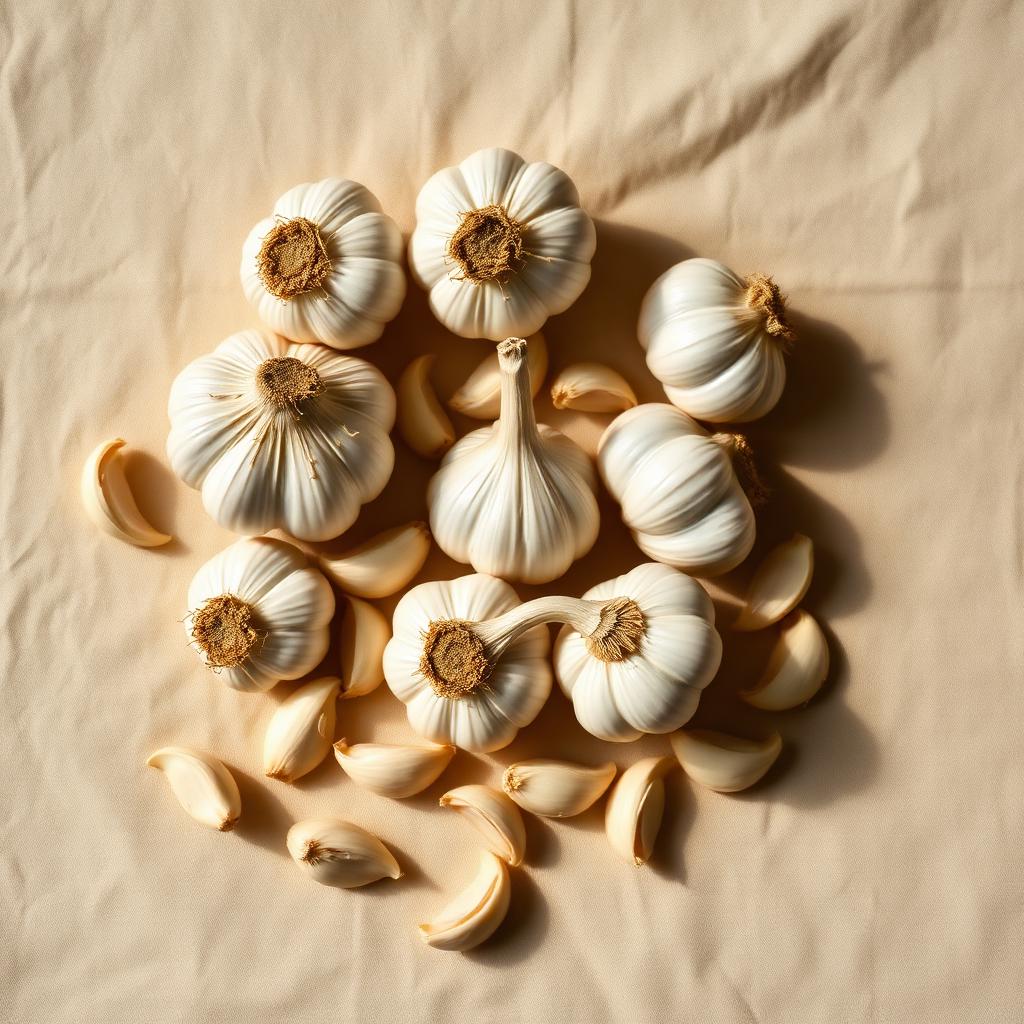
Garlic — The Pharmacy of the Persian Pantry
The clove found in every great kitchen on earth — and one of the most consistently evidenced foods for blood pressure, cholesterol, immune resilience, and the long arc of cardiovascular health.
- English
- Garlic
- Family
- Amaryllidaceae
- Also known as
- Sir, Lasun, Ail
What this may support
Brings systolic blood pressure down meaningfully with consistent daily use.
Steadies immune resilience through cold and flu season.
Patterns described in research and tradition — not a treatment claim.
A little background
- Cultivated for over 7,000 years; given to the builders of the Egyptian pyramids for stamina.
- Avicenna devoted long sections of the Canon to garlic — for the chest, the joints, and the cold winter constitution.
- Persian torshi-e sir (aged garlic pickle) is treasured as both food and medicine; older jars (10–20+ years) command premium prices.
What tradition has long understood
- Hot and drying — opening to the chest, warming to a cold constitution, protective in winter and travel.
- Used raw with bread and cheese, cooked into stews, and aged into vinegar pickles.
- Considered as much medicine as flavor in every traditional Persian household.
What the research now shows
- Meta-analyses of aged garlic and standardized garlic powder show systolic blood pressure coming down 5–10 mmHg in adults with hypertension.
- People who eat garlic daily tend to show modestly lower LDL cholesterol and more flexible, supple arteries.
- In aged garlic extract trials, coronary artery calcification progressed more slowly over 12 months.
- Garlic's compounds (allicin, ajoene) show antimicrobial, antiviral, and antifungal activity in the lab and in some clinical settings.
- Long-term studies link a daily allium habit to lower colorectal and gastric cancer risk.
Evidence-based benefits
- Brings systolic blood pressure down meaningfully with consistent daily use.
- Nudges cholesterol and arterial flexibility in the right direction.
- Steadies immune resilience through cold and flu season.
- Lifts almost every cooked dish with depth and warmth.
The active compounds inside
- Allicin — the sulfur compound released when raw garlic is crushed; the source of most acute activity.
- Ajoene, S-allyl cysteine — formed during aging and cooking; antioxidant and cardioprotective.
- Selenium and germanium — trace minerals concentrated in good garlic.
What to actually do this week
- 1–2 cloves daily, crushed and rested 10 minutes before cooking — allicin needs time to form.
- Raw garlic in salad dressings, yogurt sauces, and Persian borani.
- A pickled clove of torshi-e sir with rich or fatty meals.
- Roasted whole heads — sweet, mellow, spreadable on bread.
Preparation methods
- Crush or finely chop, then let stand 10 minutes — this is when allicin forms.
- Add at the end of cooking when possible — high heat destroys allicin but cooked garlic still provides ajoene and flavor.
- For raw use, mince fine and mix into yogurt or oil to soften the bite.
Typical culinary use
- Persian borani-e bademjan, mast-o-musir, torshi-e sir.
- Mediterranean tomato sauces, hummus, tzatziki, aioli.
- Roast lamb, chicken, vegetables, soups.
Best food combinations
- Garlic + olive oil + lemon — Mediterranean foundation.
- Garlic + yogurt + cucumber + mint — Persian summer plate.
- Garlic + ginger + turmeric — winter warming trio.
Foods that quietly help
- Olive oil
- Yogurt
- Lemon
- Onion
- Ginger
Gentle cautions
- Very well tolerated as a daily food.
- Raw garlic on an empty stomach can cause heartburn — pair with food.
- May cause body odor or garlic breath — chew parsley or fennel seed after.
Medication interactions to know
- Anticoagulants (warfarin, aspirin, clopidogrel) — high-dose supplements can add to bleeding risk; food amounts are fine.
- HIV protease inhibitors (saquinavir) — garlic supplements can lower drug levels; coordinate with your physician.
- Stop high-dose supplements 1–2 weeks before surgery.
Pregnancy & breastfeeding
- Culinary amounts are considered safe and traditionally encouraged.
- Avoid high-dose supplements without clinician guidance.
A few honest answers
Raw or cooked — which is better?
Both. Raw provides allicin (acute antimicrobial and vascular effects). Cooked provides ajoene and S-allyl cysteine (long-term cardiovascular effects). Eat both across the week.
Are garlic supplements as good as eating it?
Standardized aged garlic extract has the strongest trial evidence for blood pressure and arterial calcification. For most people, 1–2 daily cloves plus a kitchen full of garlic is plenty. Supplements have a place when food intake is hard.
What about garlic breath?
A real trade-off. Chew fresh parsley or fennel seeds after, drink water, and accept that this is the smell of a long life.
Real questions, honest answers
I take a daily aspirin — can I still eat garlic?
Does the pre-chopped jar garlic count?
How much is too much?
In plain language
A few ideas worth understanding clearly. Tap to read each one explained as Hakim would — quietly, without jargon.
Allicin
Explain this simply. The sharp-smelling sulfur compound that forms when raw garlic is crushed.
Why it matters. It is the molecule behind most of garlic's acute antimicrobial and vascular activity — and why crushed-and-rested is better than chopped-and-rushed.
Aged garlic extract
Explain this simply. Garlic that has been slowly fermented over months, losing the sharp smell and gaining stable cardiovascular compounds.
Why it matters. It is the form with the strongest blood-pressure and coronary-calcium trial evidence.
Practical scenarios — where to begin
Doctor said 'lifestyle first'.
- 1–2 cloves crushed daily into food.
- Pair with hibiscus, walking, and salt-mindfulness.
- Recheck in 8–12 weeks.
Run-down, low resilience in winter.
- Raw garlic in salad dressings 4–5x a week through winter.
- Pair with sleep, sunshine, and ginger tea.
- Notice across one cold season.
Plant-forward, heart-protective goal.
- Garlic + olive oil + greens as a weekly cooking pattern.
- Add lentils and barley.
- Read the Mediterranean–Persian Plate.
A week where a clove of garlic touches almost every meal
Not a prescription — a quiet example of how the foundations can fit an ordinary week. Adapt freely.
| Day | Morning | Afternoon | Evening |
|---|---|---|---|
| Mon | Yogurt + walnut | Salad w/ garlic dressing | Stew with garlic |
| Tue | Eggs + sabzi | Lentil soup w/ garlic | Mast-o-musir side |
| Wed | Toast + olive oil + garlic rub | Soup-and-bread | Roast vegetables w/ garlic |
| Thu | Yogurt + cucumber + garlic | Salad + sumac | Walk after dinner |
| Fri | Sabzi plate | Fish + greens + garlic | Borani-e bademjan |
Where to wander next
These are the next quiet places to explore — each chosen because it deepens what you just read, not because it is merely related.
Why this. Garlic and olive oil together are the foundation of nearly every Mediterranean and Persian cardioprotective meal.
ContinueWhy this. Where the daily clove sits inside a fuller heart-protective rhythm.
ContinueWhy this. Garlic and hibiscus together are one of the most evidence-based food-and-tea blood-pressure pairs.
ContinueConnects to Nutrition · Heart · Immune.
Feeds: Crushed clove in cooking · Weekly pickle.
Shapes: Blood pressure · Cholesterol · Immune.
"Some foods you eat for joy. Some you eat for nourishment. A few — garlic among them — you eat for the long quiet protection of the heart."
Tomorrow, crush one clove of garlic, let it rest 10 minutes, and stir it into a yogurt or olive-oil sauce before serving.
"Help me use garlic more deliberately in my everyday cooking."
Ask Hakim, Your Personal AIWhere this comes from
- Ried K et al., J Nutr 2016 — aged garlic extract and blood pressure, meta-analysis.
- Matsumoto S et al., J Nutr 2016 — aged garlic extract and coronary artery calcification, RCT.
Questions worth asking
Tomorrow, crush one clove of garlic, let it rest 10 minutes, and stir it into a yogurt or olive-oil sauce before serving.
Hakim's Thoughts on Garlic — The Pharmacy of the Persian Pantry
"Garlic is one of those foods that crosses every long-lived culture without exception. The body recognizes it as old, useful, and trustworthy."
— Hakim
One thoughtful next step
If this resonated, pomegranate — the ruby fruit at the heart of persian winter is a gentle next step. A natural next read is "Pomegranate — The Ruby Fruit at the Heart of Persian Winter" — it carries the same thread from a different angle. Take what feels right; leave the rest for another season.
Pomegranate — The Ruby Fruit at the Heart of Persian Winter Ask Hakim, Your Personal AIYou may also enjoy…
Few fruits carry more story than the pomegranate. At Yalda — the longest Persian night — families gather around a table crowned with anār…
ContinueThe single dietary pattern most consistently associated with a longer, sharper life — and one of the few foods both Persian and Mediterra…
ContinueThe red fruit treated as a vegetable that joined Persian cooking only 400 years ago and now defines half its sauces, stews, and salads — …
ContinueThe deep red root with strong modern evidence for lowering blood pressure and improving exercise stamina through dietary nitrates — and a…
ContinueContinue the thread with Hakim in a calm daily ritual.
Continue