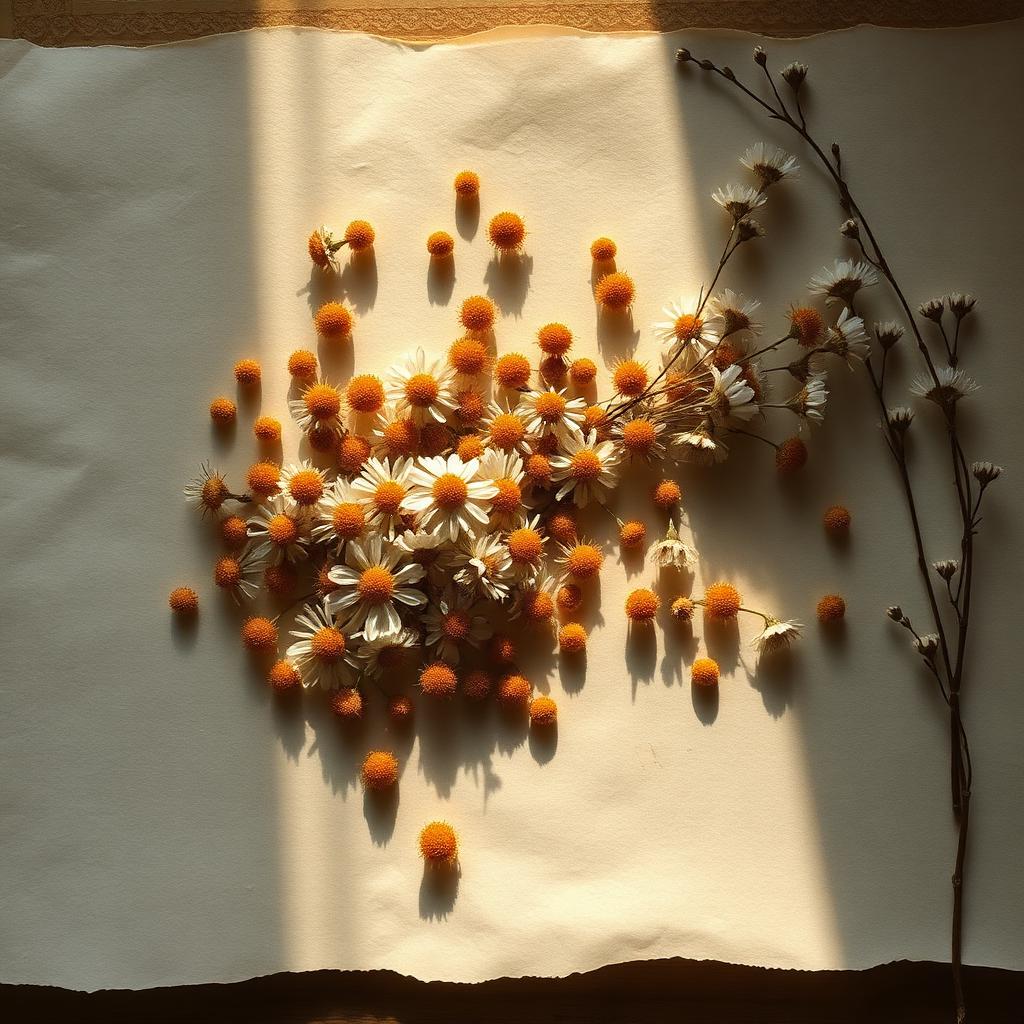
Chamomile — The Evening Cup
Small white-and-yellow flowers that almost every traditional culture independently figured out to brew in the evening. The result is one of the most studied calming teas in the world — gentle enough for children, useful enough for adults who simply cannot land at the end of the day.
- English
- Chamomile
- Family
- Asteraceae
- Also known as
- Bābūne, German chamomile
What this may support
Apigenin — the main plant pigment compound in chamomile. In laboratory studies it attaches weakly to some of the same brain signalling sites that calming medicines act on. Researchers are still working out what these laboratory findings mean for how people actually feel.
Soothes a tight or irritated stomach.
Helps you fall asleep faster and sleep a little better — modestly, but measurably.
Takes the edge off mild evening anxiety and the thoughts that won't stop circling.
Applied to the skin, chamomile is well studied for mild skin inflammation and atopic dermatitis.
Calms minor skin redness when applied to the skin.
Patterns described in research and tradition — not a treatment claim.
A little background
- People have brewed it since Pharaonic Egypt; Galen and Avicenna both recommended it for restless sleep and uneasy stomachs.
- Persian apothecaries — the ʿaṭṭāri — kept bābūne as a household staple: for tea, for compresses, even for inflamed eyes.
- Monastery gardens carried it through medieval Europe, where it became everyone's universal nighttime cup.
What tradition has long understood
- Read as cool and slightly dry — the cup that calms a heated, restless mind and an irritated stomach.
- A warm compress of it for tired eyes and minor skin inflammation.
- A nighttime cup, often shared between a mother and child before sleep.
What the research now shows
- In human trials where people were assigned by chance to chamomile extract (about 270 mg twice daily) or a dummy pill, the chamomile group reported a small but real drop in anxiety over 8 weeks.
- Smaller sleep trials show better sleep quality and less time lying awake before sleep arrives — most clearly in older adults.
- Apigenin — the main plant pigment compound in chamomile. In laboratory studies it attaches weakly to some of the same brain signalling sites that calming medicines act on. Researchers are still working out what these laboratory findings mean for how people actually feel.
- Applied to the skin, chamomile is well studied for mild skin inflammation and atopic dermatitis.
Evidence-based benefits
- Takes the edge off mild evening anxiety and the thoughts that won't stop circling.
- Helps you fall asleep faster and sleep a little better — modestly, but measurably.
- Soothes a tight or irritated stomach.
- Calms minor skin redness when applied to the skin.
The active compounds inside
- Apigenin — a pale plant pigment compound (a flavonoid) that attaches weakly, in laboratory tests, to some of the brain signalling sites calming medicines act on.
- Bisabolol and chamazulene — the scent oils; they help calm irritated tissue.
- Matricin — the precursor to chamazulene, formed during steaming.
What to actually do this week
- The evening cup, 30–60 minutes before bed, brewed properly strong — 2 teaspoons of flowers in a covered mug for 10 minutes.
- A cool compress of steeped chamomile for tired eyes after a screen-heavy day.
- A standardized chamomile extract if you want the anxiety effects seen in studies.
Preparation methods
- Always cover the mug while steeping — the calming oils escape with the steam.
- 10 minutes minimum; weak chamomile is just warm water.
- Pair with honey, not sugar; pair with whole milk if you find tea cold.
Typical culinary use
- Tea, occasionally syrup for cordials, sometimes ice cream.
- Folded into honey for sore throats.
Best food combinations
- Chamomile + lavender — a sleep-friendly evening pair.
- Chamomile + lemon balm — gentle anxiety blend.
- Chamomile + honey + warm milk — a Persian household sleep ritual.
Foods that quietly help
- Honey
- Warm milk
- Lemon balm
- Lavender
Gentle cautions
- Very well tolerated by most people, including children.
- True allergic reactions are rare but possible — especially in those allergic to ragweed, daisies, or marigolds.
Medication interactions to know
- Mild interaction with warfarin at high or supplement doses — culinary tea is fine for almost everyone.
- May potentiate sedatives — usually a feature, occasionally a caution.
Pregnancy & breastfeeding
- Occasional cups are widely considered safe.
- Avoid concentrated supplement doses during pregnancy without clinician guidance.
A few honest answers
Will it actually put me to sleep?
Not in the way a sleeping pill does. It softens the on-ramp. The cup matters; the ritual around it matters more.
Tea bag or loose flowers?
Whole flowers, covered, ten minutes. Tea bags work but lose more aroma.
Every night, or sometimes?
Every night is fine. Most people who keep the habit notice the cue (warm mug, dim light) is half of the effect.
Real questions, honest answers
Is chamomile safe for kids?
Can I drink it during the day?
Will it interact with my anti-anxiety medication?
In plain language
A few ideas worth understanding clearly. Tap to read each one explained as Hakim would — quietly, without jargon.
Sleep latency
Explain this simply. How long it takes you to fall asleep after the light is off.
Why it matters. Chamomile mostly shortens this — it helps you cross the line, not stay asleep all night.
Anxiolytic
Explain this simply. A substance that quietly takes the edge off anxiety.
Why it matters. Chamomile is at the very gentle end — useful for daily wear, not for clinical panic.
Practical scenarios — where to begin
You're tired, the day is over, but the ceiling won't stop being interesting.
- Brew chamomile 30 minutes before bed, covered mug, 10 minutes.
- Drink it without your phone.
- Add 5 minutes of slow breathing while you sip.
School, screens, late dinner — bedtime turns into an hour-long negotiation.
- Half a cup of warm, weak chamomile with a drop of honey (over 1 year old).
- Lights low, book in hand, no screens.
- Same time every night — the ritual does most of the work.
An evening cup, repeated quietly
Not a prescription — a quiet example of how the foundations can fit an ordinary week. Adapt freely.
| Day | Morning | Afternoon | Evening |
|---|---|---|---|
| Mon–Sun | — | Optional cup if tense | Chamomile + dim lights + book |
Where to wander next
These are the next quiet places to explore — each chosen because it deepens what you just read, not because it is merely related.
Why this. Chamomile is the centerpiece of a fuller evening ritual.
ContinueWhy this. Understand what chamomile is actually helping, and what it isn't.
ContinueWhy this. The natural partner to chamomile in an evening blend.
ContinueConnects to Sleep · Stress.
Feeds: Evening wind-down · Phone-free hour before bed.
Shapes: Sleep · Stress.
"A good evening cup is less about the herb and more about the permission to slow down."
Tonight, brew chamomile in a covered mug for ten minutes and drink it slowly, away from screens, before bed.
"Help me build an evening chamomile ritual that I'll actually keep."
Ask Hakim, Your Personal AIWhere this comes from
- Mao JJ et al., Phytomedicine 2016 — chamomile extract for generalized anxiety.
- Hieu TH et al., Phytotherapy Research 2019 — chamomile and sleep quality meta-analysis.
Questions worth asking
Tonight, brew chamomile in a covered mug for ten minutes and drink it slowly, away from screens, before bed.
Hakim's Thoughts on Chamomile — The Evening Cup
"Chamomile is not a sedative. It is a signal. A warm mug, a covered steep, a few minutes without the phone — these are small permissions you give yourself to let the day end. The flowers are simply the excuse."
— Hakim
One thoughtful next step
If this resonated, you may also enjoy exploring stress and nutrition. A natural next read is "Persian Evening Wind-Down — A Practical Ritual" — it carries the same thread from a different angle. Take what feels right; leave the rest for another season.
Persian Evening Wind-Down — A Practical Ritual Ask Hakim, Your Personal AIYou may also enjoy…
A small, fragrant flower so closely tied to the idea of calm that the word itself has become an adjective for soft, slow evenings. Modern…
ContinueA knotted, pungent root that traditional kitchens turn to for the same things modern trials confirm: nausea, slow digestion, period cramp…
ContinueFew plants are more woven into Persian life than mint. It cools the hand that brushes it, calms the stomach after a heavy meal, and softe…
ContinueA gentle, sweet seed chewed after meals from Tehran to Bombay to Naples. It quiets bloating, softens cramps, and freshens breath — and in…
ContinueContinue the thread with Hakim in a calm daily ritual.
Continue