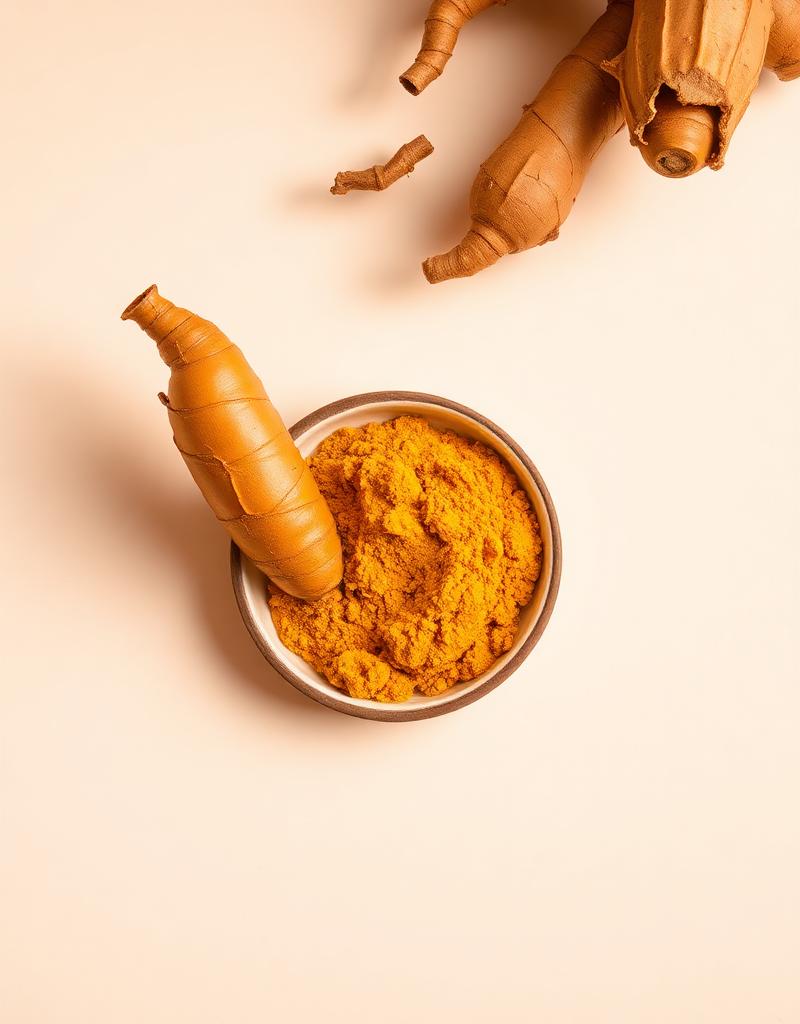
Turmeric — The Golden Root of Quiet Inflammation
A warm, bittersweet root quietly added to lentils, rice, and stews across South and West Asia for three thousand years. Modern science now studies the same root for what traditional kitchens always treated it as — a daily anti-inflammatory food, taken in small amounts, almost every day.
- English
- Turmeric
- Family
- Zingiberaceae
- Also known as
- Zardchūbe, Haldi, Indian saffron
What this may support
Eases stiff, mildly aching joints — when you take it consistently, not occasionally.
When researchers pooled human trials together, they found that 500–1000 mg a day of a standardised curcumin supplement eased knee arthritis pain about as much as common anti-inflammatory painkillers over 8–12 weeks — with less stomach upset along the way.
Quietly lowers the chronic low-grade inflammation that comes with metabolic stress.
Eases stiff, mildly aching joints — when you take it consistently, not occasionally.
Patterns described in research and tradition — not a treatment claim.
A little background
- Turmeric has been quietly colouring Persian pots for thousands of years — the everyday yellow in Khorasanian rice, in Indian dal, in the lentil stews a grandmother stirs without measuring anything.
- Persian and Greco-Islamic physicians called it warming, drying, and clarifying, and reached for it when the liver, the joints, or the skin needed gentle help.
- It travelled the spice routes west and became the soft daily gold of curries, koftas, and morning broths — a kitchen staple long before anyone in a laboratory named curcumin.
What tradition has long understood
- Traditional healers read turmeric as warm and dry — a clearer of dampness, reached for when digestion felt sluggish, joints felt stiff, or a rich meal sat heavily.
- The old pairing survived because it worked: turmeric with black pepper and a little fat — ghee, olive oil. Modern bioavailability studies have since caught up with the kitchen.
- A paste of turmeric and yogurt lived in household cupboards, smoothed onto inflamed skin and minor wounds the way we might reach for a cream today.
What the research now shows
- When researchers pooled human trials together, they found that 500–1000 mg a day of a standardised curcumin supplement eased knee arthritis pain about as much as common anti-inflammatory painkillers over 8–12 weeks — with less stomach upset along the way.
- Human trials also report lower CRP and IL-6 — two blood tests that rise when the body carries long-running inflammation. A better number on a lab report is not, on its own, proof of feeling better.
- Smaller human trials hint at gentle improvements in mood, blood fats, and the soreness that follows exercise.
- Here is the honest catch: on its own, very little curcumin ever reaches your bloodstream. Piperine — the pepper compound in black pepper — raises how much gets in, and fat helps too. But more in the blood is not, by itself, evidence of a health benefit.
Evidence-based benefits
- Eases stiff, mildly aching joints — when you take it consistently, not occasionally.
- Quietly lowers the chronic low-grade inflammation that comes with metabolic stress.
- Supports the liver's natural detoxification pathways.
- Early studies suggest a gentle lift for mood and clear thinking.
The active compounds inside
- Curcuminoids — the yellow pigments of the root. Most of turmeric's studied calming-of-inflammation is credited to them.
- Turmerones — the scent oils. In laboratory tests they slow the growth of some microbes and protect nerve cells in a dish. Laboratory results do not tell us what happens in a person.
What to actually do this week
- A pinch — about ¼ tsp — in lentils, rice, eggs, or roasted vegetables, almost daily. That is the whole habit.
- Golden milk before bed: ½ tsp turmeric, a pinch of black pepper, and a teaspoon of ghee or olive oil stirred into warm milk.
- If you want the anti-inflammatory effects seen in studies, that is supplement territory: a standardized curcumin supplement (500 mg twice daily with food) — and a conversation with your clinician first if you take blood thinners.
Preparation methods
- Bloom it in fat: warm 1 tsp turmeric in olive oil or ghee for 30 seconds before anything else goes in the pan — that is what releases the curcuminoids.
- Always finish with a pinch of black pepper; it is the difference between turmeric that passes through and turmeric that stays.
- It stains everything it touches. Keep a wooden spoon you don't mind seeing turn yellow forever.
Typical culinary use
- Persian lentil rice (adas polo) and yellow rice.
- South Asian dals, curries, and tadka (tempered oil).
- Golden milk, scrambled eggs, roasted cauliflower, bone broth.
Best food combinations
- Turmeric + black pepper + olive oil — the bioavailability triangle.
- Turmeric + ginger — warming, anti-inflammatory, gentle on the gut.
- Turmeric + yogurt — Persian and South Asian everyday pairing.
Foods that quietly help
- Black pepper
- Ginger
- Olive oil or ghee
- Lentils
- Yogurt
Gentle cautions
- Culinary amounts are safe for nearly everyone.
- Supplement doses (>1 g curcumin) can cause mild GI upset; rare reports of liver enzyme elevation — discontinue if upper-right abdominal discomfort develops.
- Buy from a reputable source — turmeric is sometimes adulterated with lead chromate for color.
Medication interactions to know
- Blood thinners (warfarin, aspirin, clopidogrel): may increase bleeding risk at supplement doses.
- Diabetes medications: may potentiate blood-sugar lowering — monitor.
- Stop curcumin supplements 1–2 weeks before surgery.
Pregnancy & breastfeeding
- Culinary amounts are considered safe.
- Avoid concentrated curcumin supplements during pregnancy — uterine effects at high doses are not well studied.
A few honest answers
Do I need a supplement, or is cooking with it enough?
For everyday anti-inflammatory background, cooking with it is enough — that is exactly how three thousand years of kitchens used it. The studied effects on joint pain came from a standardized curcumin supplement, which is a different dose level entirely.
Why black pepper?
Piperine in pepper slows the liver enzyme that clears curcumin almost as soon as it arrives, so more of it reaches your blood. A pinch is all it takes. And remember — more in the blood is not, by itself, proof of benefit.
How long until I notice anything?
For chronic inflammation and stiffness, give it a fair trial: 6–8 weeks of consistent daily use. Turmeric is not the right tool for anything acute.
Real questions, honest answers
Is turmeric safe to take every day?
What's the difference between turmeric powder and curcumin?
Will it stain my teeth?
Can I take it on an empty stomach?
Does it actually help knee pain?
In plain language
A few ideas worth understanding clearly. Tap to read each one explained as Hakim would — quietly, without jargon.
Chronic low-grade inflammation
Explain this simply. A quiet, body-wide irritation that doesn't hurt anywhere in particular but slowly wears tissues down — joints, blood vessels, brain.
Why it matters. It's the soil that the diseases of aging grow in. Lowering it is one of the highest-leverage things an ordinary daily diet can do.
Bioavailability
Explain this simply. How much of what you swallow actually reaches your blood.
Why it matters. Curcumin's is famously low — which is why black pepper and fat matter more than the number on the label.
Standardized extract
Explain this simply. A supplement guaranteed to contain a specific percentage of the active compound.
Why it matters. Plain 'turmeric capsules' vary wildly. For the studied effects, look for '95% curcuminoids' with piperine.
Practical scenarios — where to begin
Morning and post-sitting stiffness, no fevers, no swelling — the everyday wear-and-tear kind.
- Daily ¼ tsp turmeric in cooking with pepper and olive oil.
- Add a standardized curcumin supplement (500 mg twice daily with food) for 8 weeks if the cooking habit isn't enough.
- Pair with daily walking — turmeric helps less if you sit all day.
CRP, ferritin, or ESR slightly elevated; no clear diagnosis; doctor said 'lifestyle'.
- Build daily turmeric into one warm meal — soups, lentils, eggs.
- Add a Mediterranean–Persian plate (olive oil, fish, vegetables, herbs) around it.
- Recheck markers in 12 weeks alongside walking and sleep changes.
DOMS that doesn't clear in 48 hours, slowing the next session.
- Golden milk the evening of harder workouts.
- Turmeric + ginger tea the morning after.
- Sleep first — turmeric helps recovery, but only on top of rest.
A week that quietly carries turmeric across ordinary meals
Not a prescription — a quiet example of how the foundations can fit an ordinary week. Adapt freely.
| Day | Morning | Afternoon | Evening |
|---|---|---|---|
| Mon | Eggs scrambled with turmeric & pepper | Lentil soup with a pinch of turmeric | Walking after dinner |
| Tue | Oats with cinnamon | Roasted cauliflower with turmeric & olive oil | Golden milk before bed |
| Wed | Yogurt with walnuts | Yellow rice & vegetables | Light stretching |
| Thu | Turmeric-ginger tea | Salad + olive oil | Family dinner, no phones |
| Fri | Eggs & herbs | Chickpea stew with turmeric | Tea & early sleep |
| Sat | Walk + sunlight | Adas polo (Persian lentil rice) | Golden milk |
| Sun | Slow breakfast | Soup-and-bread lunch | Plan the week, sleep early |
Where to wander next
These are the next quiet places to explore — each chosen because it deepens what you just read, not because it is merely related.
Why this. The two are studied together for joint and gut support, and they cook together beautifully.
ContinueWhy this. Turmeric works best inside an anti-inflammatory plate, not on top of a pro-inflammatory one.
ContinueWhy this. Curcumin needs fat to be absorbed — olive oil is the most studied partner.
ContinueConnects to Nutrition · Heart · Brain.
Feeds: Evening golden milk · Warm cooked breakfast.
Shapes: Nutrition · Inflammation.
"The strongest medicines are sometimes the ones you forget you're taking, because they live inside the food you already love."
Tonight, warm a teaspoon of olive oil in a small pan, swirl in a quarter teaspoon of turmeric and a pinch of black pepper, then pour it over whatever you're eating.
"Help me bring turmeric into my week without making my cooking complicated."
Ask Hakim, Your Personal AIWhere this comes from
- Daily JW et al., J Med Food 2016 — curcumin meta-analysis for knee OA.
- Hewlings & Kalman, Foods 2017 — curcumin and human health, narrative review.
Questions worth asking
Tonight, warm a teaspoon of olive oil in a small pan, swirl in a quarter teaspoon of turmeric and a pinch of black pepper, then pour it over whatever you're eating.
Hakim's Thoughts on Turmeric — The Golden Root of Quiet Inflammation
"Turmeric is the patient yellow at the edge of three thousand years of kitchens. It does not promise to fix anything quickly — it asks instead to be part of dinner, gently, almost every day, for the rest of your life. That is its kind of medicine."
— Hakim
One thoughtful next step
If this resonated, ginger — the warming root for digestion and aches is a gentle next step. A natural next read is "Ginger — The Warming Root for Digestion and Aches" — it carries the same thread from a different angle. Take what feels right; leave the rest for another season.
Ginger — The Warming Root for Digestion and Aches Ask Hakim, Your Personal AIYou may also enjoy…
Three crimson threads, hand-picked from a single autumn flower. For three thousand years, saffron has been Persia's most beloved medicine…
ContinueTwo related barks travel under the same name. Ceylon — the gentle, true cinnamon of Persian sweets — and cassia, the bolder, cheaper one …
ContinueA gentle, sweet seed chewed after meals from Tehran to Bombay to Naples. It quiets bloating, softens cramps, and freshens breath — and in…
ContinueContinue the thread with Hakim in a calm daily ritual.
Continue