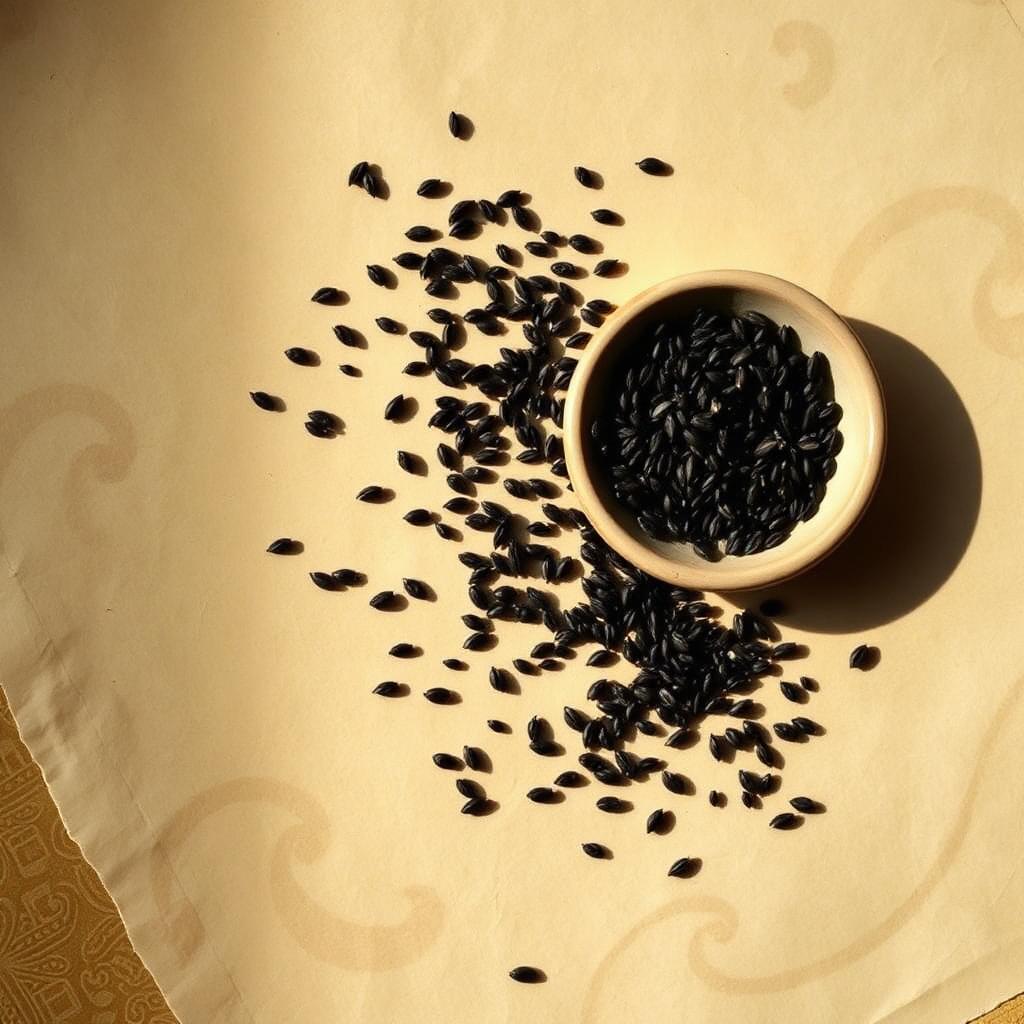
Black Seed — The Blessed Seed of Tradition and Trial
A small, peppery black seed used across Persia, the Arab world, and South Asia for two thousand years — and called, in tradition, the seed that heals all but death itself. Modern science finds something less mythical but still remarkable: meaningful effects on inflammation, blood sugar, and cholesterol.
- English
- Black seed
- Family
- Ranunculaceae
- Also known as
- Siah daneh, Habbat al-barakah, Kalonji, Black cumin
What this may support
Supports blood sugar and cholesterol when used daily.
Gentle immune-system support.
Supports blood sugar and cholesterol when used daily.
Thymoquinone, the main active compound, has been studied in laboratory and animal work and in early human trials for calming inflammation and steadying the immune system. Early work does not tell us for sure what happens in people.
Thymoquinone, the main active compound, has been studied in laboratory and animal work and in early human trials for calming inflammation and steadying the immune system. Early work does not tell us for sure what happens in people.
Patterns described in research and tradition — not a treatment claim.
A little background
- Found in Tutankhamun's tomb; mentioned across Greco-Islamic and Persian medical texts.
- Sprinkled on flatbreads, mixed with honey, pressed for oil.
- A daily teaspoon of seed or oil was a household morning habit in many Persian and Arab homes.
What tradition has long understood
- Considered warm and dry — strengthening for digestion, immunity, and 'cold' joints.
- Mixed with honey for chronic cough and weak lungs.
- Pressed oil rubbed into the scalp and joints.
What the research now shows
- Reviews pooling human trials of black seed oil (1–3 g daily for 8–12 weeks) found drops in fasting blood sugar, LDL cholesterol, blood pressure, and HbA1c — a blood test showing average blood sugar over about three months. Do not change diabetes or blood-pressure medicine on the strength of this.
- Trials in metabolic syndrome and type 2 diabetes report meaningful improvements alongside diet — though it is not a substitute for medication.
- Small trials in seasonal allergy show reduced symptoms with black seed oil; trials in mild asthma show modest improvement in symptom scores.
- Thymoquinone, the main active compound, has been studied in laboratory and animal work and in early human trials for calming inflammation and steadying the immune system. Early work does not tell us for sure what happens in people.
Evidence-based benefits
- Supports blood sugar and cholesterol when used daily.
- May ease seasonal allergy symptoms.
- Gentle immune-system support.
- Adds flavor and crunch to bread, cheese, and roasted vegetables.
The active compounds inside
- Thymoquinone — the main active compound; it calms irritation and acts as an antioxidant, which means it helps protect cells from everyday wear.
- Nigellone, alpha-hederin — supportive immune-active compounds.
- Healthy fats and dietary fiber from the whole seed.
What to actually do this week
- ½ teaspoon whole seeds chewed or sprinkled on bread, eggs, or salads daily.
- 1 teaspoon cold-pressed black seed oil mixed with honey, warm water, or yogurt.
- Sprinkle on flatbread before baking; mix into cheese or labneh.
- Discuss higher supplement doses with a clinician — most trials use 1–3 g/day for 8–12 weeks.
Preparation methods
- Buy whole seeds and grind in small batches — oil oxidizes fast.
- Choose cold-pressed, dark-glass-bottled oil for supplement use; store in the fridge.
- Toast lightly to release the peppery aroma before sprinkling.
Typical culinary use
- Persian and Levantine flatbreads, naan, cheese.
- Indian dal tadka, vegetable curries, pickles.
- Sprinkled on roasted vegetables, eggs, hummus.
Best food combinations
- Black seed + honey — traditional morning tonic.
- Black seed + olive oil + za'atar — Levantine flatbread topping.
- Black seed + yogurt + cucumber — gentle daily dip.
Foods that quietly help
- Honey
- Olive oil
- Whole-grain bread
- Yogurt
Gentle cautions
- Culinary amounts (½–1 tsp seeds daily) are safe.
- Higher doses of oil can cause GI upset; rare reports of low blood pressure or low blood sugar at concentrated doses.
- Stop 1–2 weeks before surgery — may affect bleeding and blood pressure.
Medication interactions to know
- Diabetes medications — may potentiate blood-sugar lowering.
- Blood pressure medications — may potentiate lowering.
- Blood thinners — may add to bleeding risk at supplement doses.
- May affect cytochrome P450 enzymes — discuss with a pharmacist if you take many medications.
Pregnancy & breastfeeding
- Culinary amounts in food are considered safe.
- Avoid concentrated oil or supplements during pregnancy — uterine effects at high doses are not well studied.
A few honest answers
Can it replace my diabetes medication?
No. Black seed can support blood sugar alongside medication, diet, and movement — never as a substitute. Tell your clinician you're using it so doses can be adjusted.
Whole seed or oil?
Both work. Whole seed is gentler and food-like; oil is more concentrated and used in most studies. Start with seed; consider oil if you want the studied dose.
Is the 'cures everything but death' phrase real?
It comes from a hadith. Tradition holds the seed in extraordinary respect — modern evidence is impressive but not infinite. Use it humbly.
Real questions, honest answers
How long until I notice anything?
Will it taste strange?
Can children take it?
In plain language
A few ideas worth understanding clearly. Tap to read each one explained as Hakim would — quietly, without jargon.
Thymoquinone
Explain this simply. The main compound that gives black seed most of its studied effects.
Why it matters. Almost every modern trial of black seed traces benefit back to this molecule.
Immune-modulating
Explain this simply. Doesn't simply boost or suppress immunity — helps it react more appropriately.
Why it matters. It's why the same seed is studied for both allergies and infections — different sides of the same calibration.
Practical scenarios — where to begin
Borderline fasting glucose, no medication yet.
- ½ tsp whole seeds daily on bread or eggs.
- Pair with walking after meals and a Mediterranean–Persian plate.
- Recheck HbA1c in 12 weeks.
Mild-to-moderate seasonal allergies, currently using antihistamines.
- Start 1 tsp black seed oil daily 2–3 weeks before allergy season.
- Continue through the season.
- Keep your antihistamine on hand — this is a softener, not a replacement.
LDL borderline, doctor said 'lifestyle first'.
- 1 tsp black seed oil + 1 tsp honey in warm water in the morning.
- Layer onto a fuller anti-inflammatory diet.
- Recheck lipids in 12 weeks.
A week that quietly weaves black seed through tradition and table
Not a prescription — a quiet example of how the foundations can fit an ordinary week. Adapt freely.
| Day | Morning | Afternoon | Evening |
|---|---|---|---|
| Mon | Honey + black seed oil in warm water | Salad + sumac | Walk after dinner |
| Tue | Yogurt + black seeds | Lentil soup | Bread with black seed & cheese |
| Wed | Eggs + flatbread | Roast vegetables | Tea & reading |
| Thu | Oats + walnuts | Hummus + black seed | Family dinner |
| Fri | Honey-oil tonic | Fish + salad | Sleep early |
| Sat | Long walk | Persian rice & stew | Black-seed flatbread |
| Sun | Slow breakfast | Soup-and-bread | Plan the week |
Where to wander next
These are the next quiet places to explore — each chosen because it deepens what you just read, not because it is merely related.
Why this. Both are studied for blood sugar and cholesterol; together they make a Persian-table foundation.
ContinueWhy this. Black seed's most consistent evidence sits inside a fuller metabolic plate.
ContinueWhy this. Black seed oil shines alongside, not instead of, the Mediterranean foundation.
ContinueConnects to Nutrition · Heart · Immunity.
Feeds: Morning honey-oil tonic · Bread-and-seed breakfast.
Shapes: Blood sugar · Inflammation · Heart.
"The oldest medicines tend to be the gentlest ones used most often — small seeds, sprinkled across many years."
Tomorrow, mix a teaspoon of honey with a few drops of black seed oil in warm water and drink it slowly before breakfast.
"Help me bring black seed into my morning in a way that fits my life."
Open CompanionWhere this comes from
- Daryabeygi-Khotbehsara R et al., Complement Ther Med 2017 — Nigella sativa and glycemic control, meta-analysis.
- Sahebkar A et al., Pharmacol Res 2016 — black seed and lipid profile, meta-analysis.
Questions worth asking
Tomorrow, mix a teaspoon of honey with a few drops of black seed oil in warm water and drink it slowly before breakfast.
Hakim's Thoughts on Black Seed — The Blessed Seed of Tradition and Trial
"Black seed is the quiet morning habit of half the world. Tradition called it the seed that heals all but death; modern trials soften the claim but keep its shape. Take a small spoon, faithfully, for a long time — and let the labs decide."
— Hakim
One thoughtful next step
If this resonated, you may also enjoy exploring longevity. A natural next read is "Nigella (Black Seed) — The Seed of Blessing" — it carries the same thread from a different angle. Take what feels right; leave the rest for another season.
Nigella (Black Seed) — The Seed of Blessing Open CompanionYou may also enjoy…
Nigella sativa — the 'seed of blessing' in many traditions — is one of the most studied seeds for metabolic and inflammatory health.
ContinueThe leaf you drop into the pot without thinking — and one of the quietest evidenced herbs for blood sugar, digestion, and the inflammator…
ContinueThree crimson threads, hand-picked from a single autumn flower. For three thousand years, saffron has been Persia's most beloved medicine…
ContinueA warm, bittersweet root quietly added to lentils, rice, and stews across South and West Asia for three thousand years. Modern science no…
ContinueContinue the thread with Hakim in a calm daily ritual.
Continue