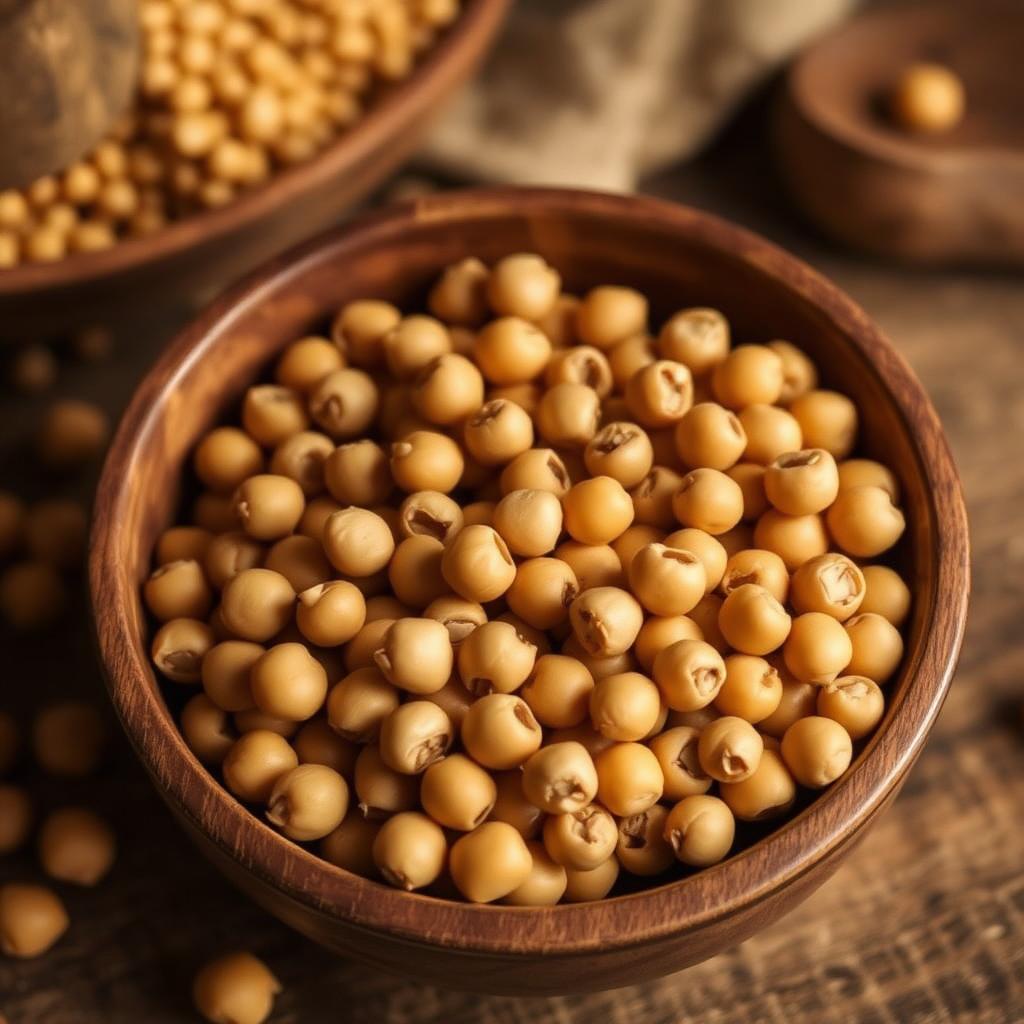
Chickpeas — The Sweet, Sturdy Pulse of the Persian Plate
The round golden bean of abgoosht, hummus, and roasted nokhod-e berenji — a daily plant protein with serious evidence for blood sugar, cholesterol, and the satiety of a long meal.
- English
- Chickpeas
- Also known as
- Nokhod, Garbanzo, Chana
What this may support
Lowers LDL cholesterol alongside lentils and barley.
Feed people a daily 3/4 cup of chickpeas in a trial, and fasting glucose, HbA1c, and LDL cholesterol tend to come down over 6–12 weeks.
Patterns described in research and tradition — not a treatment claim.
A little background
- Cultivated in Persia and the Fertile Crescent for at least 7,000 years.
- The base of abgoosht (Persian lamb-and-chickpea pot), Levantine hummus, Indian chana masala.
- Roasted chickpea flour (nokhodchi) is folded into Persian sweets and used as a children's tonic.
What tradition has long understood
- Warm and slightly drying — grounding, sustaining, considered strengthening through winter.
- Often paired with grain (rice, bread) to make a complete daily protein.
- Aab-e nokhod (chickpea broth) used as a gentle convalescent drink.
What the research now shows
- Feed people a daily 3/4 cup of chickpeas in a trial, and fasting glucose, HbA1c, and LDL cholesterol tend to come down over 6–12 weeks.
- Chickpeas keep you full — and in controlled feeding studies, that fullness carries into the next meal, where people naturally eat fewer calories.
- With a glycemic index of ~28, they are among the gentlest starches you can build a meal around.
- In the long-running population studies, people who eat pulses regularly — 3+ servings/week — live with lower cardiovascular mortality.
Evidence-based benefits
- Smooths blood-sugar curves at modest daily intake.
- Lowers LDL cholesterol alongside lentils and barley.
- Anchors plant-forward meals with serious staying power.
- Cheap, shelf-stable, and endlessly versatile.
A nutritional snapshot
- ½ cup cooked: ~7 g protein, ~6 g fiber, ~135 calories.
- Rich in folate, manganese, copper, iron, and magnesium.
- Resistant starch and oligosaccharides feed beneficial gut bacteria.
What to actually do this week
- Abgoosht: lamb, chickpeas, beans, tomato, turmeric — Persian Friday lunch.
- Hummus: chickpeas + tahini + lemon + garlic — a daily Mediterranean spread.
- Roasted chickpeas with sumac and olive oil — a high-fiber snack.
- Khoresh-e gheymeh: split-pea stew with chickpea variations.
Preparation methods
- Dried: soak overnight with a pinch of baking soda; simmer 60–90 min with bay leaf.
- Canned: drain and rinse to remove ~40% of sodium; an excellent shortcut.
- Aquafaba (chickpea cooking water) whips like egg white — a useful kitchen trick.
Typical culinary use
- Persian abgoosht, ash-e nokhod, khoresh-e gheymeh, nokhodchi sweets.
- Mediterranean hummus, falafel, chickpea stews.
- Salads, curries, roasted snacks.
Best food combinations
- Chickpeas + tahini + lemon + garlic — hummus foundation.
- Chickpeas + olive oil + sumac + parsley — Persian salad.
- Chickpeas + rice = complete protein, eaten this way for millennia.
Foods that quietly help
- Tahini
- Olive oil
- Lemon
- Sumac
- Bay leaf
Gentle cautions
- Very well tolerated as a daily food.
- Can cause gas at first — start small, cook with bay or cumin, let the gut adapt.
- Soaking and rinsing reduce oligosaccharides that cause bloating.
Medication interactions to know
- Phytates may modestly reduce iron and zinc absorption — pair with vitamin C foods (sumac, lemon) to offset.
- No significant drug interactions.
Pregnancy & breastfeeding
- Excellent during pregnancy — folate, iron, protein.
- Pair with citrus or sumac to enhance iron absorption.
A few honest answers
Chickpeas or lentils?
Both. Chickpeas are sweeter and starchier with more satiety per spoon; lentils cook faster and digest more easily. Alternate them across the week.
Are canned chickpeas as good as dried?
Nearly. Drain and rinse to cut sodium. Use dried when you want chewier texture and aquafaba for cooking.
How much for the blood-sugar benefit?
Roughly 3/4 cup cooked, 3–5 days per week, in place of refined starches.
Real questions, honest answers
I bloat when I eat them.
Is hummus actually healthy?
Can I replace meat with chickpeas?
In plain language
A few ideas worth understanding clearly. Tap to read each one explained as Hakim would — quietly, without jargon.
Oligosaccharides
Explain this simply. Short carbohydrate chains that humans don't fully digest — your gut bacteria do.
Why it matters. They are why beans cause gas at first and feed a healthier microbiome over time.
Aquafaba
Explain this simply. The starchy water canned chickpeas come in.
Why it matters. It whips like egg whites and replaces eggs in many recipes — one of the kitchen's most useful tricks.
Practical scenarios — where to begin
Mid-afternoon energy crashes.
- Roasted chickpeas with sumac and olive oil as your default snack.
- Pair with a walk.
- Replace one bowl of cereal a week with hummus + vegetables.
Plant-forward but cautious.
- Cook one big pot of abgoosht-style chickpea stew weekly.
- Add hummus to lunches.
- Read the Mediterranean–Persian Plate.
Borderline LDL.
- 3/4 cup chickpeas, 4–5 days a week.
- Pair with barley, walnuts, olive oil.
- Recheck in 3 months.
A week with chickpeas threading through nearly every day
Not a prescription — a quiet example of how the foundations can fit an ordinary week. Adapt freely.
| Day | Morning | Afternoon | Evening |
|---|---|---|---|
| Mon | Yogurt + walnut | Hummus + vegetables + flatbread | Salad + olive oil |
| Tue | Oats + cinnamon | Chickpea + lentil soup | Walk after dinner |
| Wed | Eggs + sabzi | Chickpea salad + sumac | Khoresh-e gheymeh + small rice |
| Thu | Yogurt + berries | Roasted chickpea snack | Abgoosht with friends |
| Fri | Toast + hummus | Fish + greens | Mast-o-khiar + flatbread |
Where to wander next
These are the next quiet places to explore — each chosen because it deepens what you just read, not because it is merely related.
Why this. Together, chickpeas and lentils form the daily pulse foundation of the world's longest-lived diets.
ContinueWhy this. Chickpeas + barley + olive oil + greens covers nearly every long-life nutritional base in one plate.
ContinueWhy this. The fuller plate where chickpeas anchor lunch and dinner.
ContinueConnects to Nutrition · Heart.
Feeds: Friday abgoosht · Weekly hummus.
Shapes: Cholesterol · Blood sugar · Heart.
"The food at the center of the Friday lunch is not an accident. It is a four-thousand-year-old vote for the long view."
This week, open one can of chickpeas, drain and rinse, toss with olive oil, sumac, and parsley — and eat it across two lunches.
"Help me cook with chickpeas more often, simply."
Ask Hakim, Your Personal AIWhere this comes from
- Pittaway JK et al., J Am Coll Nutr 2008 — chickpeas and glycemic control / lipids, RCT.
- Mudryj AN et al., Br J Nutr 2014 — pulses and cardiometabolic health, review.
Questions worth asking
This week, open one can of chickpeas, drain and rinse, toss with olive oil, sumac, and parsley — and eat it across two lunches.
Hakim's Thoughts on Chickpeas — The Sweet, Sturdy Pulse of the Persian Plate
"Chickpeas are one of the great quiet inheritances of the Persian and Mediterranean table — humble, sweet, and serious all at once."
— Hakim
One thoughtful next step
If this resonated, lentils — the humble pulse of a long life is a gentle next step. A natural next read is "Lentils — The Humble Pulse of a Long Life" — it carries the same thread from a different angle. Take what feels right; leave the rest for another season.
Lentils — The Humble Pulse of a Long Life Ask Hakim, Your Personal AIYou may also enjoy…
The grain Persian and Greek physicians fed to soldiers, gladiators, and the sick — and one of the only foods with an FDA-approved health …
ContinueOne of the most complete, affordable protein foods on earth — and, after decades of unfair suspicion, now firmly back in the long-life ki…
ContinueThe long, freckled flatbread baked on hot pebbles in every Persian neighborhood — a whole-grain, slowly fermented bread that quietly belo…
ContinueThe Persian and Arabian desert's oldest sweet — a whole-food sugar wrapped in fiber, potassium, and polyphenols, eaten for millennia with…
ContinueContinue the thread with Hakim in a calm daily ritual.
Continue