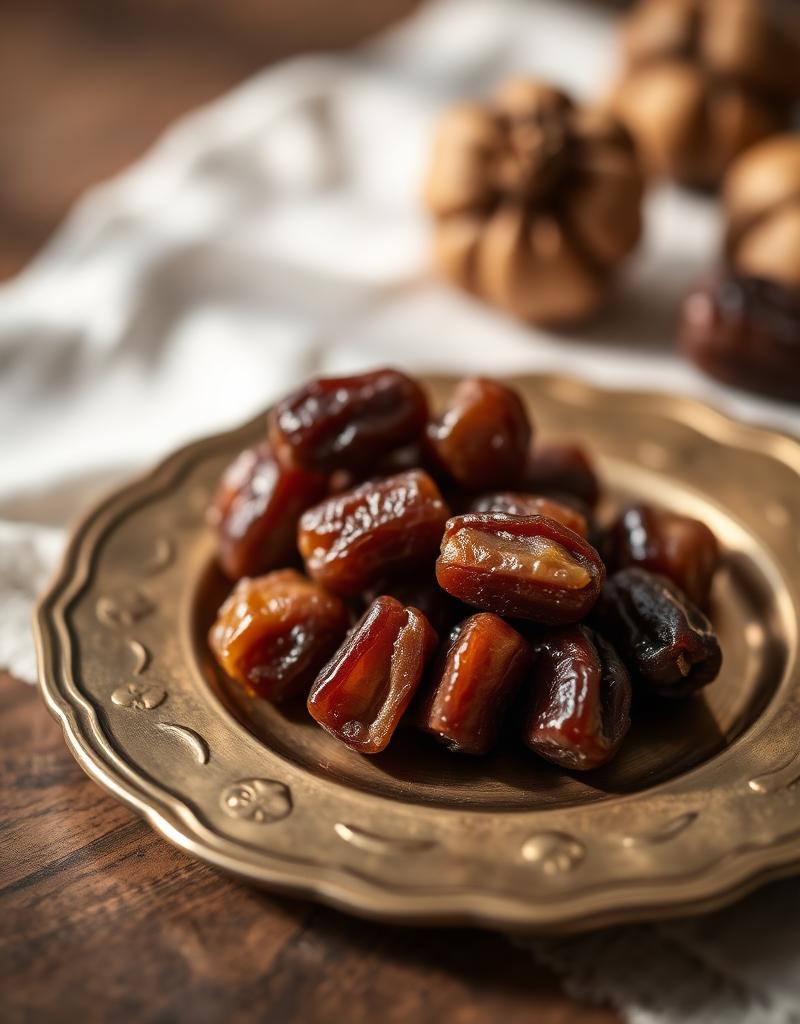
Dates — The Sweet Energy of the Desert
The Persian and Arabian desert's oldest sweet — a whole-food sugar wrapped in fiber, potassium, and polyphenols, eaten for millennia with tea and walnut.
- English
- Dates
- Also known as
- Khorma, Medjool, Mazafati
What this may support
Potassium content gently supports blood pressure.
Dates are rich in polyphenols, which are linked to lower oxidative stress and healthier blood lipids.
Supports bowel regularity through soluble fiber and sorbitol.
Despite their sweetness, dates have a low-to-moderate glycemic index (~42–55) and a modest glycemic load per piece — gentle, for how sweet they taste.
Dates are rich in polyphenols, which are linked to lower oxidative stress and healthier blood lipids.
A whole-food replacement for refined sugar and energy bars.
Patterns described in research and tradition — not a treatment claim.
A little background
- Cultivated in Persia and Mesopotamia for at least 6,000 years.
- Traditionally eaten with tea, walnut, or sesame paste for gentle, steady energy.
- Mazafati from Bam and Piarom from Hormozgan are among the world's most prized varieties.
What tradition has long understood
- Warm and moist — strengthening, restorative after illness, recommended for the convalescent and the elderly.
- Eaten with walnut to balance sweetness and add grounding fat.
What the research now shows
- Despite their sweetness, dates have a low-to-moderate glycemic index (~42–55) and a modest glycemic load per piece — gentle, for how sweet they taste.
- In clinical trials, people with type 2 diabetes who ate a few dates a day (3–7/day) did not see their HbA1c (long-term blood sugar) rise.
- Dates are rich in polyphenols, which are linked to lower oxidative stress and healthier blood lipids.
- Several small trials link eating dates late in pregnancy to shorter labor and less need for induction.
Evidence-based benefits
- A whole-food replacement for refined sugar and energy bars.
- Supports bowel regularity through soluble fiber and sorbitol.
- Potassium content gently supports blood pressure.
A nutritional snapshot
- 1 Medjool date: ~66 calories, 1.6 g fiber, 167 mg potassium.
- Source of magnesium, copper, B6, and polyphenols.
What to actually do this week
- 1–2 dates with walnut and tea as a Persian afternoon ritual.
- Stuff dates with tahini or almond butter as a dessert.
- Blend into smoothies in place of sugar or syrup.
Preparation methods
- Eat fresh or refrigerated; warm slightly to soften.
- Pit and stuff with walnut, pistachio, or tahini.
Typical culinary use
- Persian tea ritual
- Ranginak (Persian date-walnut dessert)
- Halva, smoothies, salads
Best food combinations
- Dates + walnut — the classic Persian pairing
- Dates + tahini — protein + polyphenol snack
- Dates + tea — afternoon ritual
Foods that quietly help
- Walnut
- Tahini
- Pistachio
- Black tea
Gentle cautions
- High in natural sugar — keep to 2–4 per day for most adults.
- Diabetics: pair with fat or protein and monitor response.
- Sticky texture can promote dental cavities — rinse after eating.
Medication interactions to know
- High potassium — caution if on potassium-sparing medications or with advanced kidney disease.
Pregnancy & breastfeeding
- Eating 6 dates per day in the last 4 weeks of pregnancy has been associated with more favorable cervical readiness and shorter labor in small trials.
A few honest answers
Are dates just candy?
No. They carry fiber, potassium, and polyphenols that candy doesn't, and their glycemic response is much gentler than refined sugar.
How many per day?
2–4 is a comfortable range for most adults. Diabetics: 1–2 paired with walnut or cheese.
Real questions, honest answers
I'm trying to quit sugar — can dates help?
Will dates spike my blood sugar?
In plain language
A few ideas worth understanding clearly. Tap to read each one explained as Hakim would — quietly, without jargon.
Glycemic index
Explain this simply. How fast a food raises your blood sugar.
Why it matters. Dates are sweet but their fiber slows absorption, so they don't spike like white sugar.
Practical scenarios — where to begin
Sugar dependence cycle.
- Keep dates and walnuts at your desk.
- Two dates + one walnut, with tea.
- Repeat for two weeks — the cookie urge fades.
Preparing for labor.
- Talk with your OB first.
- If approved, 6 dates/day in the last 4 weeks.
- Pair with walking.
A week where dates take the place of refined sweets
Not a prescription — a quiet example of how the foundations can fit an ordinary week. Adapt freely.
| Day | Morning | Afternoon | Evening |
|---|---|---|---|
| Mon | Tea + 2 dates + walnut | Salad + chickpeas | Soup + bread |
| Tue | Yogurt + date + cinnamon | Lentil stew | Walk |
| Wed | Oats + date + walnut | Hummus + vegetables | Fish + greens |
| Thu | Tea + dates | Chickpea salad | Khoresh + small rice |
| Fri | Sangak + feta + dates | Abgoosht | Tea + date + walnut |
Where to wander next
These are the next quiet places to explore — each chosen because it deepens what you just read, not because it is merely related.
Connects to Nutrition · Energy.
Feeds: Afternoon tea · Date-and-walnut snack.
Shapes: Blood sugar · Energy.
"Sweetness is not the problem. Sweetness without nourishment is."
This week, replace one afternoon cookie with two dates and a walnut, with tea.
"Help me use dates to replace refined sugar in my week."
Ask Hakim, Your Personal AIWhere this comes from
- Rock W et al., J Agric Food Chem 2009 — date consumption and lipid profile, RCT.
- Al-Kuran O et al., J Obstet Gynaecol 2011 — late-pregnancy date consumption and labor outcomes.
Questions worth asking
This week, replace one afternoon cookie with two dates and a walnut, with tea.
Hakim's Thoughts on Dates — The Sweet Energy of the Desert
"A date and a walnut, in the afternoon, with tea. It is one of the smallest, oldest, and most quietly intelligent rituals in Persian food."
— Hakim
One thoughtful next step
If this resonated, figs — the honeyed fruit of ancient persia is a gentle next step. A natural next read is "Figs — The Honeyed Fruit of Ancient Persia" — it carries the same thread from a different angle. Take what feels right; leave the rest for another season.
Figs — The Honeyed Fruit of Ancient Persia Ask Hakim, Your Personal AIYou may also enjoy…
The fragrant, hard, golden fruit Persian grandmothers slice into khoresh-e beh and simmer into jam — high in soluble fiber, pectin, and g…
ContinueBoring on purpose. A daily apple is one of the most consistently studied small habits in nutrition — for cholesterol, blood sugar, and lo…
ContinueThe golden, honeyed autumn fruit beloved in Persia and East Asia — one of the highest fruit sources of carotenoids and tannins for heart …
ContinueThe golden, honeyed fruit of Persian and central Asian summers — fresh in June, dried year-round, and one of the best whole-food sources …
ContinueContinue the thread with Hakim in a calm daily ritual.
Continue