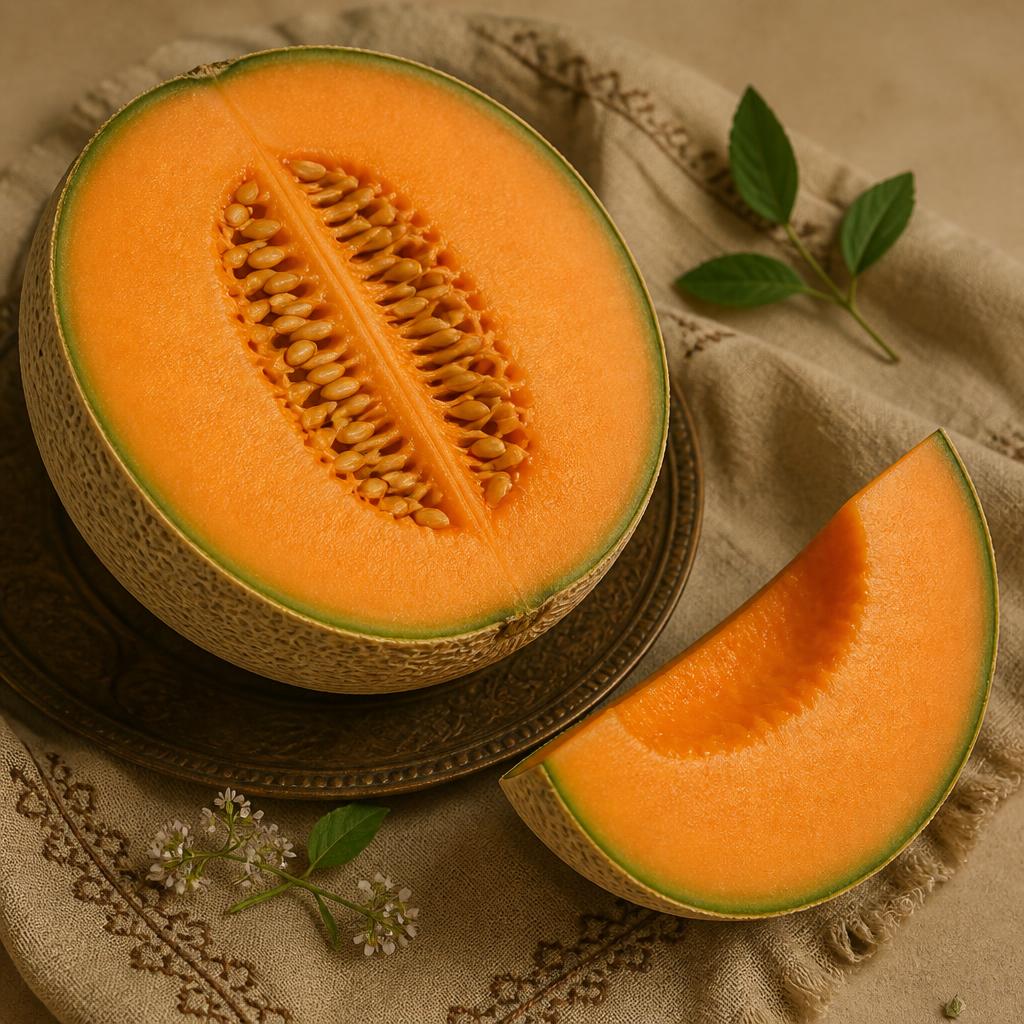
Cantaloupe
Tālebi — fragrant Persian musk melon that hydrates, cools the liver, and refreshes the spirit.
Traditional wisdom and modern evidence—clearly explained.
“Before we go deeper into Cantaloupe, step through — even people who have known it all their lives rarely notice these small things.”
A curiosity cabinet. Open each drawer.
4 small things about Cantaloupe that quietly surprise most people.
Exceptionally high in β-carotene
About 90% water
Gentle potassium and folate for cardiovascular and prenatal support
The classical Persian summer table pairs slices of tālebi with feta and fresh bread
“People have practiced this quietly for centuries — long before we had a science to explain why it worked.”
How Persian physicians understood cantaloupe
Persian medicine reads tālebi as cool and moist (2nd degree) — cooling, hydrating, and gently diuretic. Best eaten alone or before a meal, not on top of heavy dishes, to avoid gastric heaviness.
In traditional Persian medicine, this describes how cantaloupe was believed to influence the body's natural balance—not its physical temperature.
Why did Hakims describe plants this way?
Mizāj (میزاج) means temperament — an old system of classifying foods and herbs by the qualities they were felt to bring to the body: warming or cooling, drying or moistening.
Persian physicians used this framework for centuries to decide which foods suited which people, seasons, and moods. It is a historical medical concept, not a modern scientific classification.
Modern evidence lives in its own section on this page — the two traditions are shown side by side so you can weigh them together.
Cooling, hydrating, gently diuretic; eat before rather than after a heavy meal.
Traditional Persian physicians developed these observations over centuries. The next section explores which of these ideas have been investigated by modern scientific research.
The Persian melon has been prized since antiquity — Ibn Sīnā devotes a full section of the Canon to the various types of kharbozeh. Tālebi is the orange-fleshed cantaloupe of the summer market.
Cantaloupe — before the words, before the science, simply this.
“And in their own careful language, the modern laboratories have been quietly agreeing.”
What the studies actually found.
A plain-English read of the research. Each line says what was studied and what was found — links go to the original source. The tag on the right notes how strong the evidence is today, and what still remains uncertain.
- β-carotene
- α-carotene
- Cucurbitacins
Dietary β-carotene from orange-fleshed fruits is associated with lower risk of vision loss in ageing.
Moderate*1Arch Ophthalmol review · open study
“Knowing all this, one small question remains — are you preparing Cantaloupe the way it deserves? Most people are not.”
How to prepare cantaloupe, step by step.
Most people prepare Cantaloupe incorrectly. Can you guess how?
- Chilled wedges
A traditional preparation of cantaloupe.
- Sharbat with rose water
A traditional preparation of cantaloupe.
- With feta and bread
A traditional preparation of cantaloupe.
- Frozen cubes
A traditional preparation of cantaloupe.
The pomegranate opens
and shows the sky its rubies.
“This shifts the moment you bring Cantaloupe into your own kitchen. Here are two gentle ways to begin.”
A gentle word of care.
“So — if you were to sit across from me and ask quietly what to do, this is what I would say.”
Dear friend,
Summer mornings and early afternoons, chilled and eaten before other foods.
And a few small habits that quietly strengthen the practice —
- Serve a wedge of tālebi with feta and bread as a light summer lunch — a classical Persian one-plate meal.
Warmly,
The remedy is often already in the kitchen. We simply forgot to look.
“Before you leave, one small thread to pull — Cantaloupe rarely travels alone.”