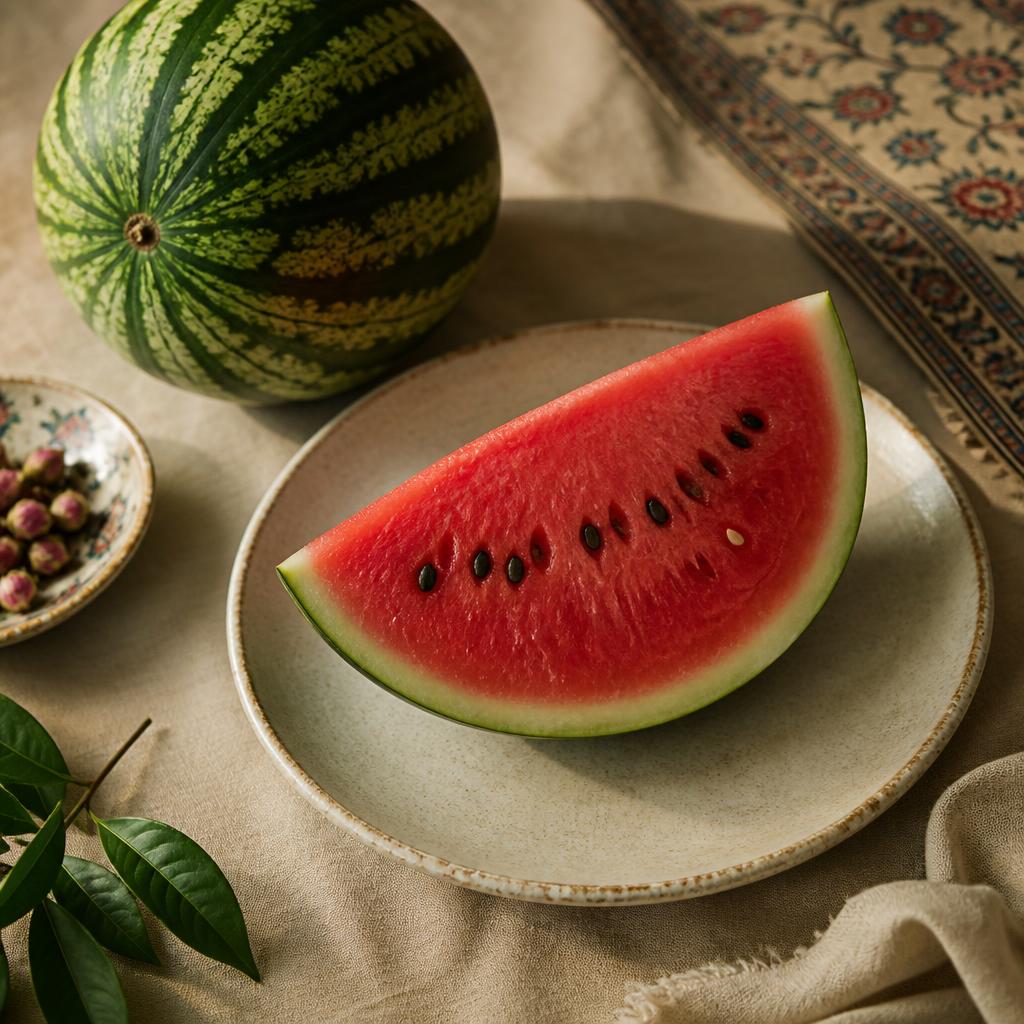
Watermelon
Hendevāneh — the classic Persian summer fruit; hydrates, cools, and flushes the kidneys.
Traditional wisdom and modern evidence—clearly explained.
“Before we go deeper into Watermelon, step through — even people who have known it all their lives rarely notice these small things.”
A curiosity cabinet. Open each drawer.
4 small things about Watermelon that quietly surprise most people.
About 92% water
Concentrated in lycopene
L-citrulline in the flesh and rind supports vascular nitric oxide
The centrepiece of Yalda-night
“People have practiced this quietly for centuries — long before we had a science to explain why it worked.”
How Persian physicians understood watermelon
Persian medicine reads hendevaneh as cool and moist (2nd degree) — cooling excess heat, quenching thirst, gently diuretic, and cleansing to the urinary tract. Reserved for the warm months; not favoured in cold weather except on Yalda night by tradition.
In traditional Persian medicine, this describes how watermelon was believed to influence the body's natural balance—not its physical temperature.
Why did Hakims describe plants this way?
Mizāj (میزاج) means temperament — an old system of classifying foods and herbs by the qualities they were felt to bring to the body: warming or cooling, drying or moistening.
Persian physicians used this framework for centuries to decide which foods suited which people, seasons, and moods. It is a historical medical concept, not a modern scientific classification.
Modern evidence lives in its own section on this page — the two traditions are shown side by side so you can weigh them together.
Cooling, diuretic, thirst-quenching in high heat.
Traditional Persian physicians developed these observations over centuries. The next section explores which of these ideas have been investigated by modern scientific research.
Watermelon has been cultivated across Persia and Central Asia for centuries. On Yalda night — the longest night of the year — a whole hendevaneh sits at the centre of the family table as a promise of summer's return.
Watermelon — before the words, before the science, simply this.
“And in their own careful language, the modern laboratories have been quietly agreeing.”
What the studies actually found.
A plain-English read of the research. Each line says what was studied and what was found — links go to the original source. The tag on the right notes how strong the evidence is today, and what still remains uncertain.
- Lycopene
- L-citrulline
- β-carotene
Watermelon supplementation modestly lowered blood pressure in adults with pre-hypertension.
Moderate*1Am J Hypertens 2012 · open study
“Knowing all this, one small question remains — are you preparing Watermelon the way it deserves? Most people are not.”
How to prepare watermelon, step by step.
Most people prepare Watermelon incorrectly. Can you guess how?
- Chilled wedges
A traditional preparation of watermelon.
- Blended sharbat
A traditional preparation of watermelon.
- Salad with feta and mint
A traditional preparation of watermelon.
- Roasted seeds
A traditional preparation of watermelon.
The pomegranate opens
and shows the sky its rubies.
“This shifts the moment you bring Watermelon into your own kitchen. Here are two gentle ways to begin.”
A gentle word of care.
“So — if you were to sit across from me and ask quietly what to do, this is what I would say.”
Dear friend,
Height of Persian summer, and ceremonially on Yalda night.
And a few small habits that quietly strengthen the practice —
- Keep a chilled watermelon in the fridge during heat waves — one of the most restorative summer habits on the Persian shelf.
Warmly,
The remedy is often already in the kitchen. We simply forgot to look.
“Before you leave, one small thread to pull — Watermelon rarely travels alone.”