Overview
Brought to Persia from the Americas via European herbalists, lādan was quickly absorbed into Persian apothecary use because of its strong mustard-like flavor and visible antimicrobial action. Modern research confirms benzyl isothiocyanate in the leaves and flowers gives nasturtium genuine activity against common respiratory and urinary bacteria.
- Scientific name
- Tropaeolum majus
- Plant family
- Tropaeolaceae
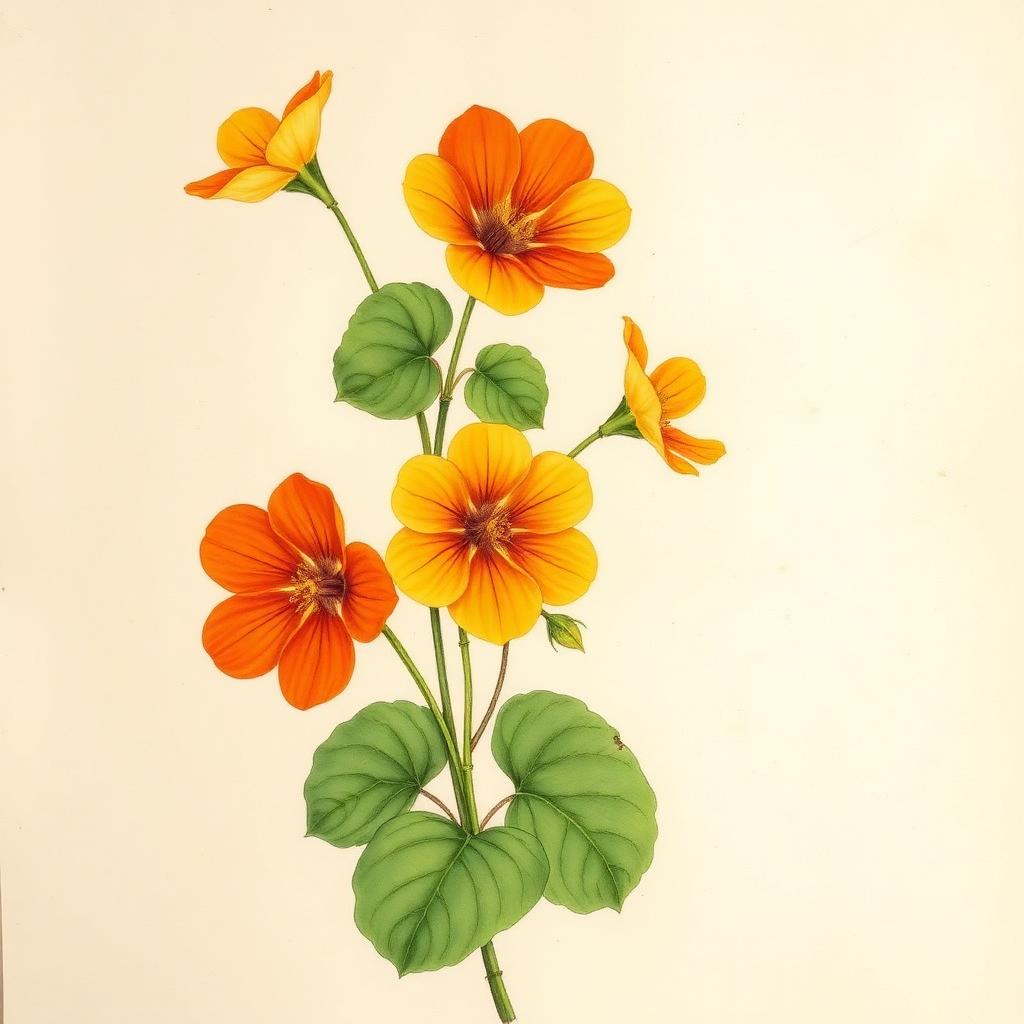
Botanical descriptionSprawling annual with round, peltate green leaves and brilliant orange, yellow, or red trumpet-shaped flowers. Every aerial part — leaves, flowers, unripe seed pods — is edible and pungent.
What to know in 30 seconds
- Benzyl isothiocyanate shows antimicrobial activity in lab studies (respiratory and urinary pathogens)
- Rich in vitamin C and lutein
- Pungent flavor stimulates digestion and circulation
- Traditional support for clearing damp lung congestion
Why this matters for everyday wellness
Nasturtium earns a place in a healthy-aging routine because it combines benzyl isothiocyanate shows antimicrobial activity in lab studies (respiratory and urinary pathogens) with rich in vitamin c and lutein — a rare combination that supports the cardiovascular, metabolic, and cellular systems that drive how we age.
Practical everyday uses
- Toss 3–5 fresh leaves and a few petals into salads daily during spring/summer
- Pickle the unripe green seed pods in vinegar as 'poor man's capers'
- Cold infusion: 5 leaves bruised in a cup of cool water, steep 4 hours
Traditional Persian perspective
Historical & cultural knowledge passed down through generations — not a medical claim.
Persian medicine considers nasturtium hot and dry — warming, pungent, and dispersing. It is grouped with cress (شاهی) and mustard as a 'fire-stirring' herb for damp chest congestion, sluggish digestion, and cold-type urinary complaints.
Benzyl isothiocyanate shows antimicrobial activity in lab studies (respiratory and urinary pathogens) · Rich in vitamin C and lutein · Pungent flavor stimulates digestion and circulation
Used across household wellness traditions as a culinary herb with daily-life relevance.
Healthy aging relevance
In a healthy-aging context, nasturtium bridges tradition and science: persian medicine considers nasturtium hot and dry — warming, pungent, and dispersing. It is grouped with cress (شاهی) and mustard as a 'fire-stirring' herb for damp chest congestion, sluggish digestion, and cold-type urinary complaints, while modern research highlights its role in the same pathways — inflammation, vascular health, and cellular resilience — that compound over decades to shape how we feel in our 60s, 70s, and beyond.
Modern scientific evidence
Benefits supported by peer-reviewed studies & contemporary nutrition science — informational only, not medical advice.
- Benzyl isothiocyanate shows antimicrobial activity in lab studies (respiratory and urinary pathogens)
- Rich in vitamin C and lutein
- Pungent flavor stimulates digestion and circulation
- Traditional support for clearing damp lung congestion
Nutritional profile
- Vitamin C
- Vitamin A (lutein)
- Iron
- Potassium
- Lutein
- Anthocyanins
- Benzyl isothiocyanate (mustard-oil glycosides)
Historical uses across cultures
From classical Persian, Greek, and Islamic-Golden-Age sources.
- Spring tonic to clear winter dampness from the chest and sinuses
- Pungent salad green to stimulate sluggish digestion
- Topical poultice for slow-healing skin and minor infections
- Mild diuretic for cold-type urinary irritation
Taken internally
- Fresh leaves and flowers in salads (3–5 leaves per serving)
- Cold infusion of fresh leaves for chest congestion
- Pickled flower buds as a Persian-style caper substitute
Applied externally
- Crushed-leaf poultice for slow-healing scratches (short contact only)
- Diluted fresh juice as a traditional scalp tonic for hair thinning
Named traditional formulas
- Lādan & Cress Spring Saladسالاد بهاری لادن و شاهی
Fresh nasturtium leaves and flowers with watercress, olive oil, lemon, and a pinch of salt — a Persian spring tonic to clear winter dampness.
Who should avoid this — and known interactions
- Active stomach or duodenal ulcer
- Known kidney disease (the mustard oils are eliminated renally)
- Children under 4 years
How it's commonly used
- Toss 3–5 fresh leaves and a few petals into salads daily during spring/summer
- Pickle the unripe green seed pods in vinegar as 'poor man's capers'
- Cold infusion: 5 leaves bruised in a cup of cool water, steep 4 hours
Safety & cautions
- Pungent — start with small amounts
- Avoid large medicinal doses in pregnancy
- May irritate sensitive stomachs or kidneys at high doses
Ask Holistic Health AI about Nasturtium
Personalized, evidence-informed guidance from your AI Wellness Coach.
Related Herbs
Related Foods
Related articles
- ImmunityEveryday Habits That Genuinely Support Your Immune System
Beyond echinacea: sleep, diet, movement, and herbs that actually move the needle on immune function.
- TraditionPersian Medicine 101: The Wisdom Behind Mizaj
A short introduction to the four temperaments and how traditional Persian medicine still influences kitchens today.
Frequently asked questions
+How is nasturtium traditionally used?
Persian medicine considers nasturtium hot and dry — warming, pungent, and dispersing. It is grouped with cress (شاهی) and mustard as a 'fire-stirring' herb for damp chest congestion, sluggish digestion, and cold-type urinary complaints.
+How do people commonly use Nasturtium?
Toss 3–5 fresh leaves and a few petals into salads daily during spring/summer Pickle the unripe green seed pods in vinegar as 'poor man's capers' Cold infusion: 5 leaves bruised in a cup of cool water, steep 4 hours
Sources & references
- Tropaeolum majus — Antimicrobial activity of benzyl isothiocyanate — Phytotherapy Research (PubMed)
- Commission E Monographs — Nasturtium herb — German Federal Institute for Drugs and Medical Devices (BfArM)
- Office of Dietary Supplements — Fact Sheets — US National Institutes of Health (NIH)
- Herbal Database — Memorial Sloan Kettering Cancer Center
- Herbs at a Glance — US NIH National Center for Complementary and Integrative Health (NCCIH)
- FoodData Central — searchable nutrient database — US Department of Agriculture (USDA)
- The Nutrition Source — Harvard T.H. Chan School of Public Health
- PubMed — peer-reviewed biomedical literature — US National Library of Medicine