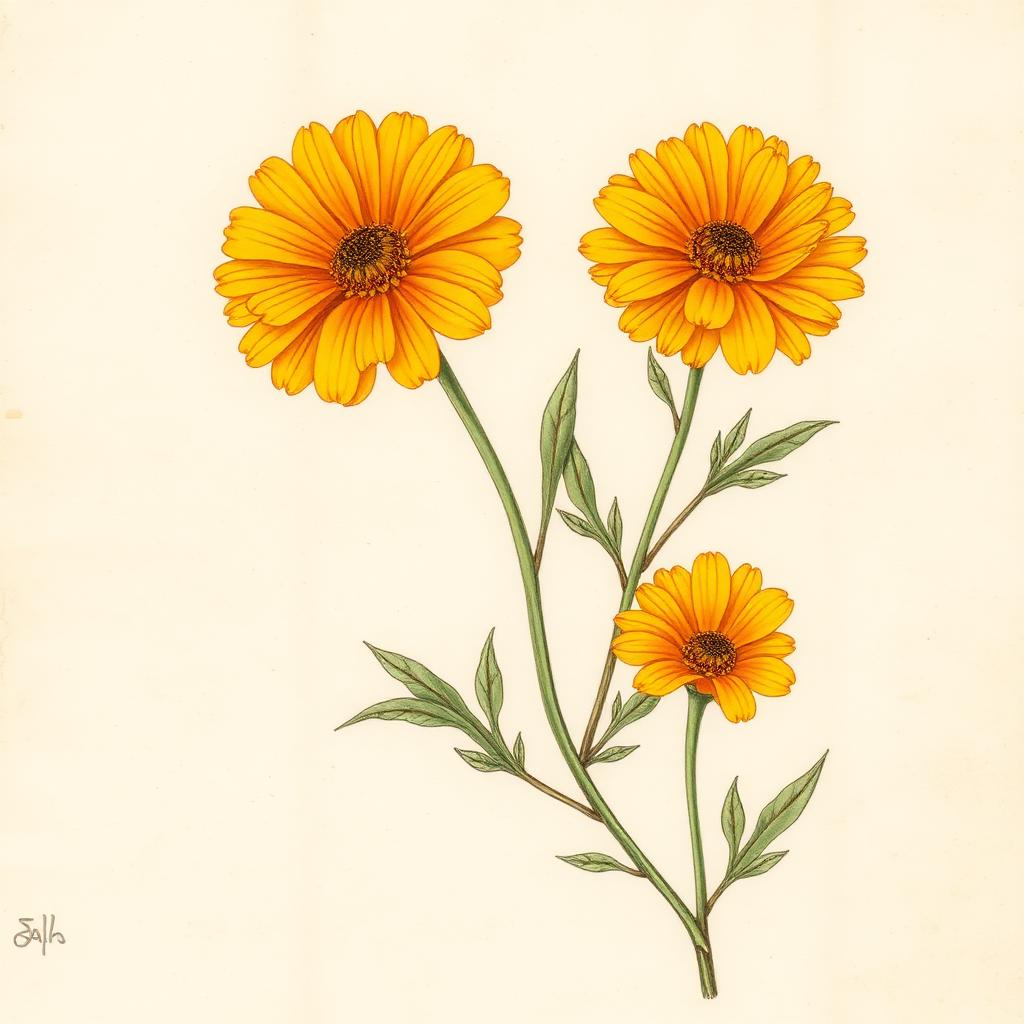
Overview
The Persian name hamisheh-bahar means 'always spring' — calendula blooms tirelessly from early spring through autumn frost, and its orange petals have been one of the most-used skin-healing herbs across Persia, the Mediterranean, and Europe for over a thousand years. Modern wound-care research consistently confirms its accelerated tissue-repair and anti-inflammatory effects.
- Scientific name
- Calendula officinalis
- Plant family
- Asteraceae (daisy family)
Botanical descriptionCheerful annual 30–60 cm tall with oblong, slightly sticky leaves and brilliant orange or golden-yellow daisy-like flowers blooming continuously from spring through frost. The whole flower head (dried) is the part used.
What to know in 30 seconds
- Multiple clinical trials support faster wound healing (burns, episiotomy, radiation dermatitis)
- Anti-inflammatory triterpenoids reduce skin redness and swelling
- Lymphagogue — traditionally supports lymphatic drainage
- Mild antimicrobial activity against common skin pathogens
Why this matters for everyday wellness
Calendula earns a place in a healthy-aging routine because it combines multiple clinical trials support faster wound healing (burns, episiotomy, radiation dermatitis) with anti-inflammatory triterpenoids reduce skin redness and swelling — a rare combination that supports the cardiovascular, metabolic, and cellular systems that drive how we age.
Practical everyday uses
- Tea: 1 tsp dried petals in 1 cup hot water, steep covered 10 min
- Salve: apply to clean cuts, scrapes, dry skin patches 2–3× daily
- Compress: soak a cloth in cooled strong tea, apply 10–15 min
- Sitz bath: a handful in warm bathwater after childbirth or for hemorrhoids
Traditional Persian perspective
Historical & cultural knowledge passed down through generations — not a medical claim.
Persian medicine classifies calendula as warm and dry — gently warming, drying for damp tissue, and resolving for swollen lymphatic glands. The orange color was traditionally linked to liver and bile function; small internal doses were used for sluggish digestion and as a mild emmenagogue.
Multiple clinical trials support faster wound healing (burns, episiotomy, radiation dermatitis) · Anti-inflammatory triterpenoids reduce skin redness and swelling · Lymphagogue — traditionally supports lymphatic drainage
Used across household wellness traditions as a culinary herb with daily-life relevance.
Healthy aging relevance
In a healthy-aging context, calendula bridges tradition and science: persian medicine classifies calendula as warm and dry — gently warming, drying for damp tissue, and resolving for swollen lymphatic glands. The orange color was traditionally linked to liver and bile function; small internal doses were used for sluggish digestion and as a mild emmenagogue, while modern research highlights its role in the same pathways — inflammation, vascular health, and cellular resilience — that compound over decades to shape how we feel in our 60s, 70s, and beyond.
Modern scientific evidence
Benefits supported by peer-reviewed studies & contemporary nutrition science — informational only, not medical advice.
- Multiple clinical trials support faster wound healing (burns, episiotomy, radiation dermatitis)
- Anti-inflammatory triterpenoids reduce skin redness and swelling
- Lymphagogue — traditionally supports lymphatic drainage
- Mild antimicrobial activity against common skin pathogens
- Gentle bitter notes support digestion when taken as tea
Nutritional profile
- Carotenoids (lutein, beta-carotene)
- Flavonoids (quercetin, isorhamnetin)
- Triterpenoid saponins
- Faradiol esters (anti-inflammatory)
- Resins
Historical uses across cultures
From classical Persian, Greek, and Islamic-Golden-Age sources.
- Topical wound-healing salve for cuts, burns, and slow-healing skin
- Compress for inflamed or congested lymph nodes
- Mild internal infusion for sluggish digestion and delayed cycles
- Gargle for sore throat and mouth ulcers
- Eye compress for tired or inflamed eyes (with sterile preparation)
Taken internally
- Damkardeh: 1 tsp dried petals per cup, 10 min, 1–2 cups daily
- Tincture: 2–4 mL of a 1:5 dried herb tincture, 3× daily (practitioner guidance)
Applied externally
- Calendula salve (petals infused in olive oil, then beeswax) for cuts, burns, diaper rash
- Compress: strong cooled infusion on a cotton cloth for wounds, sprains, swollen lymph
- Sitz bath: a handful of dried flowers in warm bathwater for episiotomy and hemorrhoids
- Mouth rinse: cooled strong infusion for gingivitis and mouth ulcers
Named traditional formulas
- Hamisheh-bahar Salveمرهم همیشه بهار
Dried petals infused in warm olive oil 2 weeks, strained, blended with beeswax (1 part wax to 4 parts oil) into a daily skin balm.
- Calendula–Chamomile Washشستشوی همیشه بهار و بابونه
Equal parts calendula and chamomile steeped in just-boiled water 15 min, cooled, used as a healing wash for irritated skin.
Who should avoid this — and known interactions
- Pregnancy — internal medicinal use (topical use is generally considered safe)
- Known Asteraceae-family allergy
How it's commonly used
- Tea: 1 tsp dried petals in 1 cup hot water, steep covered 10 min
- Salve: apply to clean cuts, scrapes, dry skin patches 2–3× daily
- Compress: soak a cloth in cooled strong tea, apply 10–15 min
- Sitz bath: a handful in warm bathwater after childbirth or for hemorrhoids
Safety & cautions
- Asteraceae allergy (ragweed, daisy, chrysanthemum) — patch test first
- Avoid medicinal internal doses in pregnancy
Ask Holistic Health AI about Calendula
Personalized, evidence-informed guidance from your AI Wellness Coach.
Related articles
- ImmunityEveryday Habits That Genuinely Support Your Immune System
Beyond echinacea: sleep, diet, movement, and herbs that actually move the needle on immune function.
- TraditionPersian Medicine 101: The Wisdom Behind Mizaj
A short introduction to the four temperaments and how traditional Persian medicine still influences kitchens today.
Frequently asked questions
+How is calendula traditionally used?
Persian medicine classifies calendula as warm and dry — gently warming, drying for damp tissue, and resolving for swollen lymphatic glands. The orange color was traditionally linked to liver and bile function; small internal doses were used for sluggish digestion and as a mild emmenagogue.
+How do people commonly use Calendula?
Tea: 1 tsp dried petals in 1 cup hot water, steep covered 10 min Salve: apply to clean cuts, scrapes, dry skin patches 2–3× daily Compress: soak a cloth in cooled strong tea, apply 10–15 min Sitz bath: a handful in warm bathwater after childbirth or for hemorrhoids
Sources & references
- Calendula officinalis in wound healing — Systematic review — Journal of Wound Care (PubMed)
- Calendula — EMA HMPC Monograph — European Medicines Agency, Committee on Herbal Medicinal Products
- Calendula — NIH NCCIH Health Information — US NIH NCCIH
- Office of Dietary Supplements — Fact Sheets — US National Institutes of Health (NIH)
- Herbal Database — Memorial Sloan Kettering Cancer Center
- Herbs at a Glance — US NIH National Center for Complementary and Integrative Health (NCCIH)
- FoodData Central — searchable nutrient database — US Department of Agriculture (USDA)
- The Nutrition Source — Harvard T.H. Chan School of Public Health
- PubMed — peer-reviewed biomedical literature — US National Library of Medicine