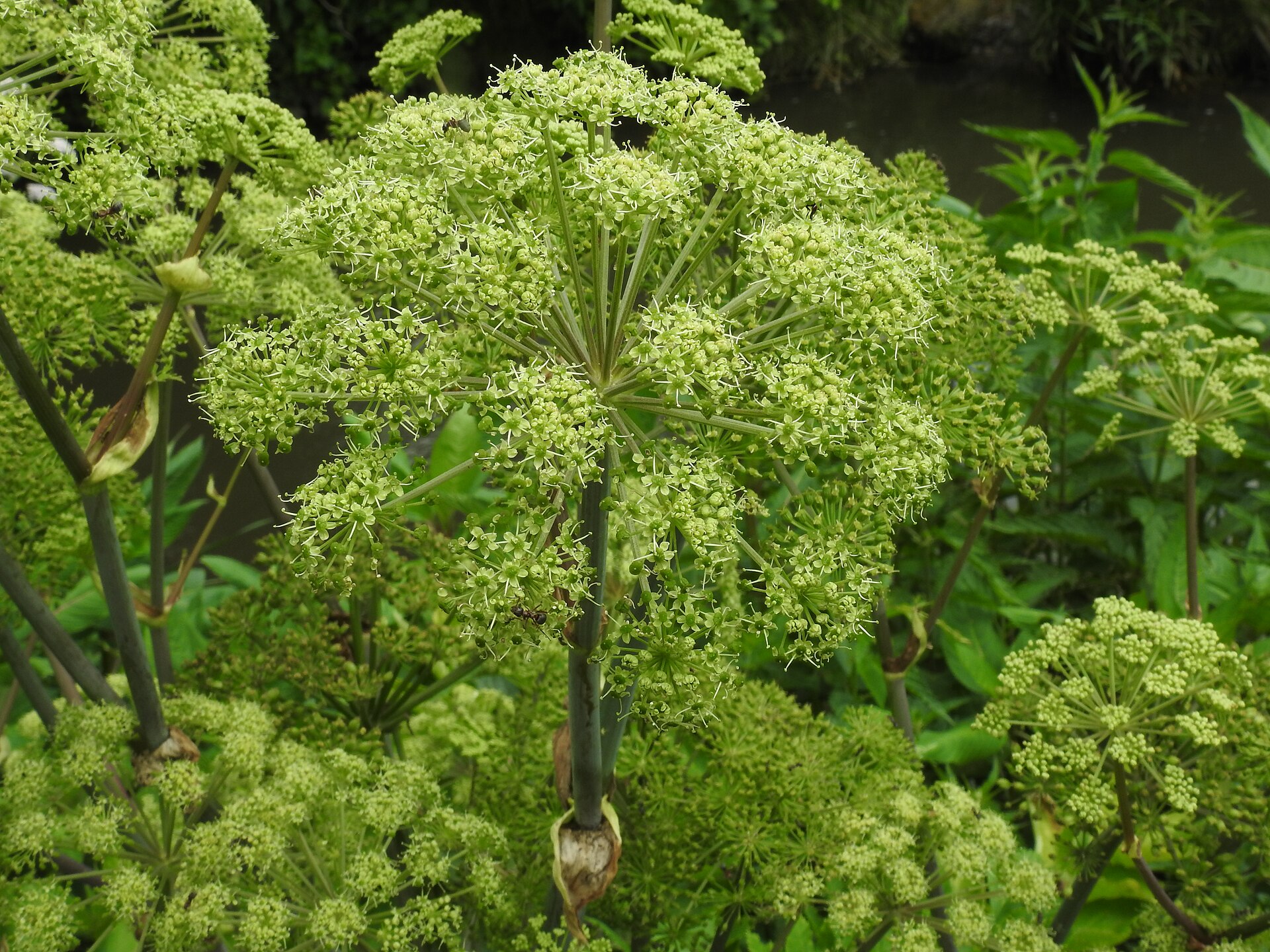
Overview
Angelica (Angelica archangelica) is a tall, hollow-stemmed umbellifer whose roots and seeds are one of the great aromatic warming medicines of Persian and European herbalism. In Persian materia medica it is grouped with the 'sonbol' family — fragrant, restorative roots used in convalescence — and overlaps in use with golpar (Heracleum persicum). It is warming, carminative, expectorant, and gently uplifting.
What to know in 30 seconds
- Classic warming digestive tonic — eases bloating, gas, and cold-type cramps.
- Aromatic root traditionally used after illness to restore appetite and strength.
- Expectorant action for damp, lingering chest congestion.
- Distinct from Chinese dong quai (Angelica sinensis), though related.
Why this matters for everyday wellness
After 50, weakened digestion and post-illness fatigue quietly erode quality of life. Angelica is one of the most traditional 'restorative' aromatics — a small, food-like dose taken consistently to rekindle appetite, warmth, and resilience.
Practical everyday uses
- Pinch of dried root in 1 cup just-boiled water, steeped 10 minutes, before meals.
- Add seeds to soups and bean stews to ease gas.
- Tincture (2–4 mL) before heavy meals when digestion feels cold and sluggish.
- Combine with chamomile or fennel for a post-meal calming tea.
Traditional Persian perspective
Historical & cultural knowledge passed down through generations — not a medical claim.
Persian and Greco-Arabic medicine classify angelica as warm and dry — a kindling (mufatteḥ) and strengthening (muqawwī) remedy for cold, weak digestion, damp chest, sluggish menstruation, and convalescence. Avicenna and later Persian herbalists describe it as 'opening the obstructions of the liver and spleen' and 'restoring the spirits after long illness.' Hildegard of Bingen called it 'the root of the Holy Spirit' for similar reasons in medieval Europe.
Carminative volatile oils (α-pinene, β-phellandrene) ease bloating and gas · Bitter principles stimulate gastric secretion and appetite · Expectorant action helps clear damp respiratory congestion
Across Iran, the aromatic seed cousin golpar is the everyday kitchen ally; the deeper, warmer angelica root is more often reserved for convalescent and apothecary teas. In northern European tradition, candied angelica stem decorates pastries and liqueurs — the same warming digestive logic in a sweeter form.
Healthy aging relevance
Strong appetite, warm extremities, and easy breathing are simple but powerful markers of healthspan. Angelica supports all three through the same aromatic-warming pathway that Persian medicine has refined for centuries — a gentle daily kindling rather than a one-time fix.
Modern scientific evidence
Benefits supported by peer-reviewed studies & contemporary nutrition science — informational only, not medical advice.
- Carminative volatile oils (α-pinene, β-phellandrene) ease bloating and gas
- Bitter principles stimulate gastric secretion and appetite
- Expectorant action helps clear damp respiratory congestion
- Mild antispasmodic effect on smooth muscle
- Traditional use as an aromatic restorative after illness
Nutritional profile
- Coumarins (angelicin, bergapten)
- Flavonoids
- Volatile oils (α-pinene, β-phellandrene)
- Bitter principles
Traditional Persian medicine uses
- Cold, sluggish digestion with bloating and gas after meals
- Loss of appetite during convalescence and in older adults
- Damp, productive coughs and lingering chest congestion
- Sluggish or scanty menstruation with cold cramps
- Joint stiffness aggravated by cold and damp weather
How it's commonly used
- Pre-meal digestive tea: 1 tsp root steeped 10 min, sipped 15 min before eating
- Add 1/4 tsp ground seeds to bean and lentil dishes
- Combine with cardamom, fennel, and a thread of saffron for a Persian after-dinner tea
- Tincture: 2–4 mL before meals, per practitioner guidance
Safety & cautions
- Contains furanocoumarins — may increase skin sensitivity to sunlight (use sunscreen)
- Avoid during pregnancy (potential uterine-stimulating effect)
- May increase the effect of blood-thinning medication — talk to your clinician
- May affect blood sugar — diabetics should monitor
- Do NOT confuse with poisonous look-alikes (e.g. water hemlock); use only verified, labeled material
Traditional preparation methods
- Damkardeh (infusion) — 1 tsp dried root per cup, steeped covered 10 min
- Jushandeh (decoction) — 1 tsp root simmered 10 min for deeper extraction
- Tincture — 1:5 in 45% alcohol, 2–4 mL up to 3× daily
- Aromatic bath — strong decoction added to warm bathwater for joint stiffness
Traditional remedies
- Angelica root + cardamom + fennel — Persian post-meal digestive tea
- Angelica + thyme + honey — warming chest tea for damp coughs
- Angelica + chamomile — calming convalescent tea after fever
Related conditions
Traditionally associated — not a treatment claim
Ask Holistic Health AI about Angelica
Personalized, evidence-informed guidance from your AI Wellness Coach.
Related articles
- DigestionFoods That Help (and Hurt) Digestion
Practical guidance for a comfortable gut — fiber, fermentation, herbs, and eating habits.
- SeasonalWinter Wellness: Eating and Living With the Cold Months
Warming foods, immune-supportive herbs, and small habits to feel well through winter.
- Healthy AgingHealthy Aging Starts in the Kitchen
Dietary patterns that quietly add years and quality of life — drawn from the world's longest-lived populations.
Frequently asked questions
+What is sonbol khataei (سنبل ختایی)?
Sonbol khataei is the Persian name commonly used for Angelica archangelica and closely related aromatic Angelica species — fragrant warming roots in the same botanical family as golpar (Heracleum persicum) and fennel.
+Is this the same as dong quai?
No. Dong quai is Angelica sinensis, a related species from East Asia used primarily as a blood and gynecological tonic. Angelica archangelica is the European/Persian aromatic digestive tonic — overlapping but distinct uses.
+Can I take angelica every day?
Small culinary or tea-strength amounts (1 cup per day) are generally well tolerated for short courses. For longer or therapeutic use, work with a qualified herbalist — and always avoid in pregnancy.
Sources & references
- Angelica archangelica — European Medicines Agency HMPC Monograph — European Medicines Agency, Committee on Herbal Medicinal Products
- Avicenna's Canon of Medicine, Book II — Translation, Laleh Bakhtiar
- Sad Giah Hezar Darman (صد گیاه و هزار درمان) — Persian herbal reference, Sekkeh Publications, Tehran
- Office of Dietary Supplements — Fact Sheets — US National Institutes of Health (NIH)
- Herbal Database — Memorial Sloan Kettering Cancer Center
- Herbs at a Glance — US NIH National Center for Complementary and Integrative Health (NCCIH)
- FoodData Central — searchable nutrient database — US Department of Agriculture (USDA)
- The Nutrition Source — Harvard T.H. Chan School of Public Health
- PubMed — peer-reviewed biomedical literature — US National Library of Medicine